

























































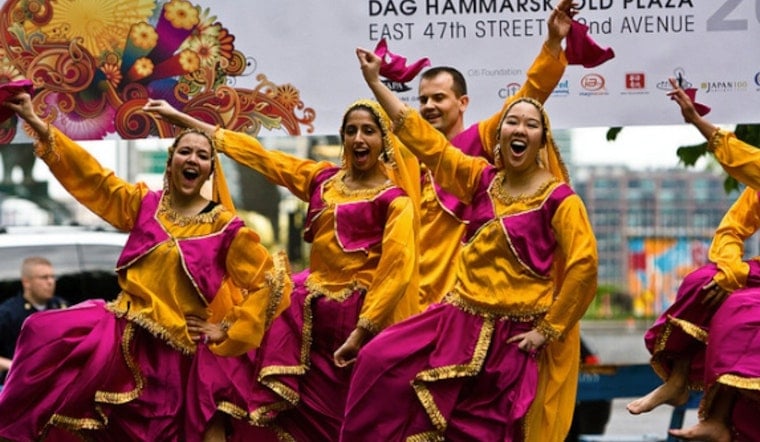
Boston Common turned into a sprawling open-air celebration Saturday as the 16th Annual Asian American Day Festival filled the park with food, performers and roughly 80 vendor booths. Local nonprofits and small businesses lined the paths alongside stalls selling skin care and travel products, drawing crowds from across Greater Boston for what organizers describe as the region's biggest outdoor showcase of Asian American culture.
Food was the main attraction, according to WBZ NewsRadio, with one Medford resident telling the station that an okonomiyaki from Ebisuya and dumplings from another stand were standout bites. Lee Song, executive director of the Asian American Association of Boston, said the event has become a fixture on the city's calendar. “Asian American Day is one of the most iconic festivals in Greater Boston,” Song said, per the same report.
The Asian American Association of Boston, which hosts the festival, describes its mission as sharing culture between Asians and Americans, and it bills the event on its website as the largest outdoor celebration of Asian Americans in Greater Boston. The festival debuted on Boston Common nearly a decade before this year's edition, after growing out of a much smaller gathering.
From a Quincy Dinner to a Statewide Institution
The organization itself traces back to July 1, 2010, when it was founded as a nonprofit in Quincy, Massachusetts, before relocating its administrative headquarters to Boston in September 2012. Its first Asian American Day celebration was held on July 26, 2011, at the China Pearl restaurant in Quincy — a modest dinner gathering that would eventually evolve into Greater Boston's largest outdoor Asian cultural event, according to The Berkeley Beacon.
That growth earned formal government recognition in September 2016, when then-Governor Charlie Baker and then-Mayor Marty Walsh designated the second Saturday of September as Asian American Day across Massachusetts and Boston, following a petition that gathered more than 1,000 signatures, according to the Asian American Association of Boston. Earlier iterations of the Common gathering, including the 7th annual event in 2017, drew more than 30,000 attendees and brought together over 15 regional ethnic partner organizations, per bostonese.com's historical accounting of the festival's scale.
The timing each September is deliberate, according to The Berkeley Beacon, aligning the festival with the traditional Mid-Autumn Festival, the harvest holiday celebrated with mooncakes and family reunions across East and Southeast Asia on the 15th day of the eighth lunar month.
A Fast-Growing Population Behind the Festivities
The festival's staying power reflects a broader demographic shift. U.S. Census data compiled by UMass Boston's Institute for Asian American Studies shows Boston's Asian American population grew 37.6% between 2010 and 2020, reaching 76,021 residents and 11.3% of the city's total population, making the group the city's third-largest racial group. Neighboring Quincy, where the hosting association was founded, had 31,282 Asian American residents in 2020 — 30.8% of its population and one of the highest concentrations in New England, per the same UMass Boston data.
Boston Police Department officers from the Bureau of Community Engagement have also become regular fixtures at the festival, setting up interactive stations to hand out child safety coloring books, badge stickers and community policing information, as Hoodline reported after the 2024 Asian American Day Festival.
Cultural Visibility Amid Economic and Housing Pressures
The festival's growing footprint on Boston Common contrasts with pressures facing Asian American communities elsewhere in the city. Reporting by Northeastern University's The Scope found that 29% of Asian American households in Boston live in poverty, a rate nearly three times higher than white residents, even as Asian workers hold only 4.8% of city jobs.
Boston's historic Chinatown, meanwhile, has seen its Asian population drop by more than 20% amid steep rent increases and gentrification, according to a report by the Asian American Legal Defense and Education Fund covered by Hoodline. That displacement trend underscores why visible public celebrations on civic grounds like the Common carry added weight for a community facing housing pressure in its traditional enclaves.
Similar cultural gatherings have unfolded elsewhere in Greater Boston this year, including Chinatown's 55th annual August Moon Festival, which Hoodline reported drew crowds with lion dances and opera performances. Together, the events reflect a season of Asian cultural visibility across the region even as underlying economic disparities persist.




