

























































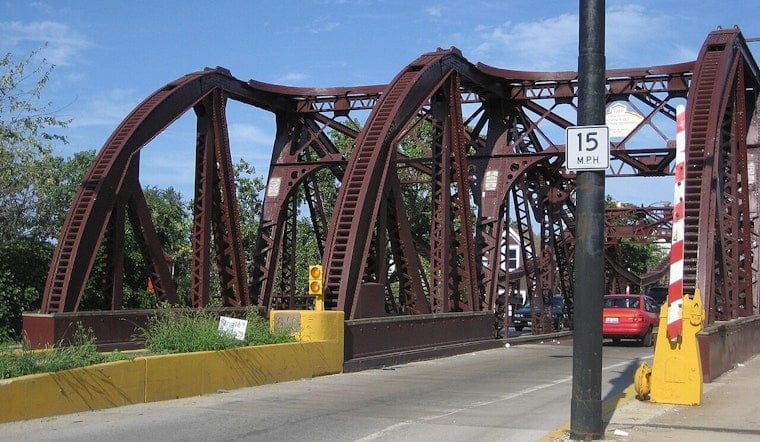
The Cortland Street Bridge has carried no cars across the Chicago River for about a year now, and two North Side alderpeople say enough is enough. Ald. Brian Hopkins and Ald. Scott Waguespack plan to introduce Chicago City Council legislation next month that would rescind the 124-year-old span's landmark protections, aiming to clear the way for a faster replacement of the Bucktown crossing that once carried roughly 18,000 vehicles a day between Bucktown and Lincoln Park.
The bridge, built in 1902, has held Chicago Landmark status for more than 30 years, according to Block Club Chicago. It uses a fixed trunnion bascule design known internationally as the Chicago style, and per HistoricBridges.org, it was the nation's first bridge of that kind when it opened, designed by City Engineer John Ernst Ericson as a prototype for movable bridges over navigable waterways nationwide. It was also named an American Society of Civil Engineers Landmark in 1981 and a Chicago Landmark in July 1991.
The Chicago Department of Transportation closed the bridge to vehicles for what it originally described, in September 2025, as an 18-to-24-month rehabilitation project. But newly discovered issues delayed that timeline, and CDOT has extended the closure indefinitely after structural assessments turned up severe steel corrosion, according to CBS News Chicago. The rehabilitation project is now expected to take years, with no announced completion timeline, and Waguespack has said city engineers could not provide one for the latest delays. The bridge remains open to pedestrians and cyclists.
Why Two Alderpeople Want To Tear It Down
Hopkins has said the congestion caused by the closure is untenable, and he supports replacing the bridge outright. He argues that removing landmark protections would give the city greater flexibility for a replacement span, and that the bridge's steel corrosion makes reusing the entire structure highly unlikely. Waguespack has estimated a new bridge would cost tens of millions of dollars, and a replacement would provide a quicker vehicle route between the two neighborhoods.
Hopkins has previously flagged the traffic toll of the closure, noting the roughly 18,000 vehicles a day the bridge once carried, a volume cited when CBS Chicago covered his concerns over CDOT's closure strategy. In February 2026, the City Council passed an ordinance Hopkins introduced requiring CDOT to submit formal traffic mitigation plans before closing any city bridge for more than 30 days, a measure that followed widespread public complaints about gridlock on the North Side.
A Landmark Rescission Chicago Hasn't Attempted in Decades
Landmark status revocation in Chicago has not occurred since the 1980s, according to Block Club Chicago's reporting. The last time it happened was in 1987, when the City Council stripped protections from the 1872 McCarthy Building to clear the way for what became Block 37; the building was torn down in the 1980s after the revocation survived a court challenge in the Illinois Supreme Court, per Wikipedia.
Not everyone agrees rescinding Cortland's landmark status is the answer. Ward Miller has said the bridge's problems resulted from poor city maintenance rather than the landmark protections themselves, and he has opposed removing those protections, calling it a dangerous precedent. Preservation Chicago, meanwhile, supports resuming car traffic on Cortland as soon as possible, even as the group and others have floated alternatives short of full demolition.
Even if the council votes to strip the landmark designation, that alone would not let the city immediately proceed with a bridge replacement. The project remains subject to state and federal environmental and historic-preservation reviews. Under Section 106 of the National Historic Preservation Act, projects funded or permitted by federal agencies require consultation with the Illinois State Historic Preservation Office regardless of local landmark status, according to the U.S. General Services Administration.
Compromise Proposals on the Table
Preservationists have proposed alternatives to outright demolition, including reusing the existing bridge elsewhere or building a new bridge near the current structure. Steve Jensen has proposed reusing the existing span as a footpath or for another purpose, while also floating the idea of removing, relocating and replacing the bridge altogether. Hopkins himself has said he supports repurposing elements of the historic bridge, such as the bridge house, even as he pushes for a new vehicle crossing.
One idea gaining traction ties the bridge's fate to the planned eastern extension of The 606, the Bloomingdale Trail. Preservationists have proposed using the existing Cortland span for that non-motorized trail connection toward Lincoln Park, according to CommercialForum, which reports that developers of the nearby Foundry Park project have incorporated a riverfront trail extension into their approved site layout. CDOT, for its part, says it is working to move the Cortland project forward as quickly and safely as possible, and spokesperson Erica Schroeder has said the city is considering all feasible options for the bridge, according to the same account. The department is evaluating whether to rehabilitate or replace the structure entirely.
Development Pressure Adds Urgency
The push for a faster fix is tied to what's coming to the riverfront nearby. The 31-acre, $3 billion Foundry Park development on the former Finkl Steel site, approved by the City Council in February 2026, is set to begin construction later this year and will bring thousands of apartments and other housing units to the area, according to the Chicago Sun-Times. The mixed-use project replaces the stalled Lincoln Yards proposal and received approval for $200 million in public infrastructure funding.
Cortland isn't the only North Branch crossing tied up right now. The Halsted Street Viaduct and Chicago Avenue Bridge are both closed for their own rehabilitation projects, and the Lake Street Bridge is also closed for repairs, concentrating pressure on already burdened arteries like North Avenue as drivers hunt for ways across the river. Chicago has faced this kind of aging-infrastructure reckoning before: Hoodline previously reported on CDOT's emergency six-month closure of the 1949 State Street Bridge in April 2025, after inspections found structural deficiencies in its load-bearing floor beams tied to extreme heat and heavy truck traffic.
For now, the fate of Cortland's landmark status will play out in City Council chambers next month, with Hopkins and Waguespack pressing for a vote while preservationists like Miller warn against setting a precedent unused since the McCarthy Building fell more than three decades ago. Whatever the council decides, federal and state reviews mean the bridge's replacement, if it happens, is unlikely to arrive quickly.





