

























































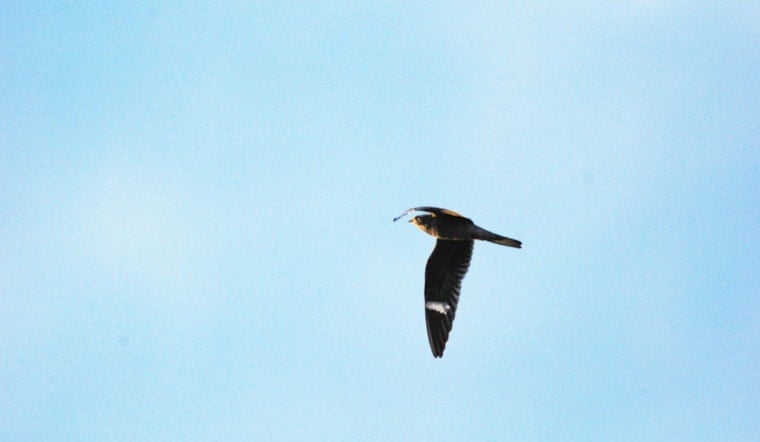
Thousands of common nighthawks are streaming over the Charles, Mystic and Connecticut River valleys this week, part of an annual migration that draws crowds to spots like Mount Auburn Cemetery and Fresh Pond even as the birds have all but stopped nesting in Massachusetts. The slender, long-winged birds are on the move from mid-August to early September, following river corridors on a journey that can stretch up to 6,800 kilometres to wintering grounds in the Caribbean or South America.
The nighthawk watch is a late-summer ritual for local birders, and Mount Auburn Cemetery is one of its best-known stages, according to Cambridge Day. Watchers there once counted 432 migrating nighthawks in a single evening on August 22, 2000, and observers have reported seeing the birds on all but one watch day since 2008. Mass Audubon, the Brookline Bird Club and the Boston Birding Festival all host their own migration watch parties, and the same report notes that visitors to Fenway Park sometimes catch nighthawks feeding on moths drawn in by the stadium lights.
Those hoping to catch the spectacle should look to the sky about 30 minutes before sunset and keep watching until roughly 30 minutes after, scanning near Fresh Pond or along the Mystic River for birds on the wing. According to the City of Cambridge, Fresh Pond Reservation consists of 162 acres of open space surrounding and protecting the 155 acre Fresh Pond water supply reservoir. The nighthawks, which belong to the nightjar family and are related to whippoorwills, are active at dawn and dusk, feeding on moths, flying ants and other flying insects as they pass. At roughly 9 inches long with a 21-inch wingspan, they are built for the kind of sustained aerial travel that makes their migration one of the longest made by any North American bird, per the Maryland Department of Natural Resources.
A Courtship Sound Made by Wind, Not Voice
Male common nighthawks, formally known as Chordeiles minor, produce a resonant booming courtship sound that has nothing to do with their voice box. According to the Cornell Lab of Ornithology, the sound is purely mechanical, generated as air rushes through stiffened primary wing feathers when the bird pulls abruptly out of a high-speed dive. It is one of the more theatrical courtship displays among North American birds, and one that once played out regularly over Massachusetts backyards and rooftops.
That is because nighthawks nest on the ground rather than building traditional nests, laying two eggs directly on bare soil, gravel or rock. The eggs and young are camouflaged so effectively against their surroundings that naturalist Edward Howe Forbush described them that way back in 1927, and the eggs can shift five or six feet from their original spot during roughly 18 days of incubation, according to Cambridge Day's reporting.
From Pine Barrens to City Rooftops, and Almost Nowhere Now
Nighthawks nested naturally in Massachusetts' pine barrens for generations, but by the 1970s nearly half of the state's occupied breeding territories were concentrated in just two regions, the Boston Basin and the Connecticut River Valley, per the Mass Audubon Breeding Bird Atlas. As early as the 1860s, the birds had adapted to city life, nesting on gravel roofs in Cambridge and Somerville and on gravelly mansard roofs in Boston by the 1870s, feeding on insect swarms drawn to early municipal electric lights.
That urban adaptation has since collapsed. Mass Audubon's atlases documented a 70% decline in the species' Massachusetts breeding footprint between the 1967-2009 Breeding Bird Atlases, one of the steepest drops of any bird tracked in the state. Modern commercial roofing has played a role: the industry's shift away from old gravel roofs toward smooth rubber roofs has made artificial nesting surfaces less suitable, according to the National Wildlife Federation.
Scientists have documented no ground nest in Massachusetts since 1982, when the last one was recorded in the pine barrens of Myles Standish State Forest, according to the Massachusetts Executive Office of Energy and Environmental Affairs. Nighthawks now breed in the state never or almost never, and the decline mirrors a broader continental collapse: North American Breeding Bird Survey data report an average annual decline of 1.23% between 1966 and 2019.
A Protected Species With a Foothold in Restoration Land
Massachusetts has undertaken efforts to conserve common nighthawk habitat. That designation has translated into active habitat work, including reported courtship behavior at the Muddy Brook Wildlife Management Area, the state agency reported. According to the City of Cambridge, the Black's Nook Resource Inventory was created to establish a sound ecological basis for habitat restoration and landscape improvement.
Whether that kind of habitat restoration can ever bring nesting nighthawks back to Massachusetts in meaningful numbers remains an open question. For now, the surest way to encounter the birds is still to look up at dusk along a river valley in late summer, when thousands of them pass overhead by the thousands on their way south, feeding on flying insects as they follow the same corridors nighthawks have used for generations.





