

























































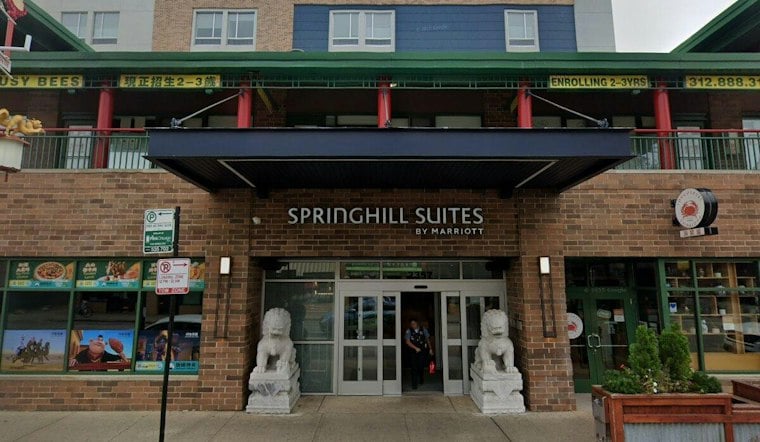
Chicago's measles scare just got bigger. Along with warning commuters about three separate exposure windows at Union Station, city health officials have listed a Chinatown hotel among the places where a person with a confirmed case of the highly contagious virus may have exposed others.
The Chicago Department of Public Health flagged the SpringHill Suites at 2357 S. Wentworth Ave. as a public exposure site tied to a domestic traveler who was there from 10:45 p.m. Saturday, Sept. 12 through 3:40 p.m. Sunday, Sept. 13, according to the Chicago Department of Public Health. The department also warned, in a notice first reported by CBS Chicago, that commuters passing through Union Station at 255 S. Canal St. may have been exposed on three separate occasions: between 10:25 a.m. and 3:30 p.m. on Sept. 10, between 8:45 p.m. and midnight on Sept. 12, and between 1:40 p.m. and 9 p.m. on Sept. 13.
The hotel exposure window overlaps with some of the Union Station windows. Union Station also appeared on an exposure list earlier this year — one potential exposure was reported there after 8 p.m. on Aug. 27 and on Aug. 28, per the same CBS Chicago report.
Why a Two-Hour-Old Room Can Still Be Dangerous
Measles is notoriously persistent in the air. According to guidance on measles from the Chicago Department of Public Health measles facts page, the virus can remain airborne and infectious in an enclosed space for up to two hours after an infected person has left, and up to 90% of non-immune people who are exposed will go on to contract it. That combination of lingering infectiousness and near-total transmission risk among the unvaccinated is why health officials move quickly whenever a confirmed case surfaces in a high-traffic public space.
Union Station itself is about as high-traffic as it gets. The terminal serves more than 3 million Amtrak passengers and 35 million Metra commuter rail riders annually across more than 300 trains a day, according to Chicago Union Station. That volume means even a narrow exposure window, like the 7-hour-20-minute Sunday afternoon alert, could theoretically have put thousands of travelers at risk.
Anyone who was in either location during the listed windows should watch for measles symptoms, which the CBS Chicago report notes include rash, high fever, cough, runny nose, and red, watery eyes. Those symptoms can take seven to 21 days to appear after exposure, and health officials say anyone who develops them should call ahead before showing up at a doctor's office or emergency room, rather than walking in and risking further spread. The MMR vaccine is available at no cost to all Chicago residents, including through CDPH immunization clinics.
Illinois Cases Already Outpace All of Last Year
The exposure warnings land amid a broader statewide surge. The Illinois Department of Public Health reported 22 confirmed measles cases statewide in 2026 as of Sept. 22 — already more than the 14 total cases recorded in all of 2025, though still well below the 67 cases seen in 2024. Illinois' first 2026 case was confirmed Feb. 17 in Metro East following out-of-state travel, while Chicago logged its first case of the year on June 23 in an international traveler, according to the Chicago Department of Public Health.
Nationally, the picture is starker still. The Centers for Disease Control and Prevention reported 3,471 confirmed measles cases and 39 outbreaks across the United States as of Sept. 17, compared with 2,289 total confirmed cases in all of 2025. The surge has been fueled in part by interconnected regional travel; a confirmed case in late August involved a passenger aboard Chicago-bound Amtrak Train 318, which prompted exposure warnings across both Missouri and Illinois transit channels, according to the St. Louis County Department of Public Health. Hoodline previously reported on St. Louis County's first case in two decades.
Illinois still maintains a statewide school measles vaccination rate of 96.78%, per the Illinois Public Health Association.





