

























































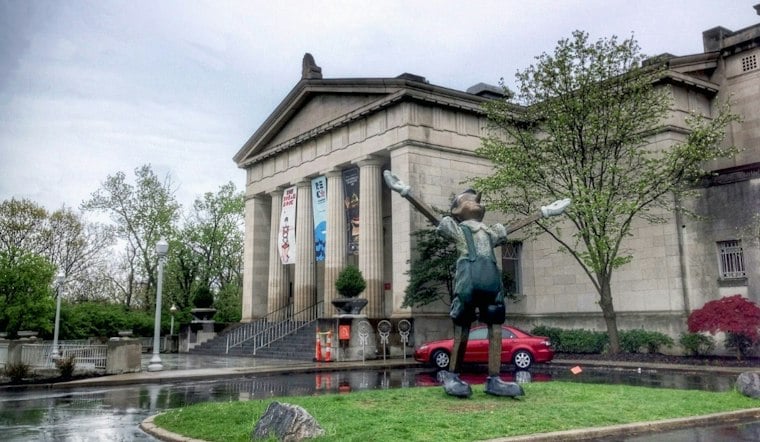
More than 50 works by Cincinnati artist Terence Hammonds will fill two galleries at the Cincinnati Art Museum starting November 20, in a free exhibition that pairs his ceramics, fabrics and wallpaper with pieces already held in the museum's permanent collection. The show, titled Terence Hammonds: Soul Is a Ham Hock in Your Cornflakes, runs through March 28, 2027, and explores Black history and cultural imagination as seen through the eyes of an artist who grew up in Cincinnati's Over-the-Rhine neighborhood.
For Hammonds, the exhibition marks a return to an institution that has shaped much of his career. As reported by Cincinnati CityBeat, Hammonds said the show at the Cincinnati Art Museum feels like a full-circle moment. The exhibition will be housed in the Sara M. and Michelle Vance Waddell Gallery and the Manuel and Rhoda Mayerson Gallery, located across from the museum's Terrace Café, with the Mayerson space identified internally as G125 and the Waddell space as G124.
An Artist Rooted in Over-the-Rhine
Hammonds, born in 1976, grew up in Cincinnati's Over-the-Rhine neighborhood and attended the School for Creative and Performing Arts before leaving the city to study art. He spent his childhood in a two-floor apartment at 1208 Main Street, above the storefront now occupied by Allez Bakery, according to Cincinnati Magazine. That same profile recounts how actress Jamie Lee Curtis once bought out all of Hammonds' remaining ceramic cups and vases during a 2017 group show at the Weston Art Gallery after reaching out to him directly on Instagram.
Hammonds earned a Bachelor of Fine Arts from the School of the Museum of Fine Arts in Boston, per the Cincinnati Arts Association. His collages use historical imagery from Black legacy publications including Jet, Ebony and Life. That archival material forms the visual backbone of the new show, which recontextualizes mid-20th-century Civil Rights imagery onto decorative, everyday objects.
Deep Ties to Rookwood Pottery and the Museum
Between 2010 and 2018, Hammonds served as director of artist outreach at Rookwood Pottery, the storied Cincinnati ceramics maker founded in the late 1880s. That connection has fed directly into his museum-held work, including the museum's 2020 purchase of his Protest Platter, made in collaboration with Breakfront Pottery and refugee artists from Wave Pool's The Welcome Project.
Hammonds also has a history inside Cincinnati's arts institutions. He was an artist in residence at the Contemporary Arts Center, Cincinnati, in 2020. His exhibition history also stretches internationally, with solo shows at the Ifö Center in Bromölla, Sweden, in 2019 and the Pottery Workshop in Jingdezhen, China, in 2016, per the Cincinnati Art Museum.
A Steady Build-Up of Regional Recognition
The Cincinnati Art Museum show follows a string of recent regional spotlights on Hammonds' work. In 2023, the Taft Museum of Art hosted his solo exhibition Universal Magnetic: New Works by Terence Hammonds, combining historical Civil Rights movement imagery with decorative ceramic motifs, according to World Literature Today. Then, from January 30 to March 15, 2026, Hammonds presented Transmission from the Mothership at the Weston Art Gallery, an Afrofuturist collage show pairing music iconography with vintage magazine cutouts.
The exhibition's title borrows from Funkadelic's 1970 track What Is Soul?, according to eLyrics.net. The song's absurd juxtapositions, defining soul as something as unexpected as a ham hock in cornflakes, echo the way Hammonds fuses solemn archival photography with domestic decorative forms. Museum organizers say the show illuminates the resilience of Cincinnati's modern Black community by combining selected pieces from the museum's permanent collection with Hammonds' new work.
Free Admission and a Public Conversation
The exhibition will be free to the public. Access is also bolstered by ArtsWave, which awarded the Cincinnati Art Museum $1.285 million in Sustaining Impact grants in July, according to prior Hoodline reporting on the local arts funding cycle.
The exhibition also invites consideration of how Hammonds' collaborative ceramic and print work reframes local Black history for museum visitors, tying his decades-long relationship with Cincinnati's cultural institutions to a broader story about the city itself.




