

























































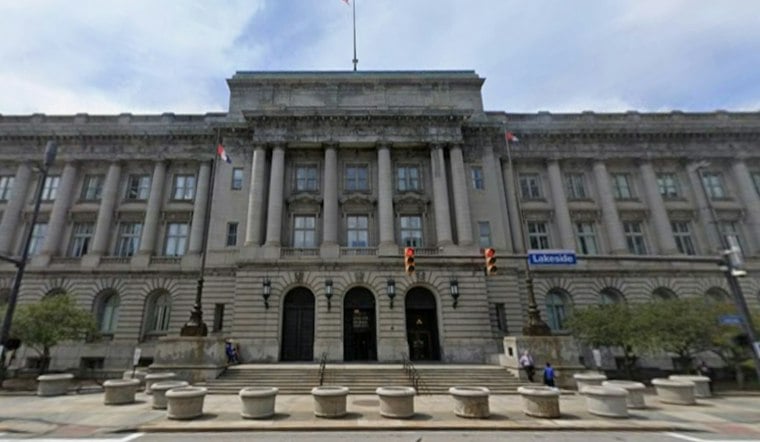
Cleveland City Council voted Monday night to rename a two-mile stretch of Lake Erie the Gulf of Cleveland, a direct jab at President Trump's recent executive orders rebranding the Gulf of Mexico and Lake Ontario. The resolution passed at the council's Monday meeting directs city departments to use the new name on all city-generated maps and documents, and instructs officials to press Apple and Google to display Gulf of Cleveland on their digital maps too.
The measure, introduced by Council Member Kris Harsh, came as a response to President Trump renaming the Gulf of Mexico and Lake Ontario, according to Cleveland 19 News. Harsh has served on council since 2022 and has largely focused on neighborhood preservation and housing policy, per his Ballotpedia profile, making the geographic name fight something of a departure for the councilman. As is often the case with municipal resolutions like this one, it functions more as a signal to federal and corporate powers than as a binding legal change.
What the Gulf of Cleveland Actually Covers
Under the resolution, the Gulf of Cleveland will stretch from the easternmost to the westernmost points of Cleveland's shoreline and extend two miles out into Lake Erie, per the same Cleveland 19 News report. Lake Erie is the shallowest of the Great Lakes by volume and runs 241 miles long, with Cleveland sitting along its southern shore, according to the U.S. Department of Energy. City departments are now expected to reference the designated zone as the Gulf of Cleveland going forward, and the name will appear on city documents and maps.
Council members say Apple and Google have already used the names Gulf of America and Lake America on their platforms, and Cleveland now expects the tech giants to add Gulf of Cleveland into the mix as well. The city plans to mail companies including Apple and Google formally demanding that their digital maps reflect the new name. Officials framed the move around not wanting Cleveland left behind in what the city itself described as a deluge of rebrandings.
How This All Started: Trump's Renaming Orders
The chain of events traces back to President Trump's executive order signed on August 27, 2026, which directed federal agencies and the U.S. Board on Geographic Names to rename Lake Ontario as Lake America across government documents and cartographic databases, according to The White House. Hoodline previously reported on the Lake America order and the backlash it drew. That order followed an earlier one from January 20, 2025, in which Trump directed federal departments to refer to the Gulf of Mexico as the Gulf of America and restored the name Mount McKinley for Alaska's Denali, per a separate White House order.
Canadian officials pushed back hard on the Lake America designation. Prime Minister Mark Carney and Ontario Premier Doug Ford rejected the name, noting that Lake Ontario derives from the Wendat word Ontari'io, meaning beautiful lake, and has carried international recognition for more than 400 years, according to Active History. Because Lake Ontario is shared between the United States and Canada, a unilateral American renaming carries no weight with Canadian authorities.
Federal Authority Versus Local Symbolism
There's a legal wrinkle underlying all of this. Official U.S. geographic nomenclature is maintained by the U.S. Board on Geographic Names within the U.S. Geological Survey under Public Law 80-242, and that board holds sole authority over federal maps even though it takes input from local governments, according to the U.S. Geological Survey. Cleveland can define terms on its own city-generated documents, but any change to official federal maps still requires the board's formal approval.
News organizations, meanwhile, are largely sticking with the old names. On September 14, 2026, the Associated Press updated its stylebook guidance to instruct newsrooms to continue using Lake Ontario and Gulf of Mexico, arguing that place names with four centuries of global usage remain standard in international journalism, per Poynter. The AP noted that presidential executive orders bind federal agencies but do not alter international cartographic standards or independent newsroom usage.
Tech Platforms and Pop Culture Caught in the Crossfire
By early September, major mapping platforms including Apple Maps and Google Maps had already updated displays for U.S.-based users to show Lake America and Gulf of America, while keeping traditional names for international users, Hoodline previously reported on the tech response. That split policy is part of why Cleveland's council specifically targeted Apple and Google in its resolution, hoping to force a third entry into the same map data those companies already update for federal directives.
The cultural fallout has stretched beyond city halls and boardrooms. In early September, Comedy Central's South Park temporarily changed its title on network websites and TV listings to South America as satire aimed at tech companies adopting federal renamings, while other platforms like MapQuest publicly refused to update Lake Ontario's name on social media. Cleveland's resolution now joins a growing list of state-level responses to the renaming push, including Florida lawmakers who introduced legislation in March 2025 to mandate Gulf of America in state statutes and educational materials, and Texas Governor Greg Abbott's earlier endorsement of Gulf of Texas.




