

























































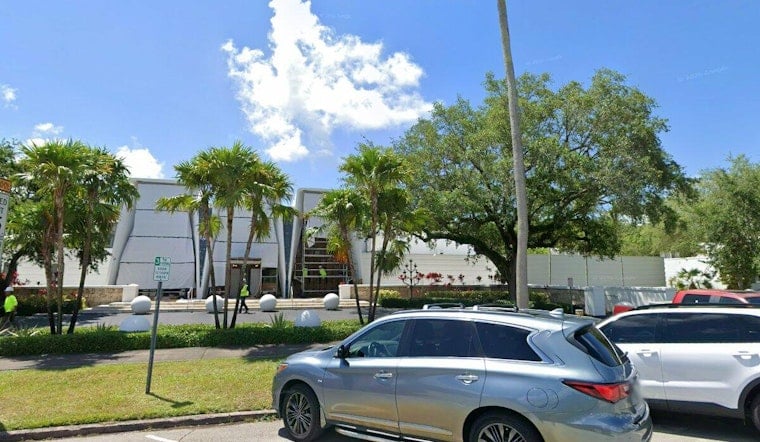
Temple Judea, the only Reform congregation in Coral Gables, has assembled a design and construction team to restore, renovate, and reimagine its historic campus along US1 — a Morris Lapidus-designed landmark that has served as a recognizable Jewish beacon in South Florida since 1966. The effort, known as the Lev — From the Heart capital campaign, will touch nearly every corner of the property, from the sanctuary to communal gathering spaces, while keeping the congregation's three signature entrance arches standing as symbols of worship, learning, and assembly.
According to Coral Gables Community News, Temple Judea traces its roots to 1946, when a group of Jewish families began worshiping and meeting in private homes, storefronts, and the University of Miami Hillel Center. The congregation organized formally as the Coral Gables Jewish Center in September 1948 and joined what is now the Union for Reform Judaism that same month. It became Temple Judea in 1956, and by 1960, as Miami's Jewish population expanded southward, congregational leaders recognized the need for a larger campus and acquired a prominent site along US1, selecting Morris Lapidus to design the new home.
Lapidus, the Miami Modernist architect behind the Fontainebleau and Eden Roc hotels, completed Temple Judea's campus in 1966 with three pavilion-style structures representing worship, study, and assembly, according to Coral Gables Magazine. The City of Coral Gables designated the campus a local historic landmark in 2013, a status that now shapes every design decision the renovation team makes.
Assembling a Team Built for Preservation
Leading the interior vision is CetraRuddy, the New York-based architecture and design firm that previously designed Manhattan's Lincoln Square Synagogue along with residential towers such as One Madison, Rose Hill, and Walker Tower, per its own project history. Miami-based ELM ARCH, founded by registered architect Erik Myers, is serving as project architect; the firm has handled complex commercial and institutional work throughout South Florida and previously designed the award-nominated Nourish 305 space at Zoo Miami, according to the University of Florida Alumni Association.
RedDoor Construction is the general contractor overseeing the physical transformation. The firm has deep local preservation experience, having led the 2016–2017 restoration of seven historic Coral Gables plazas and entrances as well as hurricane repair work at Vizcaya Museum & Gardens, per RLA Conservation. Per Coral Gables Community News, Temple Judea leaders describe the combined team — ELM ARCH, RedDoor Construction, and CetraRuddy — as committed to preserving Lapidus' original design while creating spaces that are more accessible and welcoming.
What the Lev Campaign Will Change
The Lev — From the Heart project, whose Hebrew name means “heart,” encompasses restoration of the historic architecture alongside renewal of the sanctuary and communal spaces, the report notes. Planned updates include enhanced accessibility and inclusion, strengthened security, and updated technology, sound, and lighting throughout the campus. Organizers describe the initiative as addressing accessibility, technology, comfort, flexibility, and community connection across the property's interior and exterior environments — spaces meant to support worship, learning, celebration, and human connection.
Lawrence Lambert, quoted in the coverage, said the project is more than a renovation and represents stewardship of an architectural and spiritual legacy. Congregational leaders Margie Baron, Michael Spritzer, Julie Simon, and Gary Simon said the project will preserve Coral Gables and Miami architectural history while creating a Temple Judea built for the next 80 years.
A Congregation Rooted in Growth
Senior Rabbi Judith L. Siegal, who joined Temple Judea in 2006 shortly after her ordination, said the temple is a spiritual home, a center of learning, a place of connection and celebration, and a gathering place for Jewish life in South Florida. Siegal recently completed a two-year term as president of the Rabbinical Association of Greater Miami, according to a Facebook post from the temple, underscoring her broader regional standing within the rabbinic community.
Temple Judea today counts nearly 700 households among its members and describes itself as dedicated to worship, lifelong Jewish learning, community, inclusion, and tikkun olam — guided by the statement that “through a strong Jewish community, we better ourselves and the world.” The campus also houses The Margaux Early Childhood School, an accredited private preschool with annual tuition around $18,000, according to Niche, making the property a daily hub for young families well beyond Shabbat services.
The renovation arrives as Miami-Dade County's Jewish community undergoes rapid demographic change. The Greater Miami Jewish Federation's 2024 Community Study, released in April 2025, found the county's Jewish population had grown to 130,100 residents across 69,700 households — a 25% increase in Jewish households over the prior decade. The same study found nearly one-quarter of Miami Jewish adults had moved to the area within the past ten years, and 33% were born outside the United States, pointing to a rapidly diversifying population that increasingly relies on institutions like Temple Judea. According to a Brandeis University summary of the 2024 Community Study, Miami-Dade's Jewish community includes 69,700 households and 151,400 individuals, of whom 130,100 are Jewish. According to the Greater Miami Jewish Federation's 2024 Community Study, Jewish residents comprise 5% of Miami-Dade's population, while Jewish households account for 8% of all county households.
Honoring a Legacy Already Shared
This is not the first time Temple Judea has navigated a major renovation with an eye toward preserving Lapidus' legacy. During a previous sanctuary renovation, the congregation donated its original Lapidus-designed Ark to Congregation B'nai Zion in Key West, where it remains in active use today, according to the Key West congregation's own facility records. That precedent of sharing rather than discarding architectural heritage now informs how Temple Judea's current design team is approaching the campus's next chapter — restoring what has stood for six decades while building toward the community it expects to serve for decades more.





