

























































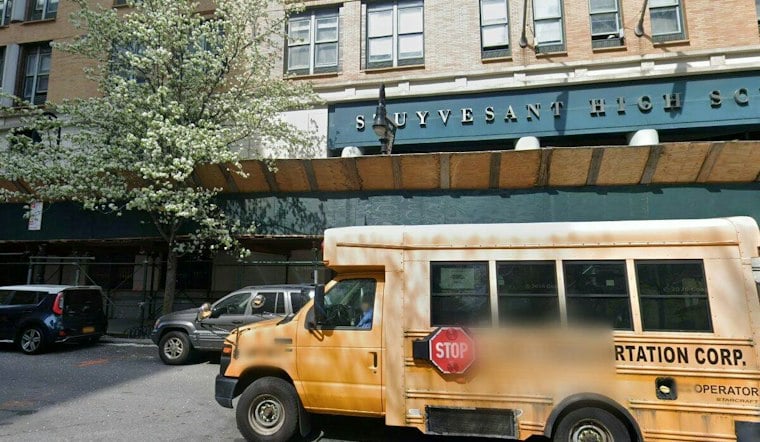
Stuyvesant High School's incoming freshman class this fall includes 3 Black students and 21 Latino students out of 777 total seats, according to the most recent specialized-school admissions statistics New York City released in July 2026. Two City Council members say those numbers are proof the city's specialized high school admissions system needs an immediate overhaul, and they're pressing Mayor Zohran Mamdani to act before state lawmakers even take up the issue.
Council Members Nantasha Williams and Lincoln Restler sent a letter to Mamdani and Schools Chancellor Kamar Samuels on September 8, arguing that the SHSAT should no longer be the sole admissions determinant for five of the city's specialized high schools, as reported by Gothamist. The two cited a persistent lack of Black and Latino students at the schools as the driving reason for their push. Citywide, Black students make up 19% of the public school student body but received only about 3.5% of the roughly 4,000 specialized high school seats, while Latino students comprise 42% of the student body yet received about 6.5% of those seats, per the same account. Asian students, who make up 19% of the student body, received 56.5% of specialized high school offers, and white students, who comprise 16% of public school students, received 17% of the seats.
At Stuyvesant specifically, 534 of the 777 freshman seats went to Asian students and 133 went to white students, alongside the 3 Black and 21 Latino students admitted. Restler said the admissions process for specialized high schools is profoundly flawed and the city needs to act now, while Williams said she wants immediate admissions changes by the upcoming cycle or the following one, according to Gothamist's reporting.
Why the Mayor Can Move Without Albany
The councilmembers' letter zeroes in on a legal distinction that gives City Hall room to maneuver. State law designates the SHSAT as the sole admissions determinant only for Stuyvesant, Bronx High School of Science, and Brooklyn Technical High School — a mandate written into the 1971 Hecht-Calandra Act, according to FREOPP. The city's Department of Education currently uses the SHSAT to determine admissions at eight specialized high schools in total, but five of them — Brooklyn Latin School, Queens High School for the Sciences at York College, the High School for Math, Science and Engineering at City College in Manhattan, the High School of American Studies at Lehman College in the Bronx, and Staten Island Technical High School — were created administratively during the Bloomberg era and are not named in state law, the Gothamist report notes.
Williams and Restler argue Mamdani can address the diversity gap by changing policies at those five schools without waiting on state lawmakers. Critics of the current system have similarly argued that the newer specialized schools created during the Bloomberg administration do not need to use the SHSAT at all, per the same account. A ninth specialized school, Fiorello H. LaGuardia High School of Music & Art and Performing Arts, already sidesteps the exam entirely, selecting students through artistic auditions or portfolio reviews rather than standardized testing, according to the NYC Department of Education.
A Two-Track Strategy: City Action and a State Repeal Push
Beyond the five administratively created schools, Williams and Restler are also pushing a state-level track focused on the state law requiring the SHSAT at the three flagship schools. Past attempts to repeal that requirement have failed.
The councilmembers also proposed expanding enrollment at the five schools by thousands of seats, reorienting the specialized-school preparatory program toward the city's poorest areas, making advanced math classes universal in middle schools, and using a combination of a baseline SHSAT score, grades, teacher recommendations, essays, and applicant background for admissions decisions, per Gothamist. Mamdani, an alumnus of Bronx High School of Science, said in July that a single test does not reflect students' aptitude across the city and called for improvements to elementary and middle school education to increase applicants citywide. The Department of Education did not respond to requests for comment, the outlet reported.
Past City Efforts Show Limited Impact
Previous mayoral efforts to diversify the schools have had mixed results. Bill de Blasio lobbied to replace the SHSAT with admission of top students from every middle school and expanded the Discovery preparatory program, which sets aside 20% of ninth-grade seats across the eight exam-based specialized schools for low-income students who score slightly below the cutoff and complete a summer prep course, according to Chalkbeat. But that expansion did not shift the racial makeup the way city officials intended.
Courts have also been considered as one avenue for change. The debate therefore continues to center on legislative and administrative action.
Alumni Groups Push Back on Changing the Test
Not everyone agrees the admissions formula needs fixing. Alumni and SHSAT advocates have pushed to keep the exam, arguing it remains an objective measure and a strong predictor of success at the rigorous schools. Yiatin Chu said schools should prepare all students to compete for spots rather than change admissions criteria to alter racial composition, and her group has backed expanding seats at specialized schools and other accelerated programs instead of overhauling how students get in.
The scale of competition underlying the debate is steep across the board. Roughly 25,000 to 30,000 New York City eighth graders take the SHSAT each autumn, competing for about 4,000 to 5,000 available seats — an overall systemwide qualification rate of around 16%, according to Wikipedia. Capacity also varies enormously between schools, including between Brooklyn Technical High School and a smaller specialized school like HSMSE at City College, per the SHSAT Score Calculator. The debate also includes questions about how much exam-school outcomes reflect students' prior academic preparation.




