

























































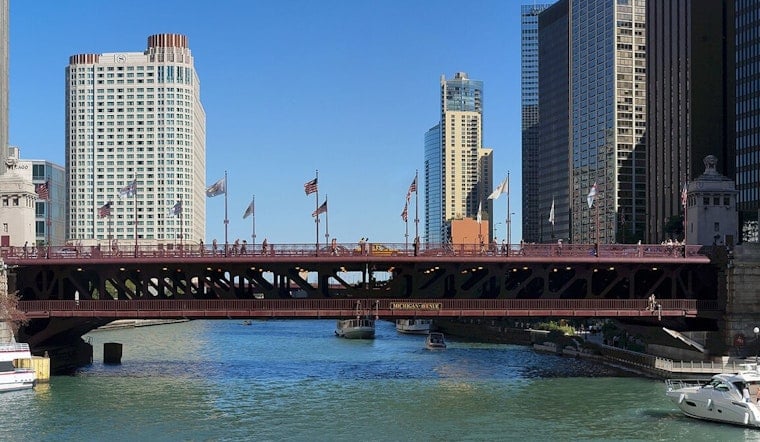
Traffic on DuSable Lake Shore Drive backed up severely near Grand Avenue on Wednesday after the bascule bridge over the Chicago River got stuck during a scheduled boat lift, and it turns out the span had already been flagged as structurally deficient two years earlier. City officials said extreme heat caused the malfunction, but inspection records show engineers had rated the 88-year-old bridge as functionally obsolete and in need of high-priority correction as far back as September 2024.
The bridge became stuck around 10 a.m. Wednesday during one of the Chicago Department of Transportation's routine seasonal boat lifts and remained raised for more than four hours before reopening shortly before 2:30 p.m., according to AP News, which cited CDOT spokesperson Erica Schroeder for the timeline. As reported by NBC 5 Chicago, city officials attributed the jam to extreme heat causing the bridge to become stuck during the lift, and Chicago firefighters along with Office of Emergency Management officials responded by cooling the bridge steel with cold water in an effort to get it moving again.
CDOT Commissioner William Cheaks was unavailable Wednesday to answer questions about the bridge lift scheduling and the high temperatures, per the same NBC 5 Chicago report. The station also noted the bridge is due for another inspection.
A 2024 Report Called The Bridge Intolerable
A DuSable Lake Shore Drive bridge inspection report completed in September 2024 rated the span's structural evaluation as intolerable and found it to be functionally obsolete, according to NBC 5 Chicago's review of the documents. The bridge was given high priority for correction at that time, though the outlet noted that such a deficiency finding does not immediately imply the bridge is likely to collapse or is unsafe to use. CDOT crews worked on the bridge from February through May 2024, the station reported.
Bassem Andrawes said the extreme heat caused excessive expansion of one bridge part over another, preventing the two halves from closing, per NBC 5 Chicago's account. Transportation expert Joseph Schwieterman told the station the bridge needed extensive repair, attributing Wednesday's malfunction to a combination of the bridge's old structure, misaligned tolerances, and the extreme heat.
Federal Data Shows A Structure Under Strain
Separately from the 2024 city inspection, federal data from the 2025 National Bridge Inventory shows the bridge carries roughly 102,000 vehicles a day and is rated in poor condition, with its superstructure scoring 4 out of 9, according to Bridge Report Card. That source notes a superstructure rating of 4 indicates advanced section loss or deterioration but does not automatically mean a bridge is unsafe. The National Weather Service had issued consecutive dangerous heat advisories for the Chicago area on Tuesday and Wednesday as heat index values pushed past 90 degrees, AP News reported, providing the meteorological trigger behind the thermal expansion in the bridge's steel.
An Aging Landmark With A Long History
The span, dedicated Oct. 5, 1937, by President Franklin D. Roosevelt and Mayor Edward J. Kelly as the Outer Drive Bridge, was the world's longest and heaviest double-leaf bascule bridge at the time, weighing 6,420 tons per leaf, according to Chicago Loop Bridges. It was renamed for Roosevelt in 1982 and for Jean Baptiste Point du Sable in 2021. The bridge isn't the only stretch of the corridor with a rocky recent past — in February 2019, northbound Lake Shore Drive was closed for more than 24 hours after inspectors found a major structural crack in a steel beam near Randolph Street, sparking citywide bridge safety reviews at the time.
Thermal expansion during extreme heat is a known risk for Chicago's drawbridges, and CDOT has proactively canceled scheduled river bridge lifts during past heat waves, including one in June 2022, to prevent thermal binding. Hours after Wednesday's DuSable Lake Shore Drive jam, a bridge over the Calumet River on the South Side experienced a similar heat-related traffic jam, per NBC 5 Chicago, underscoring how the day's heat put simultaneous stress on steel crossings across the city's waterway network.
Part Of A Bigger Infrastructure Picture
The bridge's deficiency finding fits into a broader pattern documented across the city's aging infrastructure. Roughly 16 percent, or about one in six, of Chicago's bridges were classified as structurally deficient or in poor condition in 2024, Hoodline previously reported, citing Illinois Department of Transportation inventory records. The DuSable Lake Shore Drive bridge sits within a seven-mile corridor between Grand Avenue and Hollywood Avenue now under review through the Illinois Department of Transportation and CDOT's Redefining the Drive Phase I study, which is evaluating comprehensive reconstruction of a corridor that carries up to 155,000 vehicles and 69,000 transit riders daily, according to Civiltech Engineering.
The bridge is one of 27 movable spans that CDOT raises sequentially between South Ashland Avenue and Lake Michigan during its twice-weekly seasonal boat runs each spring and fall, a routine Hoodline detailed in a May report on how the lifts, races, and festivals disrupt Chicago traffic. Each lift typically halts road traffic for only 8 to 12 minutes under normal conditions — a routine that turned into a four-hour ordeal Wednesday once the heat took hold.





