

























































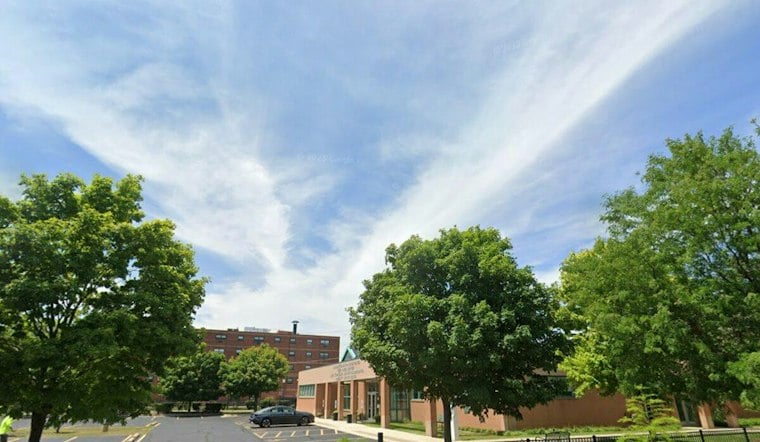
After 13 years of vacancy, the former Fiske Elementary School at 6145 S. Ingleside Ave. is approaching a decision that could shape more than one aging property. Chicago Public Schools received three bids for the nearly 74,000-square-foot building and its roughly 107,000-square-foot site, and the Board of Education is expected to consider the finalists by the end of 2026. The outcome remains unsettled: the board could approve one proposal or reject both, followed by required approval from the City Council or Public Buildings Commission. Block Club Chicago reported that the bids followed a CPS solicitation with a $750,000 minimum bid and $25,000 deposits from each bidder.
Three bids, three different tests
The proposals differ in what they treat as the site’s primary public value. Prime Capital Group and Straight-A Realty proposed the Ingleside Innovation and Wellness Center, a privately financed community facility focused on youth, seniors, training and wellness services. Center Court Development’s Housing Now proposal would renovate the school into 48 apartments, divide units between market-rate and affordable housing, and place Africa International House in part of the building. Bailey Tucker’s Fiske Community Center proposal combines youth programming with 40 affordable apartments and says it would rely on private money rather than public or grant funding. These descriptions and funding plans come from the bidders’ proposals as reported by Block Club Chicago; their ultimate feasibility and financing have not been independently established here.
That distinction matters because the proposals face different execution hurdles. The housing-led plan would depend on tax credits, grants and several construction phases. The wellness-center proposal says it could proceed without outside funding, while Tucker’s plan rejects public and grant financing altogether. In each case, the board must weigh not only the bid amount but also whether the proposed end use, financing and rehabilitation plan can be delivered in a building that has been unused since 2013.
Chicago’s reuse record offers cautionary comparisons
Past school-reuse projects show why approval is not the same as completion. The former Mulligan Elementary School in Lincoln Park was converted into 24 apartments, although a 2014 fire delayed the work by more than a year, according to WTTW. In North Lawndale, the Board of Education approved a 2018 bid to convert the former Henson Elementary School into 80 low-income mini-studios, but the sale never closed, Chalkbeat Chicago reported. The former Peabody Elementary School in West Town, meanwhile, was sold to a luxury developer for $3.5 million in 2014, a completed transaction but a substantially different use from the affordable-housing and community-service options proposed for Fiske, according to the Chicago Tribune.
The comparisons do not predict what will happen at Fiske. They do show why the next stage—financing, closing, permits and construction—will be as consequential as the board vote. A winning bid would still need to convert a long-vacant public asset into an operating building, and the public record currently does not establish which proposal can do that most reliably.
The housing question is larger than one school
Fiske is being evaluated in a neighborhood where demand and affordability are moving in opposite directions. Block Club Chicago, citing DePaul University’s Institute for Housing Studies, reported that prices for single- and multifamily homes on the East Woodlawn side nearest the Obama Center doubled since 2019, while less than one-third of the area’s housing stock was considered affordable in 2024. A University of Chicago summary of the Woodlawn Housing Data Report identified high vacancy, at-risk renters and homeowners, increasing market activity and inadequate resources as central local conditions. The university summary does not, however, establish that any one Fiske proposal would prevent displacement or meet the neighborhood’s full housing need.
City policy sets a benchmark for some development on public land. Under the Woodlawn Housing Preservation Ordinance, projects on 25% of city-owned vacant land must make 30% of their units affordable to households earning 30% to 50% of area median income. Yet delivery has been slow: Block Club Chicago, citing an Illinois Answers Project review of city records, reported that only one development—a 58-unit apartment building—had been completed in five years among 52 city-owned lots reserved for affordable housing. That record gives the Fiske decision a practical dimension: the question is not only which vision is most attractive, but which one can produce promised space and homes.
What happens next
The school’s vacancy began after the Board of Education voted in May 2013 to close Austin O. Sexton Elementary and move Fiske’s operations to the former Sexton building, leaving the original facility unused, according to board records at Chicago Public Schools. The three current bids followed CPS’s 2025 sale process. The board is expected to act by the end of 2026; any approved transaction would then require an additional city-level approval. Until those steps occur, the building remains a vacant public property—and the proposed community programs, apartments and cultural space remain plans rather than completed neighborhood assets.



