

























































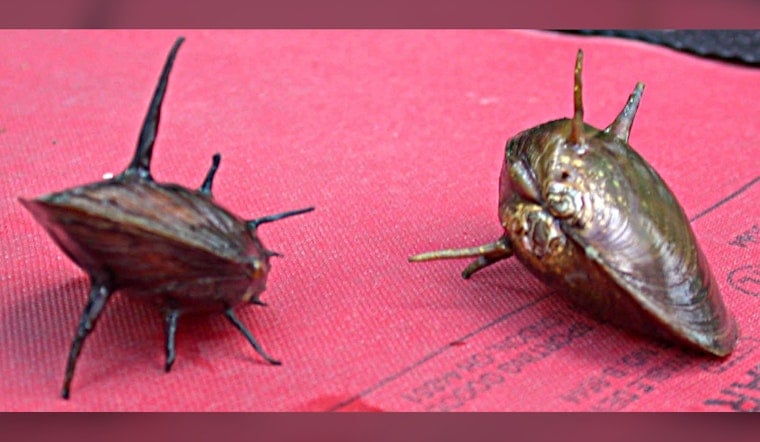
A Georgia Department of Natural Resources biologist felt something unusual buried in the sand-and-gravel bed of the lower Ocmulgee River this summer, and it turned out to be a species many had all but written off. Researchers confirmed the find was a live Altamaha spinymussel, a federally endangered freshwater mussel that had not been documented alive anywhere in the wild since 2011.
DNR aquatics biologist Zach Schumber and technician Percy Knight were conducting a routine survey when Schumber felt the mussel buried in the riverbed, according to the Georgia Wildlife Blog. Schumber said he nearly spit out his snorkel when he realized what he had found, as reported by WSB-TV. The previous live sighting had come in 2011 near Jesup, Georgia, around the time the species received federal protection, per the same blog post.
The Altamaha spinymussel is found only in Georgia and nowhere else on earth, native exclusively to the Altamaha River basin. Adult mussels can grow up to 4.3 inches long, with pink or purple interior nacre and shell spines that measure up to an inch, according to WSB-TV's report, which described the shell as bearing one to five short spines. State aquatic biologists say the precise biological purpose of those spines is still unknown, though DNR researchers hypothesize they may help stabilize the mussels in loose, shifting river sands or protect them from predators.
A Species Many Feared Was Gone
The U.S. Fish and Wildlife Service added the Altamaha spinymussel to the endangered species list in October 2011, establishing 147.5 miles of critical river habitat across 11 Georgia counties. Dozens of DNR surveys conducted in the 15 years since failed to turn up a single live specimen, the Georgia Wildlife Blog notes. Matt Rowe said he and others were about ready to call the species extinct, before this summer's discovery, per WSB-TV.
“The rediscovery was heartening and offered hope that the species can be saved,” Rowe said, according to the same report. Although historically present throughout the Altamaha River basin, the spinymussel has been functionally extirpated from the Oconee River and lower Altamaha River, surviving only in fragmented reaches of the Ocmulgee River basin, according to a Nuclear Regulatory Commission document. Historical records show shells were once collected as far up the Oconee River as Mt. Vernon, Georgia, a sign of how dramatically the species' range has contracted.
What Drove the Decline
The exact cause of the Altamaha spinymussel's decline has been described as something of a mystery, but the species has been in decline since the late 1970s. Water quality degradation from agricultural runoff, erosion, logging sediment, kaolin mining, and municipal wastewater discharge have been identified as primary drivers of that steep population drop, according to the Center for Biological Diversity. Droughts and low river flows have further stressed the small, localized populations that remained.
The species faces ongoing habitat pressures from watershed sedimentation, agricultural runoff, and industrial development along the Ocmulgee River basin, a concern Hoodline has previously reported extends to data centers eyeing the Ocmulgee. Genetic analysis indicates the Altamaha spinymussel diverged from other North American spinymussel species roughly 3.76 million years ago, evolving its distinctive shell spines independently — it is one of only three freshwater mussel species in North America that produce true shell spines, according to the mussel's Wikipedia entry.
Recovery Plan Still Faces Basic Unknowns
The U.S. Fish and Wildlife Service finalized a formal recovery plan for the species in January 2024 to guide long-term habitat protection and restoration across the Ocmulgee, Altamaha, and Ohoopee River systems. That plan outlines priority actions including identifying host fish species and establishing insurance populations, per Georgia Biodiversity Portal records. Yet critical aspects of the species' life cycle remain unknown, including which host fish its larvae rely on for reproduction, a gap that continues to complicate propagation efforts.
Freshwater mussels like this one act as natural filters in Georgia's rivers, extracting suspended algae, bacteria, and silt while stabilizing sandbars, according to the Georgia Department of Natural Resources. Georgia hosts roughly 130 species of freshwater mussels, making its river basins among the most biodiverse aquatic habitats in North America. For now, biologists say the discovery of one live spinymussel offers genuine hope, but the species remains federally endangered and vulnerable to any new disturbance along the Ocmulgee.





