

























































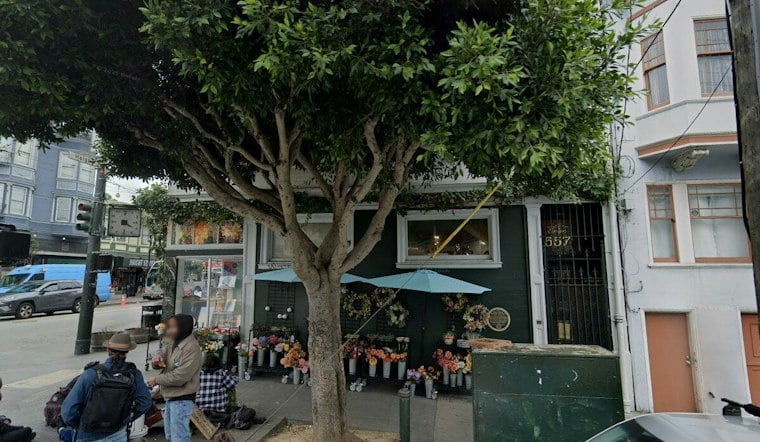
A proposal to turn a 123-year-old building at the corner of Haight and Ashbury into a broadcast studio, teaching rooms and rooftop concert venue has small business owners worried they are about to lose their storefronts. San Francisco Heritage has partnered with Seattle public radio station KEXP and the nonprofit Blue Bear School of Music to potentially transform the Doolan-Larson building, and six merchants who currently occupy its ground floor say they could be displaced if the plan moves forward.
The Doolan-Larson building sits on the northwest corner of Haight and Ashbury streets, according to San Francisco Heritage, which said it would issue a Request for Concept Proposals for the redevelopment and reuse of the property. The nonprofit wants to adapt the landmark into what it describes as a cultural facility exploring the lessons and legacy of counterculture. In June, KEXP and Blue Bear submitted a proposal that included a rooftop venue for live music and community celebrations, broadcast facilities for radio shows originating from the corner of Haight and Ashbury, and a full floor dedicated to Blue Bear's music education programming, according to KEXP.
As reported by The San Francisco Standard, the building currently houses a jewelry store, gift shop, barbershop, toy store, vintage boutique and a Nepalese art and jewelry vendor, most in spaces of about 500 square feet each. Six of those merchants reportedly hold month-to-month leases, and the Standard's reporting says they would be displaced if San Francisco Heritage moves ahead with the plan.
A Century-Old Building With Deep Roots
Built in 1903 for Richard P. Doolan, the building survived the 1906 earthquake and has cycled through decades of Haight Street history, per San Francisco Heritage. The clothing boutique Mnasidika opened inside in 1965, at the height of the neighborhood's countercultural moment, and Norman Larson bought the building in 1980, according to the Standard's reporting. Arkady Pletman opened a jewelry store and watch repair shop there in 1994. The building was designated San Francisco Landmark No. 253 in 2006 and listed in the National Register of Historic Places in 2011, San Francisco Heritage says.
Accounts differ on exactly when ownership passed to San Francisco Heritage. KEXP states that the nonprofit has owned and stewarded the property since 2017, when it was donated by longtime resident and owner Norm Larson, while the Standard's reporting places that transfer in 2018. San Francisco Heritage, which also owns and operates the Haas-Lilienthal House as a museum, has said the Doolan-Larson project would need to meet the Secretary of the Interior's standards for restoration and rehabilitation of buildings on the National Register of Historic Places.
Merchants Fear Losing Their Foothold
Robert Emmons, who owns the Welcome Haight & Ashbury gift shop, told the Standard that six small businesses would be pushed out for what he characterized as an out-of-state radio station. The Haight Ashbury Merchants Association is working to arrange a meeting with the project's leaders, the outlet reported, and Naomi Silverman, owner of Mendel's Art Store, is among the tenants watching the process closely.
The stakes are heightened by a broader retail recovery in the neighborhood. Retail vacancies in the Haight fell from 32 at the pandemic's peak to fewer than 10, according to figures attributed to a neighborhood merchant association in the Standard's reporting, a trend that has made the prospect of losing storefronts along the corridor feel more consequential to shop owners now than it might have a few years ago.
Competing Visions For The Corner
Project proponents say the music hub would connect with Haight-Ashbury's music and counterculture history while bringing locals and tourists together for events, per the Standard's account. KEXP, which began broadcasting in the Bay Area in 2024, has said the plans will have lots of room for community input, according to CEO Ethan Raup, and the station says it will work with San Francisco Heritage on a transition plan that prioritizes keeping the displaced businesses in the Haight. San Francisco Heritage has said it is supported by the mayor and other city agencies, per the Standard's reporting.
Woody LaBounty, who has commented on the project, said Haight and Ashbury is the most famous intersection in the world and that any redevelopment must be an impeccable stewardship of the historic building, according to the Standard. San Francisco Heritage's own materials say it planned to spend three months meeting with residents, businesses and community associations to gather input, and its concept-proposal process had scheduled public presentations of finalists for May 2026.
Money, Timeline And Next Steps
KEXP says the project will need to raise more than $16 million for construction, and the Standard reports that construction is expected to start in several years, with the project potentially completed in about five years. Businesses can remain in the building until construction begins, according to that reporting, and any final plan would still require San Francisco Planning approval.
The two organizations describe the current arrangement as preliminary. KEXP says it and San Francisco Heritage have signed a letter of intent to keep evaluating the adaptive-reuse plan, community input, construction feasibility and financing, and that the ultimate decision on whether to pursue the project into its next phase rests with each organization's board of directors. Accounts also differ on how many teams competed for the project: KEXP says three teams submitted full proposals in June and that its team was selected in August as the sole finalist, while the Standard's reporting describes San Francisco Heritage choosing the KEXP and Blue Bear proposal from three finalists. KEXP says it hopes to share an update by early 2027.




