

























































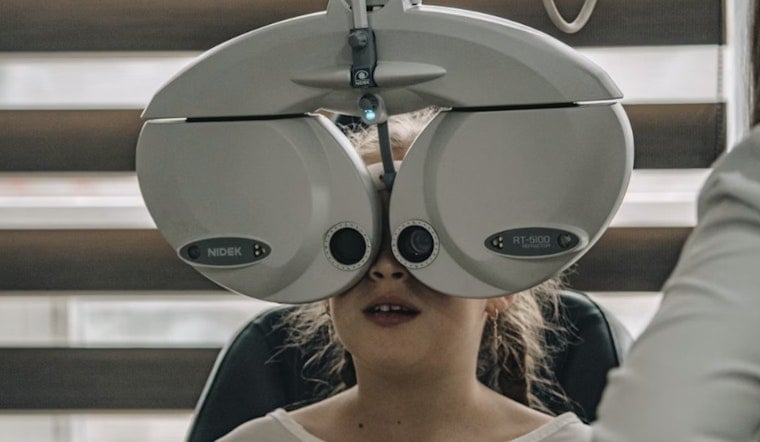
A new mobile clinic rolled onto the campus of Versa Reece Academy in Aldine ISD on Tuesday, bringing free eye exams directly to preschoolers instead of waiting for them to be bused across town. The Houston Health Department calls it the Eye Believe Bus, and officials say it's designed to reach kids who typically fall through the cracks of the city's existing vision care system.
The bus expands on See to Succeed, a children's vision program that has provided comprehensive eye exams and free eyeglasses to more than 115,000 Greater Houston-area children since it began in 2011, according to Berkeley Eye Center. That program, launched by the Houston Health Foundation, works with more than 17 school districts across the Houston area and serves an average of 10,000 school-age students, per Community Impact. Until now, that meant busing children field-trip style to centralized clinics in the Heights, where teams handle 150 to 350 children a day and custom glasses aren't hand-delivered back to schools for four to eight weeks, according to Houston Health Department program documentation.
Robin Mansur, president and CEO of the Houston Health Foundation, said reaching younger children marks a turning point for the program. Mansur said expanding outreach for younger kids represents a major advancement for early intervention, and described the mission as giving every child a chance to flourish developmentally and academically by supporting health and access, per the same account from Community Impact.
Closing a Gap That Leaves Thousands Without Glasses
The need is substantial. Houston Health Department data shows that between 20,000 and 40,000 Houston-area students fail mandatory school vision screenings every year, yet roughly half never receive a follow-up professional eye exam or corrective eyewear. Texas law requires public and private schools to screen kids for vision and hearing problems in preschool at age 4, kindergarten, first, third, fifth and seventh grades, plus all first-time school entrants, under Chapter 36 of the Texas Health and Safety Code, according to La Feria Independent School District.
Officials say earlier detection of nearsightedness, a common concern for young children, can help prevent academic and personal struggles down the line. That's not just a talking point — a Houston Health Foundation evaluation found that among students treated through See to Succeed, 80% with previously failing grades improved, including 67% of those who'd failed math going on to pass, while 68% of chronically absent students improved their attendance and 69% with prior misconduct showed fewer behavior issues.
Why Reece Academy, and Why Now
The clinical team examined local preschool students on-site at Versa Reece Academy, a specialized Aldine ISD campus built around Head Start, Montessori and early childhood education programs, according to Aldine Independent School District. Natalie Andrus, principal of Reece Academy, said the launch will connect local children with essential care in their community and reduce accessibility obstacles, Community Impact reported.
The timing matters for a district under financial strain. Aldine ISD approved plans last year to close six elementary schools amid enrollment declines and budget pressures. Bringing vision services directly to campuses, rather than requiring districts to arrange transportation to central clinics, could ease some of that logistical burden even as schools navigate tighter resources.
Broader Stakes Behind a Simple Eye Exam
The push to catch vision problems early carries stakes well beyond the classroom. Houston Health Department program documentation cites national research indicating that up to 70% of juvenile offenders in the United States have undiagnosed vision problems, and that children who can't read proficiently by third grade face significantly higher risks of dropping out or later incarceration.
The program's coalition includes the University of Houston College of Optometry, Essilor Vision Foundation, Berkeley Eye Center, San Jacinto College's Eye Technology Program, and Walmart, according to Berkeley Eye Center. Corporate philanthropy has also played a role: Aramco Americas has provided a dedicated $100,000 donation to fund optometry exams, frames and specialized medical referrals, as reported by Click2Houston.
According to a news release cited by Community Impact, the Eye Believe Bus is expected to increase the program's overall capacity by at least 20%, with officials describing it as a way to bring vision services to communities such as rural areas that have struggled to access the existing clinic-based model. Questions remain about how the mobile unit will sustain funding over the long term and how equipped its traveling clinical teams will be to manage more complex pediatric eye conditions beyond routine prescriptions, issues the dossier behind the program's expansion does not yet resolve.




