

























































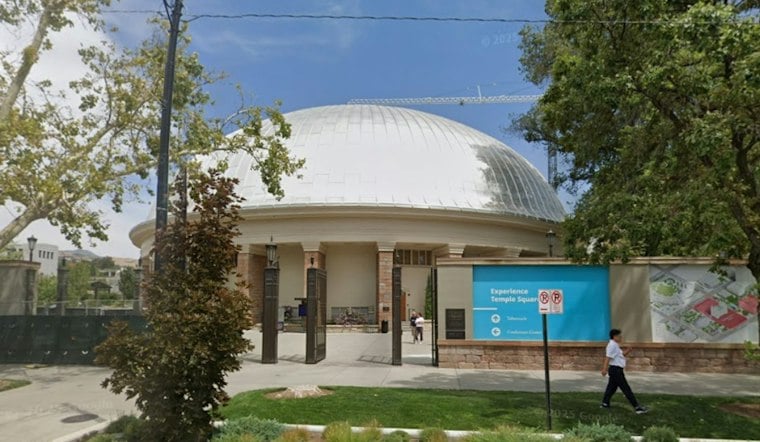
For four months in 2025, the famed pipe organ inside Salt Lake City's Tabernacle underwent work while technicians took apart pieces of the instrument. Daily recitals didn't stop, they simply moved down the block, and by the end of summer the organ was back home with restored string voices that had not been heard in half a century.
From May through August 2025, the Tabernacle's daily organ recitals relocated entirely to the nearby Conference Center while crews removed pipes and other components for the overhaul, according to the Church of Jesus Christ of Latter-day Saints. By the time the work wrapped, more than 75,000 individual organ pieces will have been assessed and either replaced or refurbished, the church says. Technicians pulled fifteen large reservoirs for refurbishment and leather replacement, and removed roughly a quarter of the organ's 11,623 pipes just to reach the components that needed repair.
Sounds Silenced Since the 1970s Return
Among the more striking parts of the project: two sets of pipes that had been removed in the 1970s were reintroduced, restoring string voices that had gone quiet for decades. Church historic sites curator Emily Utt said the work would let audiences hear tones missing for a generation. “Visitors to this organ will hear sounds that have not been heard for 50 years,” Utt said, per the church's account. By the end of August, refurbished components were placed back into the organ so recitals and the weekly Music & the Spoken Word broadcast could resume at the Tabernacle itself.
The instrument being worked on traces its roots to the late 1860s, when it was built by Joseph Ridges, and it has been reshaped roughly every two decades since, per the same church account. It has grown enormously over that span — from about 700 pipes in 1867 to the 11,623 pipes across 206 ranks that fill the building today, according to Deseret News. Roughly 130 pioneer-era pipes from that original 1867 build are still housed in the building, the outlet reports.
A Building Meant to Carry Sound Without Amplification
The Tabernacle itself, dedicated in 1875 and located on Temple Square, was designed to help audiences hear speakers and music long before microphones and modern sound systems existed, according to KSL.com. Its rounded roof over an oval footprint isn't just architectural flourish — the building's favorable acoustics stem from that large, elliptical dome, which reflects and distributes sound across the structure, Deseret News notes. The Tabernacle is often called the 361st member of the Tabernacle Choir at Temple Square for exactly that reason, KSL reports.
The structure that stands today replaced an earlier, open-air bowery that Brigham Young invited church members to help build in July 1847, according to KSL's reporting. That first bowery gave way to a permanent building in 1857, which itself was later used as something of a test structure — Utt has said the old tabernacle let builders practice construction techniques with the materials available before tackling the more ambitious project. The current Tabernacle, proposed in the 1860s with seating for 10,000, held its first meeting in 1867, per KSL, and once the new building stood complete, the old tabernacle was demolished, later replaced on that spot by the Salt Lake Assembly Hall.
Sandstone Pillars and Pine Painted Like Marble
Much of what visitors see today is remarkably close to what pioneer-era craftsmen built. Sandstone from Red Butte Canyon and interior wood from City Creek Canyon went into the original construction, KSL reports, and the benches, rear gallery and interior columns were all built from pine — with the columns painted to resemble red marble. Utt has said pioneers drew on skills they already had when they built the Tabernacle, calling it a testament to craftsmanship and to individual builders' desire to create something beautiful.
That old-world handiwork sits alongside quieter modern upgrades. A modernization project completed in 2005 was aimed primarily at seismic stabilization, threading steel beams inside the sandstone pillars and securing the roof to those pillars, according to KSL. Elsewhere, that broader push toward modernization included an overall seismic upgrade along with replacement of electrical and audiovisual systems and an overhaul of the mechanical system, per FFKR Architects, whose account also notes the Tabernacle was originally built in 1867. Crucially, renovation teams were instructed not to alter the building's essential structure, including its dome and acoustic features, according to PLSN.
Sean McFarland, chief engineer of broadcasting for the Church of Jesus Christ of Latter-day Saints, has said that pioneer handiwork was preserved through it all, and KSL reports the building remains almost 95% original to the 1800s. The original hand-smoothed ceiling design was retained during renovations, and the ceiling struts still carry original rawhide strips, per KSL's account.
Decades-Old Wiring Meets Decades-Old Pipework
Not every fix is glamorous. Organ control panels installed in the 1940s are now being upgraded to modern standards, KSL reports, and some pipes reportedly haven't worked since 1948 — part of why, by some accounts, the organ hasn't played at its full robust capacity for 60 to 70 years. The organ has kept playing anyway, even with failed connections, according to KSL. Metal pipes expand and contract with outside temperature and humidity, meaning organ tuners are constantly adjusting components just to keep the instrument in tune.
That kind of upkeep is expected to continue well beyond the 2025 project. Organ technician Joseph Nielsen is expected to keep inspecting and repairing pipes for years to come, the church notes, because gravity, dust, use and time never really stop working on an instrument this size. An earlier restoration effort, detailed by Church News, saw the organ largely disassembled, cleaned, repaired and kept out of service for two years, with 70 ranks — about 4,200 pipes — removed and all 11,623 pipes washed.
A Recital Tradition Dating to the 1800s
The daily recitals that briefly relocated during the 2025 work trace back to the late 1860s and became a daily fixture by 1911, according to Deseret News, and they continue today on a Monday-through-Saturday noon schedule with a 2 p.m. Sunday recital. Even the COVID-19 pandemic couldn't fully silence them — recitals paused briefly at the outset before resuming via livestream, the outlet reports. Guest organists are regularly invited to play the instrument, and the Tabernacle co-hosts an annual organ festival with the Cathedral of the Madeleine, per KSL.
The Tabernacle Choir at Temple Square, which performs in the building and dates back to August 1847, now includes 360 singers, according to KSL. Missionaries perform a daily acoustics demonstration for the thousands of visitors who pass through Temple Square, showcasing the very qualities that made the building famous in the first place. Utt has described caring for the Tabernacle as a labor of love, saying she wants the building to remain standing for the next 100 years.


