

























































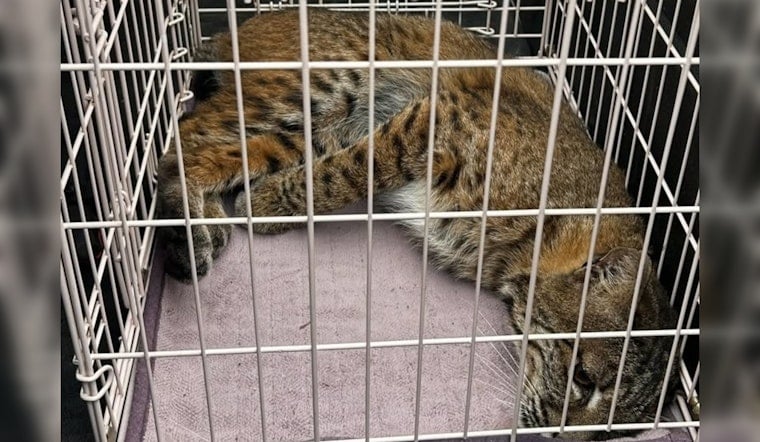
A Kirkland resident heard loud banging inside their Moss Bay home and dialed 911, fearing a burglar had broken in. When officers arrived, they instead found a bobcat perched at the top of a staircase, having apparently climbed a tree and slipped through an open window.
Kirkland Police said officers safely removed the bobcat from the home, corralling the wild cat into an isolated room before Washington Department of Fish and Wildlife staff arrived to help finish the job, according to KOMO News. Police believe the bobcat may have been drawn inside by the resident's own cat, which was found unharmed. Neither the resident nor responding officers were injured, and the bobcat itself was not hurt during the encounter.
To manage the situation without putting anyone — human or animal — at risk, officers deployed an unmanned aircraft to monitor the bobcat's movements inside the home. The drone allowed officers to keep a safe distance while guiding their response as the animal was cornered and contained. The bobcat was ultimately sedated before being released near Forbes Creek.
Kirkland's Drone Program Built for Exactly This Kind of Call
The department's ability to send a camera-equipped aircraft into a home rather than an officer traces back to a trial program the City of Kirkland launched in April 2023. That Unmanned Aircraft Systems program includes two operational drones and 15 FAA-licensed pilots dedicated to emergency response, life safety, and incident management, according to the City of Kirkland. The tool has already proven useful in more dire circumstances: this past January, Kirkland Police and regional emergency responders used a drone with thermal imaging to locate a missing woman alive in steep, wooded terrain near Woodinville after residents reported hearing faint cries for help.
Moss Bay, where the bobcat encounter unfolded, is Kirkland's downtown waterfront neighborhood along Lake Washington. It's widely considered the city's most walkable district, home to roughly 4,300 residents packed among a dense mix of retail, dining, and multi-family buildings, per Walk Score data. That urban density is precisely what made a wild predator turning up inside a residence so jarring for the neighborhood.
How a Wild Cat Ends Up Downtown
Despite its walkable, built-up character, Moss Bay sits close to natural corridors that funnel wildlife toward the lake. Forbes Creek runs 2.5 miles across Kirkland into Juanita Bay, anchoring a 6.6-square-mile watershed containing more than 120 wetland areas that function as urban wildlife corridors for native mammals, birds, and amphibians, according to a Wikipedia entry on the waterway. Those wetlands connect undeveloped habitat directly to residential streets, giving animals like bobcats a path into neighborhoods that otherwise look nothing like wilderness.
Adult male bobcats typically maintain home ranges of 2.5 to 6 square miles, often using greenbelts and stream corridors to move through suburban areas largely unnoticed, according to wildlife biologist data cited by the City of Mercer Island. That mobility helps explain how a bobcat could travel from Forbes Creek's wetlands into the middle of one of Kirkland's busiest residential districts without being spotted along the way.
The timing of the resident's 911 call also reflects a neighborhood already on alert. Just days earlier, on August 26, Kirkland Police ProAct detectives recovered more than $30,000 in stolen property and arrested two suspects following a multi-city investigation into residential and vehicle burglaries across King County, the city said. With break-ins fresh in residents' minds, banging noises inside a home understandably read as a home invasion rather than an animal encounter.
What to Do if a Bobcat Gets Inside
Kirkland Police say anyone who finds a bobcat inside their home should call 911, then move themselves and any pets away from the area rather than attempting to handle the situation directly. The Washington Department of Fish and Wildlife recommends giving bobcats plenty of space and never approaching or feeding them.
The agency also advises residents in wildlife-adjacent areas to keep pets indoors, especially between dusk and dawn, and to secure small livestock and poultry, guidance the Mercer Island wildlife page echoes for coops and outdoor pet food that can attract wild carnivores. State law also gives property owners some room to act on their own: under Washington Administrative Code and RCW 77.36.030, property owners, their immediate family, or tenants are legally permitted to trap or kill wild animals causing property damage or posing an imminent safety risk, though carcasses of game animals remain state property.
Bobcats are classified as small game animals in Washington, with a statewide hunting season running from September 1 through March 15, though hound hunting and night hunting with artificial lights are prohibited during fall deer and elk seasons, per WDFW eRegulations. Since 2024, the department has also required hunters and trappers to submit the entire lower jaw of harvested bobcats during pelt sealing so biologists can extract canine teeth for population age monitoring, according to the Daily Chronicle. For this particular bobcat, though, the outcome was simpler: a trip back to the wetlands near Forbes Creek, far from Moss Bay's staircases and startled homeowners.





