

























































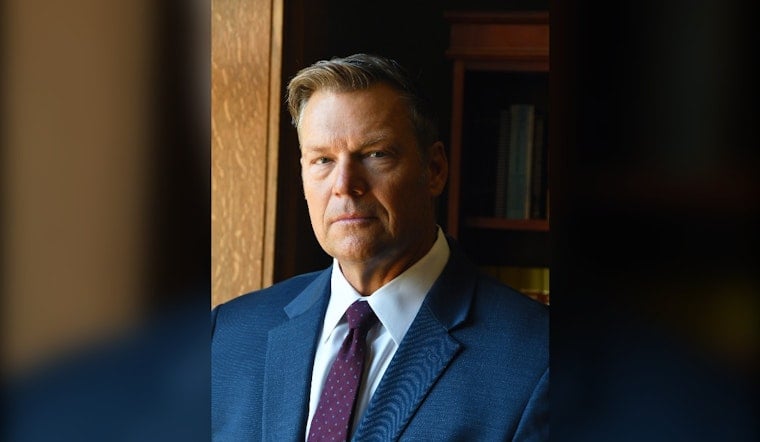
Kansas Attorney General Kris Kobach told a House Judiciary subcommittee that the U.S. Supreme Court's ruling upholding birthright citizenship is “weakly reasoned” and unlikely to survive, pitching lawmakers on legislation that would narrow who automatically becomes a citizen at birth. Kobach testified before the subcommittee, arguing the modern interpretation of birthright citizenship stretches well beyond what the authors of the Fourteenth Amendment intended.
The hearing, reported by the Kansas City Star, came after the Supreme Court ruled 5-4 in June that President Donald Trump's executive order seeking to end automatic birthright citizenship was unlawful, according to the Star's account. Chief Justice John Roberts wrote that the Fourteenth Amendment's text and English common-law principles support citizenship for children of undocumented immigrants and visitors, the Star reported. Kobach told the panel he does not believe the ruling will stand the test of time, saying it improperly relies on the concept of attachment to “the lord of the soil” and ignores normal methods of determining constitutional original intent.
According to Oyez, the case, decided June 30, 2026 in a 5-4 opinion authored by Roberts, held that Trump's executive order violated the Fourteenth Amendment's Citizenship Clause and reaffirmed automatic birthright citizenship under the common-law principle of jus soli. Justice Brett Kavanaugh authored a concurring opinion agreeing to invalidate the order on narrower statutory grounds under 8 U.S.C. § 1401(a), suggesting Congress might have authority to legislate limited immigration exceptions without violating the Constitution. Per the Star's reporting, Kobach said a birth-tourism statute would likely gain support from Kavanaugh and either Roberts or Justice Amy Coney Barrett.
A Long History Behind the Amendment
The Fourteenth Amendment, ratified in 1868, guaranteed birthright citizenship for formerly enslaved Black people, their children, and others born in the United States, the Star noted, and Congress passed the first federal legislation distinguishing legal and illegal immigration in 1882. The modern legal foundation for constitutional birthright citizenship traces to the 1898 Supreme Court decision in United States v. Wong Kim Ark, which held 6-2 that a child born in San Francisco to Chinese immigrant parents acquired U.S. citizenship at birth under the amendment. Wong Kim Ark held that the Fourteenth Amendment protects birthright citizenship. Kobach argued the United States is an outlier in the world on birthright citizenship, per the Star. According to the U.S. Census Bureau, net international migration accounted for 84% of the nation's 3.3 million population increase between 2023 and 2024, rising by 2.8 million people.
Wayne State University law professor Jonathan Weinberg pushed back on that framing during the hearing, saying the Constitution unambiguously guarantees citizenship to children born in the United States regardless of their parents' status, according to the Star. Weinberg warned that restrictive citizenship standards can leave people alienated from the countries where they were born and live, and argued the United States should not create a hereditary class of noncitizens. Rep. Jamie Raskin criticized critics of birthright citizenship for what he called constitutional amnesia, the Star reported, while Rep. Mary Gay Scanlon condemned the broader push to erode birthright citizenship as, in her words, a plot to turn the United States into a white nationalist ethnostate.
Trump's Executive Orders Face Court Challenges
President Trump signed two executive orders aimed at narrowing the definition of citizenship, according to the Star's reporting. The first covered cases where neither parent is a citizen and either parent is a foreign government employee or committed fraud to obtain citizenship, directing federal agencies not to issue citizenship documents in those specified cases. The second directed the State Department and Department of Homeland Security to prevent people from traveling to the United States for the express purpose of giving birth — the practice known as birth tourism.
Both new orders face legal challenges, the Star reported. Separately, the White House issued Executive Order 14418 on August 6, 2026, attempting to narrow citizenship document issuance for children of foreign government employees or alien enemies, per the White House's own record of the order. Hoodline previously reported on Trump's birth-tourism orders and on the resulting enforcement wave that saw hundreds of visas revoked by a federal task force.
Not every conservative witness at the hearing agreed with Kobach's approach. Ken Cuccinelli was also associated with the hearing.
A Rematch With Chris Mann Looms
Kobach will face Democratic attorney general nominee Chris Mann in a rematch two months after his congressional subcommittee appearance. The two candidates last met in 2022, when Kobach defeated Mann by less than one percentage point, 50.8% to 49.1%. Heading into their rematch, Mann had raised about $1.3 million as of late July.
Michael Smith said Kobach's hostility toward immigrants has defined his career in Kansas politics, the Star reported. That career includes a 2018 case in which a federal judge struck down a Kansas law Kobach championed requiring voters to prove U.S. citizenship to register. The judge ordered Kobach to complete a remedial legal-education course; the ruling was affirmed by the Tenth Circuit in 2020 before Kansas settled the plaintiffs' legal fees for $1.425 million in 2021, according to the ACLU of Kansas. Kobach has also alleged, without evidence, that undocumented immigrants vote in U.S. elections, the Star noted.
Kobach's national profile on immigration and voting issues dates back further. Donald Trump appointed him to lead a commission investigating voter fraud during Trump's first term; the commission was disbanded in 2018 without producing evidence of widespread fraud, per the Star. Kobach also did not defend a Kansas law allowing some immigrants without legal status to receive in-state tuition after the Department of Justice sued the state over the 2004 statute, instead filing a joint motion siding with the DOJ that the law is invalid. He has advocated concerns about undocumented immigrants since the early 2000s, the Star reported.
The birthright citizenship fight is playing out alongside other Kobach legal offensives closer to home. In July, he issued formal demand letters as attorney general giving three Kansas municipalities — Lawrence, Roeland Park and Prairie Village — 60 days to repeal local conversion therapy bans, as Hoodline first reported. With the House subcommittee hearing behind him and the fundraising gap against Mann still wide, Kobach's push on birthright citizenship now stands as one of the highest-profile planks of his campaign message heading into November.





