

























































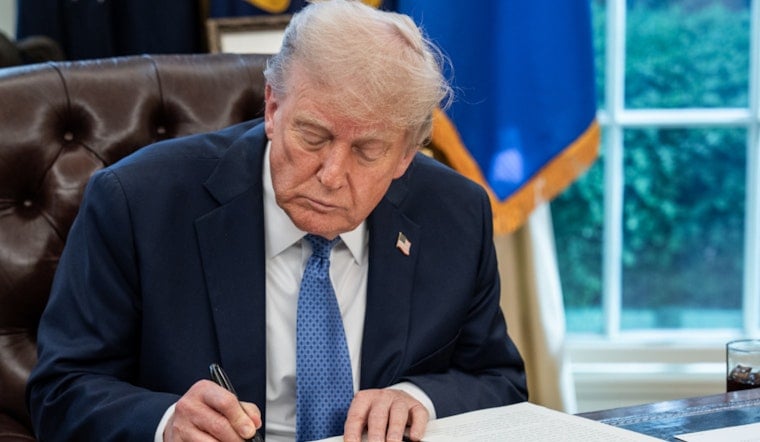
President Donald Trump plans to sign two executive orders Thursday aimed at denying U.S. citizenship to children born in the country because of commercial birth tourism, according to Axios. A separate order would seek to deny birthright citizenship for children born to some foreign diplomatic staff in the United States, per the same Axios report. The signings are scheduled for an event at the Oval Office.
The White House released an official schedule placing the signing-time event about 55 minutes earlier than 3:55 p.m., though as of that time Thursday, the event had not yet begun, according to Reuters. The push comes as the United States recorded 3.6 million births in 2025, though official figures do not establish the cost to taxpayers of birth tourism, nor do they tally the number of foreigners who come to the country explicitly to give birth and secure citizenship for their children. Per Axios, Trump may also seek to deny birthright citizenship for children born in U.S. territories at some point in the future.
A Legal Gray Area, Not an Outright Ban
U.S. law does not outright bar birth tourism itself, but a federal regulation implemented during Trump's first term prohibits using temporary tourist and business visas primarily to obtain U.S. citizenship for a newborn. That rule, put in place in 2020, amended 22 C.F.R. § 41.31 to let consular officers refuse B-1/B-2 visitor visas when there is a rebuttable presumption that the applicant's main purpose is giving birth in the U.S. to secure citizenship, according to the State Department. People engaging in birth tourism schemes could still be prosecuted for fraud or other related crimes.
The scale of the practice has been hard to pin down. The Center for Immigration Studies estimated that 20,000 to 25,000 mothers came to the United States for birth tourism during a year-long period between 2016 and 2017, per that group's analysis. Hoodline previously reported that U.S. Immigration and Customs Enforcement's Homeland Security Investigations component launched a nationwide Birth Tourism Initiative in early 2026, directing agents to target organized facilitation networks, financial crimes, and visa fraud connected to maternity travel.
Constitutional Precedent Looms Over Executive Action
Any attempt to alter automatic citizenship at birth through executive order runs into settled constitutional doctrine. The U.S. Supreme Court held in the 1898 case United States v. Wong Kim Ark that the 14th Amendment guarantees citizenship to children born on U.S. soil to foreign parents, carving out narrow exceptions only for children of accredited foreign diplomats and hostile occupying forces. Under existing federal regulation at 8 C.F.R. § 101.3, children born in the U.S. to accredited foreign diplomatic officers are not considered subject to U.S. jurisdiction and do not automatically acquire citizenship, though the Department of Homeland Security permits them to voluntarily register for lawful permanent resident status effective from birth.
Trump's first-term successor attempt at reshaping birthright citizenship, Executive Order 14160, signed in January 2025 and titled Protecting the Meaning and Value of American Citizenship, sought to deny automatic citizenship to children born to undocumented immigrants or temporary visa holders. Federal district courts subsequently issued preliminary injunctions blocking its implementation, leaving that fight unresolved as this new pair of orders moves forward.
Territories Present Their Own Complications
Trump's reported interest in eventually targeting birthright citizenship for children born in U.S. territories, as flagged by Axios, would run into its own thicket of legal distinctions. Individuals born in American Samoa are already classified under 8 U.S.C. § 1408 as noncitizen U.S. nationals rather than citizens at birth, a status the 10th Circuit Court of Appeals affirmed in Fitisemanu v. United States in 2021 after the American Samoan government itself argued against mandatory birthright citizenship in order to preserve traditional land-ownership structures. American Samoa remains the sole U.S. territory where birthright citizenship is not automatically extended.
Part of a Broader Pattern in Washington and Texas
Thursday's orders continue a pattern of administration and congressional activity aimed at narrowing birthright citizenship this year. Representative Greg Steube introduced the Birthright CLAIM Act on July 14, proposed legislation that would amend the Immigration and Nationality Act to deny birthright citizenship unless at least one parent is a U.S. citizen or lawful permanent resident, as Hoodline reported in its piece on Steube's citizenship bill. Days later, a similar measure emerged from Texas Representative Brandon Gill.
State-level enforcement has also intensified. Texas officials launched administrative inquiries in July into healthcare facilities, including a hospital in Mission, after investigators flagged foreign-language marketing materials offering bundled maternity delivery packages to international visitors, according to Hoodline's earlier coverage of the Mission hospital case. That followed a similar action in Houston earlier in the spring.
Research Points to Long-Term Consequences
A May 2025 study by the Migration Policy Institute projected that fully repealing automatic birthright citizenship would increase the U.S. unauthorized population by 1.3 million by 2045, even under a scenario with complete border enforcement and heightened deportations. Researchers warned the change could create a multi-generational noncitizen class born on U.S. soil. Public opinion has not shifted decisively in favor of restricting the guarantee: a 2026 Reuters/Ipsos joint survey found that 55% of Americans support maintaining the constitutional guarantee of birthright citizenship for all persons born in the United States, per the polling group YIP.
The Reuters article on Thursday's planned signings was reported by Kristina Cooke, Ryan Patrick Jones and Ismail Shakil.





_(cropped).jpg)