

























































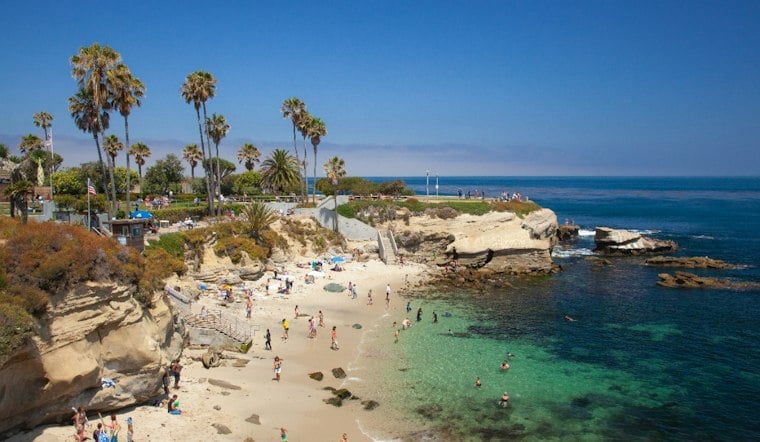
The La Jolla Cove Swim was canceled two days before its scheduled September 13 race after high tides and beach erosion left organizers without a safe area for swimmers to gather. FOX 5 San Diego reported that waves were reaching the cliffs and the beach disappeared when the tide came in.
More than 1,100 swimmers had signed up, according to the same report, but organizers concluded that the conditions could not safely accommodate a crowded staging area and lifeguard operations. Race director Aaron Brennan said the decision was made to prioritize swimmer safety; organizers now plan to look ahead to the next race rather than attempt a last-minute relocation.
A small beach with limited room to adapt
The physical setting helps explain why a temporary workaround was difficult. City shoreline records describe La Jolla Cove as a heavily used pocket beach of about 0.4 acres, reached by concrete stairways and bordered by important visual and historical resources. The city's shoreline inventory identifies the Cove as the site of the La Jolla Roughwater Swim.
A California Coastal Commission staff report likewise describes the pocket beach and its two public stairways as the main route to the water and shore recreation. That configuration does not establish why every alternative was unavailable, but it shows why losing the usable sand area can have an outsized effect on a large event.
The conditions fit a documented coastal hazard pattern, but the local trend is not quantified here
The immediate combination of surf and tide is consistent with the mechanism described in a City of San Diego coastal-erosion assessment: large waves combined with high tides and other short-term water-level factors can produce rapid retreat along vulnerable coastlines. The city's vulnerability planning also identifies sea-level rise, storm surge and coastal erosion as risks requiring attention.
That broader planning record does not prove that long-term climate change caused this particular cancellation, and the available sources do not quantify how much sand La Jolla Cove lost during this episode. SANDAG's shoreline-monitoring program notes that beaches generally are widest in summer and narrowest in winter, making seasonal variation an important distinction when interpreting a single high-tide event.
A long-running race facing a changing venue
The swim traces its history to 1916, when it was known as the La Jolla Rough Water Race. Openwaterpedia's historical account says the event later became an annual tradition and records earlier interruptions, including a 1935 cancellation. FOX 5 also reported previous cancellations linked to World War II, a shark scare and bacteria in the water. The current cancellation is distinctive because the stated obstacle is the loss of a safe beach staging area during high tide.
The site is also governed by competing public goals. The city's adopted La Jolla plan calls for preserving beaches, bluffs and environmentally sensitive resources while enhancing public access. Those policies mean that expanding or hardening the staging area cannot be treated as a simple logistical fix.
Not an isolated infrastructure concern
Other coastal sites illustrate the same vulnerability without serving as direct proof of conditions at La Jolla Cove. In a separate matter, the California Coastal Commission said facilities at Cardiff State Beach were particularly susceptible to storm damage because of their exposure to both the shoreline and the mouth of the San Elijo Lagoon. The comparison is limited: Cardiff involves park facilities and a lagoon mouth, while La Jolla's immediate problem was safe race staging on a small pocket beach.
Any future substitute involving city lifeguards or other municipal services would also face administrative constraints. San Diego's special-events rules require a permit application for events involving services such as lifeguards, Fire-Rescue or street closures, making an immediate replacement venue more complicated than simply moving a start line.
For this year's participants, FOX 5 reported that registration fees could be rolled over to the next race or donated to the Prevent Drowning Foundation of San Diego County. The organizers' longer-term question is more basic: whether the Cove will reliably provide enough safe, accessible sand for a large swim event when high tides and heavy surf coincide.




