

























































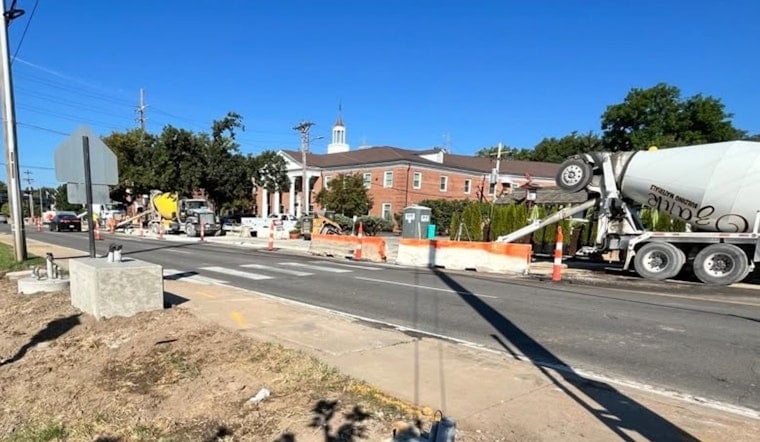
Drivers navigating the four-lane stretch of Clayton Road near Dwyer Place have likely noticed the orange cones and construction crews camped outside Sportsman's Park Restaurant & Bar in recent weeks. It's the visible sign of a new pedestrian-activated HAWK signal going in at 9901 Clayton Road, designed to give walkers a safer, controlled way to cross a road that has long lacked one.
According to the City of Ladue, construction on the signal began on August 26 and is expected to wrap up this fall. Once activated, the beacon will alert motorists and stop traffic safely, giving pedestrians a dedicated window to cross in front of the restaurant, a stretch of road that sees steady commercial foot traffic throughout the day.
The project traces back further than this summer's construction fencing. Ladue's Public Works department awarded the construction contract to Gerstner Electric, Inc. for $188,633.20 through Resolution 2026-07, approved by the City Council on March 23. Gerstner Electric was the lowest of three bidders when proposals were opened on March 17, and the award came in above the project's original $137,000 budget line from the city's Road & Bridge Fund.
Why the Project Cost More Than Planned
City documents show the overrun stemmed from custom aesthetic requirements, including a decorative finial designed to match the pedestrian signals already installed nearby. Consultant estimates updated in February had pegged the total project cost at $198,000, still short of the final contract figure. Rather than delaying the work, the city covered the gap using roughly $200,000 in savings identified in its microsurfacing budget, allowing construction to proceed on schedule.
The idea for a beacon at this particular spot didn't originate this year. It grew out of a 2022 business district pedestrian walkability audit conducted by engineering firm CBB, which evaluated safety at unprotected crosswalks along the Clayton Road commercial corridor. That audit fed into a broader push: Ladue's City Council adopted an updated citywide Walk Plan in April 2023 following a study by engineering firm Horner & Shifrin, formally setting the policy direction for pedestrian infrastructure and trail connectivity across the city.
A Future Link to Deer Creek Preserve
The Clayton Road crossing isn't meant to stand alone. City planning documents describe the new signal as designed to eventually connect with a shared-use path planned for 2027 along South 40 Drive, which would link the Deer Creek Preserve trail directly to the Clayton Road business district. Horner & Shifrin, the same firm behind the 2023 Walk Plan, was awarded the design contract for that South 40 Drive path in October 2024.
Pedestrian infrastructure isn't the only thing tearing up this stretch of Clayton Road right now. The concurrent sewer work underway is part of the Metropolitan St. Louis Sewer District's multi-billion-dollar Project Clear initiative, which is replacing aging infrastructure and reducing wastewater overflows across St. Louis County. That timing explains why both utility crews and signal contractors have been working the same corridor simultaneously.
The walkability push has continued to expand even after the HAWK signal broke ground. In July, the City of Ladue solicited bids for its ADA Phase 6 Sidewalks Improvements project along Clayton Road, a further upgrade to pedestrian accessibility in the corridor. Bid openings for that sidewalk project closed on August 11.
How the New Signal Will Actually Work
For drivers unfamiliar with the technology, a HAWK signal, formally known as a Pedestrian Hybrid Beacon, behaves differently from a standard traffic light. Per the Federal Highway Administration, the beacon stays dark until a pedestrian activates it, then cycles through flashing yellow, solid yellow, and solid red to bring vehicles to a full stop, before switching to a flashing red phase that allows drivers to proceed once the crosswalk is clear.
Federal research backs up the push for this kind of technology. FHWA studies analyzing 21 HAWK installation sites against 102 unsignalized intersections found that the beacons reduce pedestrian-involved crashes by up to 69% and cut overall crash rates by 29% compared to crossings without any signal at all.
The location outside Sportsman's Park adds a layer of local familiarity to the project. The restaurant has operated at that address since 1974, when it opened as Jackie's Place under Pro Football Hall of Famer Jackie Smith and businessman Norman Probstein, according to St. Louis Restaurant Review. The spot celebrated its 50th anniversary in 2024, making it one of the longest-running landmarks along this section of Clayton Road.
Once finished this fall, the beacon will give pedestrians the ability to activate the signal whenever they need to cross, closing a gap identified years earlier by the city's own walkability studies. For now, the construction fencing and utility work remain part of daily life along Clayton Road, but city officials frame the disruption as a temporary trade-off for a safer, more walkable corridor.




