

























































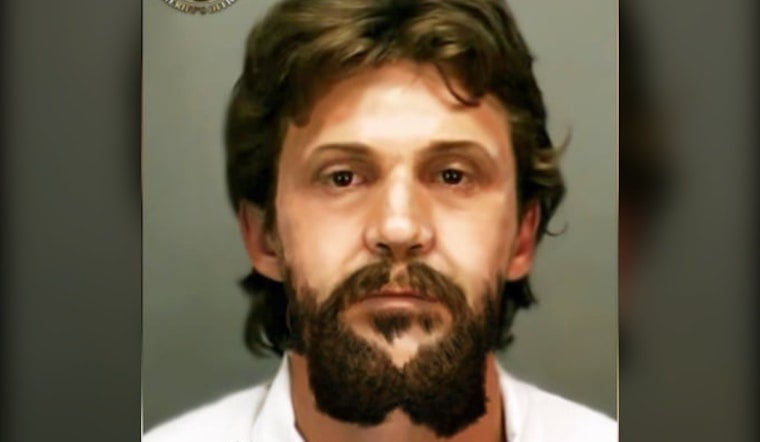
For nearly 43 years, he was just an unidentified man pulled from a waterway in the 2400 block of 10th Avenue North in unincorporated Lake Worth — a case with no name, no family, and no answers. Now investigators say that man was Archie Patterson Jr., born August 15, 1940, and roughly 43 years old when he died. An autopsy on November 25, 1983, determined his cause of death was accidental drowning, and the case is now officially closed.
According to WPTV, Palm Beach County Sheriff's Office detectives had investigated the case for decades without a breakthrough. At the time of his death, investigators estimated the unidentified man was between 25 and 35 years old and about 5 feet 8 inches tall, with brown hair and a reddish-brown beard and mustache. Medical examiner records described him as wearing blue trousers, a black leather belt, and black leather loafers when his body was recovered, according to a thread on Websleuths.
In November 2012, PBSO's forensic imaging unit created a facial reconstruction of the man and released it to the public in hopes someone would recognize him. Since no photograph of him existed, the department relied on the rendering instead. Those public recognition efforts went nowhere, and the case sat cold for another decade-plus before technology caught up with it.
DNA Testing Reopens a Decades-Old Mystery
The case was assigned to PBSO's Forensic Biology, Genetic Genealogy Unit in April 2026, and the following month the PBSO Cold Case Unit partnered with Othram, a forensic genomics company, in a forensic genetic genealogy investigation. Forensic genetic genealogy testing used the unidentified man's DNA profile, funded by a PBSO forensic genetic testing grant awarded by the State of Florida. Othram provided preliminary genetic genealogy findings to the PBSO Forensic Biology Unit and additional investigative leads identifying potential relatives of the unknown man.
Othram then performed subsequent kinship analysis. That work eventually pointed detectives toward someone believed to be Patterson's child, and in August, PBSO detectives traveled to California to interview that individual and obtain a DNA sample. The sample was compared with the unidentified man's DNA profile, and Othram and the PBSO Forensic Biology, Genetic Genealogy Unit positively identified the man as Archie Patterson Jr. His next of kin has since been notified of the identification, per WPTV's report, credited to author Aja Dorsainvil.
A Statewide Push to Clear the Backlog
Patterson's case is one of a growing number PBSO has cracked using the same DNA pipeline. In February, the agency and Othram announced the identification of Patricia Ann Ritchie, a Virginia woman whose skeletal remains had lain unidentified in unincorporated Boca Raton for 47 years — a case Hoodline covered when it broke. In January 2026, the same partnership identified William McKinnis, whose remains washed ashore on Lake Okeechobee in 2021, according to DNA Solves. And back in June 2023, PBSO and Othram solved a 47-year-old cold case by identifying Douglas Streeter of Ohio, whose skeletal remains had been discovered in a rural Palm Beach County cane field.
The sheriff's office is sitting on a cold-case backlog of roughly 360 unsolved homicides dating back to 1962. Much of the recent momentum traces back to funding: in October 2022, PBSO was awarded a $500,000 federal grant from the U.S. Department of Justice's Prosecuting Cold Cases Using DNA program to fund testing with private labs like Othram, according to Palm Beach County Board of County Commissioners records, and county commissioners later extended that grant's performance period through September 2026. The Florida Legislature also allocated $500,000 in a Fiscal Year 2023-2024 local funding initiative for multi-county forensic genetic genealogy testing across Palm Beach, Collier, Orange, and Hillsborough counties.
Florida's Backlog Runs Into the Thousands
The state's investment has since scaled up. In April 2026, Florida Attorney General James Uthmeier announced a $600,000 state partnership with Othram to deploy forensic genetic genealogy across Florida's backlog of more than 21,000 unsolved murder cases dating back to 1965, according to WUSF. State officials reported at the time that Florida maintains nearly 900 cases of unidentified human remains and approximately 2,500 unsolved missing persons cases alongside its open murder investigations.
Patterson's identification is now among more than 50 publicly announced cases in Florida where law enforcement agencies have resolved unidentified remains or missing person cases through Othram's forensic genetic genealogy pipeline. But as PBSO's own record shows, naming a body and solving a crime are not always the same task — Patterson's death was ruled accidental, closing his case, while other identifications from the same DNA pipeline remain open homicide investigations still searching for a suspect.



