

























































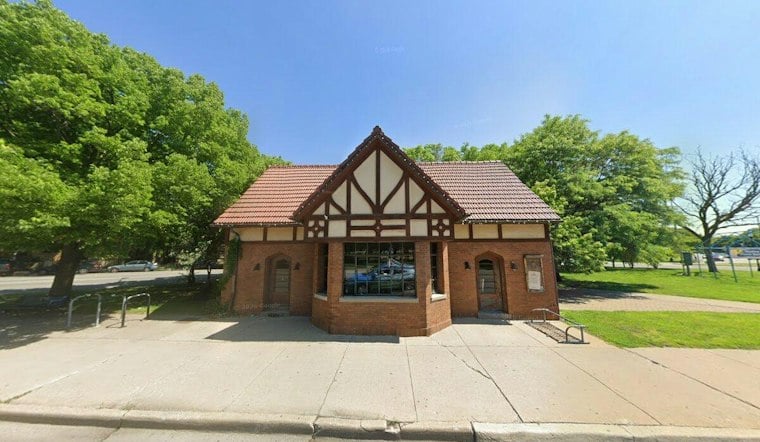
The Comfort Station, a nearly 100-year-old city-owned building at 2579 N. Milwaukee Ave. inside Logan Square Park, has closed ahead of a major renovation — its first significant overhaul since reopening to the public in 2010. As crews prepare to fence off the property, four people living in tents nearby must relocate at least a few feet away, and so far, neighbors have shown little pushback to the move.
The renovation, first reported by Block Club Chicago, includes exterior tuckpointing and painting, interior plumbing, electrical and lighting work, a new gender-neutral ADA restroom, new doors, and updates to water drainage and gas service. According to Block Club, the work will last through at least May and could stretch to the end of July, per Ald. Anthony Quezada. A construction fence will go up around the building and surrounding sidewalks this month.
A Century-Old Building With a Layered History
Built between 1926 and 1927 by the West Chicago Parks Commission, the Tudor Revival structure was one of nine identical comfort stations built along the city's boulevard system to give trolley passengers a place to warm up and use the restroom, according to the Comfort Station. Today only two of those original nine buildings survive — the Logan Square structure and a dormant twin in Columbus Park — as most were demolished by the mid-20th century, the Chicago Tribune reported.
Though it sits inside parkland, the building is actually owned by the City of Chicago and falls under the Chicago Department of Transportation rather than the Chicago Park District — a quirk that explains why CDOT, not park officials, is driving the current renovation. The building was once used to store landscaping equipment, per the Comfort Station's own account. Logan Square Preservation led a 2005 campaign to save the structure from demolition, securing Tax Increment Financing funds through then-Ald. Rey Colon that paid for tuckpointing, a new clay tile roof, and copper gutters before it reopened as a public arts space in 2010. Since 2016, it has been run by the nonprofit Comfort Station NFP in partnership with Logan Square Preservation, hosting up to 200 public events a year.
Tent Residents Relocate, Not Disappear
Two people in the tent cluster near the Comfort Station have already been matched to housing, Block Club reported. One unhoused woman is waiting to move into a new apartment and will move her tent just a few feet away in the meantime. David Bachman, who has lived in Logan Square for more than a year and has moved twice already in 2026, said he and others in the encampment are not fighting the relocation. Bachman, who creates sculptures from trash and alley finds, told Block Club he does not want to live in a shelter and is instead considering a rehabilitation program with Haymarket Center. He was evicted from a former Logan Square residence in 2018 and struggles with mental health issues and substance abuse, according to the outlet; he's now waiting to be matched with housing through the Department of Family and Support Services Homeless Services Division and plans to help other tent residents move their belongings.
Kitty Rauth, connected to the Comfort Station's programming, said outdoor events earlier this year saw no major issues with tent residents nearby, and expressed hope for reciprocity and respect between Logan Square residents and their unhoused neighbors. The Comfort Station has offered bathrooms and charging stations to people living outside and has maintained relationships with them over time, per Block Club's reporting.
A Pattern of Displacement Tied to Plaza Construction
This isn't the first move this year for people living near the square. Block Club reported that unhoused residents have relocated twice in 2026 as construction has crept across the area — including people displaced from the Milwaukee Avenue and Logan Boulevard lot, which is set to become another public plaza, who relocated to the Comfort Station area and other spots in the neighborhood. Some of those displaced were connected to housing, and one went to a city-run shelter. About 10 people were living in the square area earlier in the year; that number is now around five, and three people have been connected to housing since the start of summer, with two currently preparing to move into their own apartments.
The plaza work is part of a broader $27 million CDOT project reconfiguring Logan Square, merging the Illinois Centennial Monument traffic circle with the Comfort Station lawn into one continuous pedestrian plaza while rerouting Milwaukee Avenue traffic away from the center square, according to the Tribune. The Comfort Station sits within the Logan Square Boulevards District, landmarked by the city in 2005 to preserve the historic boulevards spanning Logan, Humboldt, and Kedzie, according to Logan Square Preservation.
How the City's Outreach Approach Shapes the Ground Rules
Under City Council Ordinance O2023-1011, city departments engaging with unhoused encampments must follow U.S. Interagency Council on Homelessness principles that emphasize voluntary service connections over forced displacement, with annual reporting required on encampment activity, according to the City of Chicago. Ald. Quezada's office works with CDOT and with Department of Family and Support Services outreach staff to connect vulnerable neighbors to housing, jobs, social services, and food assistance, per Block Club. DFSS provides outreach, shelter, public benefits, mental health treatment, substance use treatment, and housing resources, and does not forcibly remove individuals, the outlet reported. CDOT is in charge of the Logan Square plaza area itself.
Placements run through a coordinated entry system that matches people to housing based on individual vulnerability, prioritizing those facing the greatest risks. Quezada said more funding is needed for non-congregate shelters and permanent supportive housing, according to Block Club's reporting.
The Citywide Backdrop
The Logan Square situation unfolds against a citywide housing landscape marked by rising costs and limited affordable stock. Chicago's January 2025 Point-In-Time count identified 1,316 unsheltered individuals on city streets alongside 6,136 people in shelters, according to the Chicago Department of Family and Support Services; unsheltered counts fell from 2024 but remained above pre-2023 levels. Black residents made up 53% of Chicagoans experiencing homelessness in 2025 despite representing less than a third of the city's population, according to the UIC Voorhees Center, which gathered the data jointly with DFSS. Block Club also reported that the Trump administration is cutting funding for housing-first models, adding pressure to an already strained system.





