

























































Rhode Island Gov. Dan McKee is staring down a 38-point deficit in the polls just days before the Wednesday, Sept. 9, Democratic primary, with voter fury over the still-unfinished Washington Bridge threatening to make him the first sitting governor in the state to lose a primary in more than 30 years. His challenger, former CVS Health executive Helena Foulkes, has flooded the airwaves with campaign ads and outraised the incumbent, setting up a rematch of their tight 2022 contest that this time looks nothing like a toss-up.
An August survey of 446 likely Democratic primary voters conducted by the University of New Hampshire Survey Center found Foulkes leading McKee 56% to 18%, according to News From The States, a margin that carried a 4.6% margin of error. A separate UNH poll found that 80% of Rhode Island residents disapproved of McKee's job performance, an all-time high tied largely to low marks on infrastructure, roads, and cost of living, per the UNH Scholars Repository. The survey also found widespread disapproval of the governor's performance.
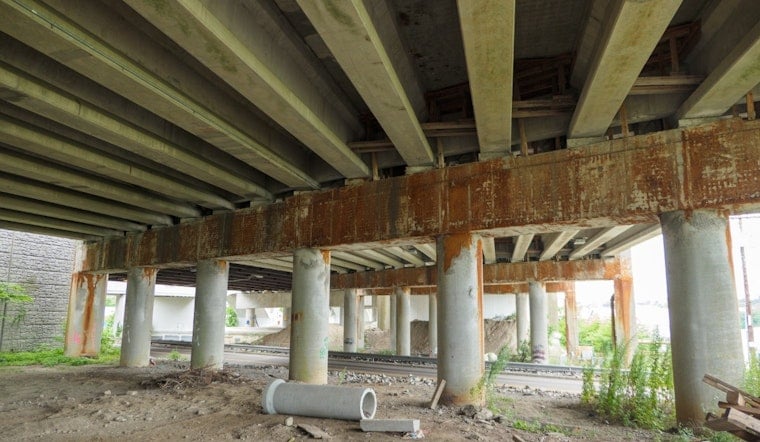
McKee, 75, closed the westbound side of the Washington Bridge in 2023 in Providence after state officials flagged a critical structural failure, according to reporting from Action News Jax. The bridge carries Interstate 195 over the Seekonk River between Providence and East Providence and serves as a key link to the south coast of Massachusetts and Cape Cod, with nearly 100,000 vehicles crossing it every day. Traffic has since been routed through a reconfigured eastbound side while the westbound span remains out of service.
A Repair Timeline That Kept Slipping
When repairs were first announced in 2023, officials said the work would take several months. Instead, costs have climbed from initial estimates and the project has dragged on for years, with McKee saying construction will be finished by 2028. The Rhode Island Department of Transportation signed a $427.9 million contract with Walsh Construction in June 2025 to rebuild the westbound span, targeting a lane reopening for November 3, 2028, according to project details posted by the department.
That timeline followed a rocky start: a July 2024 request for proposals to rebuild the bridge received zero bids from private contractors, as reported by ENR. Attorney General Peter Neronha and McKee had filed a Providence County Superior Court lawsuit that August against 13 design, construction, and inspection companies to recover public money spent addressing the bridge failure, alleging breach of contract and negligence. The U.S. Department of Transportation later stepped in with $221 million in federal infrastructure grants through the INFRA and MEGA programs, covering over half of the total build cost — a grant Hoodline covered when Duffy finalized the funding last year.
Foulkes Casts Herself as the Outsider
Foulkes, 62, spent 25 years at CVS, rising to president of its pharmacy division from 2014 to 2018 before becoming chief executive officer of Hudson's Bay Company, which she left in 2020. On the trail, she has argued that people feel state government works with a powerful few, and has said it is a great moment to be an outsider. She is drawing support even from Democrats in McKee's hometown of Cumberland.
McKee has pushed back hard, accusing Foulkes of being an out-of-touch corporate executive trying to buy her way into the election and saying she put profits ahead of people. He has also accused her of helping fuel the opioid crisis during her CVS tenure, pointing to the company's 2022 agreement to pay $5 billion to settle nationwide opioid lawsuits — a settlement in which CVS admitted no wrongdoing. Foulkes denies helping fuel the opioid crisis and notes that CVS reduced opioid dispersal by 40% while she led its pharmacy division. She has also warned that McKee's criticisms of CVS could drive companies out of Rhode Island, a point she made in Woonsocket, and business leaders from the state's 50 largest companies wrote a letter asking McKee to stop criticizing CVS.
Money, Endorsements and a Historic Stakes
The financial gap between the two campaigns has been stark. Foulkes raised $900,000 in the second quarter of 2026 compared with $253,000 for McKee over the same three-month period, according to News From The States, letting her dominate primary television advertising. McKee has countered with institutional support, picking up many labor endorsements, though neither the Rhode Island Democratic Party nor the Rhode Island AFL-CIO has endorsed a candidate in the race.
Adam Myers, a political scientist at Providence College, said bridge responsibility appears clear enough for people to place blame on state government. The comparison to the 2024 collapse of Baltimore's Francis Scott Key Bridge, after a container ship crashed into it and killed six construction workers, has circulated in coverage of the race — though that bridge's replacement is set to be completed in 2030, even further out than Rhode Island's 2028 target. It's a comparison worth noting once, without leaning on it as the story's center of gravity, since McKee's predicament is rooted in his own bridge's stalled timeline and cost overruns, not the Baltimore disaster itself.
McKee also faces pressure beyond the bridge. The clean-energy political action committee Invest in Tomorrow Coalition launched a $500,000 ad campaign this month opposing McKee over his attempts to delay renewable energy targets and cut energy-efficiency spending, according to Canary Media, citing his veto of building energy reporting legislation.
What History Says About Incumbents
The last sitting Rhode Island governor to lose a primary did so more than 30 years ago, according to the Brown Daily Herald. McKee now faces the possibility of becoming not just the first Rhode Island governor to lose a primary in more than 30 years, but the first U.S. governor to lose a primary since 2018.
The rematch echoes the 2022 primary, when McKee edged Foulkes by just 3,326 votes — roughly 3 percentage points — in a five-candidate field before winning the general election. This time, the state's Democratic primary on Wednesday, Sept. 9, will determine the heavy favorite heading into the general election, with polling suggesting Rhode Island voters are far less forgiving of the governor than they were four years ago.



