

























































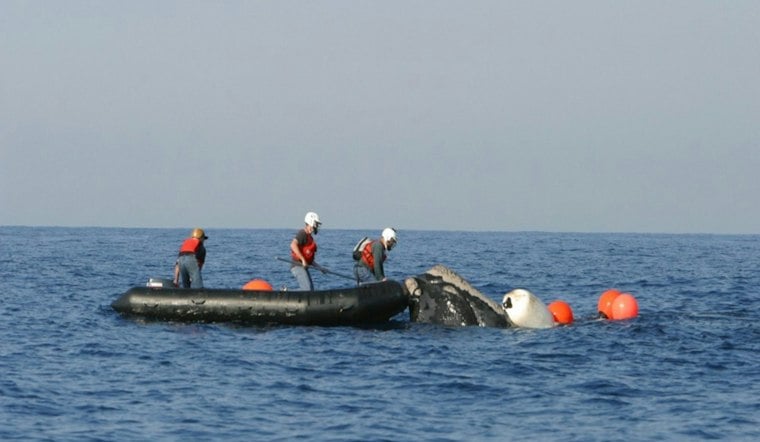
Responders freed most of the rope entanglement from a roughly 18-foot minke whale off Eastham after finding line wrapped around its body and running through its mouth, according to the Center for Coastal Studies. The whale resumed normal swimming after the operation, although the center said its prognosis remained poor.
What rescuers removed
The rope was wrapped around the whale several times, with buoys still attached. Because the line in its mouth would have prevented the whale from feeding, the Marine Animal Entanglement Response team used a hook-shaped knife mounted on a long pole to cut away most of the gear, the Center for Coastal Studies said.
A section of line was left in the whale’s flipper because it was deeply embedded in an injury. The center and NBC Boston reported that removing that portion could have caused excessive bleeding.
How the whale was located
The whale was reported entangled on Sunday in Cape Cod. A response team searched the following day without finding it, and an aerial survey later spotted the animal off Nauset Inlet in Eastham, according to the Center for Coastal Studies and NBC Boston.
Protection and reporting
The Marine Animal Entanglement Response program operates under a federal permit, and the Center for Coastal Studies says it has freed more than 200 large whales and other marine animals since the program was founded in 1984. The center’s program information says members of the public should report live or dead entangled marine animals rather than attempt a rescue themselves.
Federal measures to reduce entanglements
According to NOAA Fisheries, the Atlantic Large Whale Take Reduction Plan is required by the Marine Mammal Protection Act and is designed to reduce serious injuries and deaths caused by accidental entanglement in U.S. commercial trap/pot and gillnet fishing gear. NOAA Fisheries says the plan, developed in 1997, was also intended to benefit minke whales, which can be incidentally injured or killed in gillnet and trap/pot fisheries.
NOAA Fisheries says common minke whales in U.S. waters are protected under the Marine Mammal Protection Act but are not listed as threatened or endangered under the federal Endangered Species Act. Anyone who spots an entangled marine animal off New England can call the Center for Coastal Studies at 1-800-900-3622 or contact the U.S. Coast Guard on VHF channel 16, according to the center.





