

























































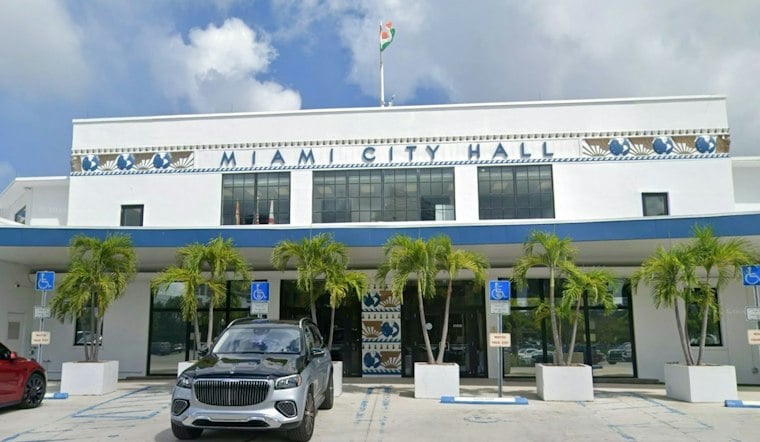
The Museum of Miami has proposed restoring the historic Pan Am Terminal at Dinner Key, the Art Deco seaplane hub that has doubled as Miami City Hall since 1954, into a public museum campus on Biscayne Bay. The plan calls for a new adjacent museum building alongside the restored terminal, all through a public-private partnership that would leave the city holding onto the land.
Museum of Miami CEO and Executive Director Natalia Crujeiras sent a letter of intent to Mayor Eileen Higgins, the city commission and City Manager James Reyes outlining the proposal, according to The Real Deal. Under the arrangement, the city would retain ownership of the property and lease the building to the museum, which is currently based at 101 West Flagler Street in the Miami-Dade Cultural Plaza. The museum would fund both the terminal restoration and the new museum building itself, per the same report.
The pitch arrives just days after Miami commissioners voted 4-1 on September 10 on a resolution sponsored by District 2 Commissioner Damian Pardo to keep the Dinner Key terminal functioning as City Hall and the primary site for regular commission meetings, according to Newsradio WFLA Orlando. That vote came even as Miami presses ahead with plans to move its administrative operations to a new eight-story, 436,345-square-foot building at Miami Freedom Park in Allapattah, a project designed by Arquitectonica on a 2.1-acre site with an accompanying 11-story garage holding nearly 900 parking spaces, per the firm's own project description.
What the Museum Is Asking City Hall to Approve
The museum's letter asks the city to authorize financial, design, environmental and historic analysis of the site, and to choose between pursuing the plan as an unsolicited proposal under Florida's public-private partnership law or through a city-led reuse process, the article notes. The museum is also seeking authorization to negotiate an interim agreement that would let it begin predevelopment work at its own expense, aiming to determine whether the project is viable before further commitments are made.
Florida Statutes Section 255.065 gives local governments the authority to receive, evaluate and negotiate proposals like this one for public infrastructure and government facility projects, according to The Florida Senate's statutory text. But if Miami decides to move forward on the basis of the museum's unsolicited pitch, the same law requires the city to publish formal notice in the Florida Administrative Register and local newspapers, opening the door to competing proposals from other private entities, per Holland & Knight.
The proposal includes safeguards meant to protect the city's ownership interest, with no mortgage, lien or debt attached to the arrangement, and any improvements would be dedicated to the city, per the museum's letter. A museum spokesperson said the project's budget is not yet known and will be established once the city clarifies its own preferences for the site.
A Civic and Cultural Campus, Not a Commercial One
The museum's vision explicitly rules out a commercial tower, a large-scale entertainment venue, residential development or a nightclub on the site. Food, beverage and retail uses would be restricted to a defined portion of the campus, with the broader footprint pitched as a civic and cultural complex anchored by public access to the waterfront.
That framing is meant to align with the Coconut Grove Waterfront Master Plan, adopted in 2008, which calls for a continuous baywalk, native vegetation, a waterfront park, protected water views and a pedestrian-oriented public realm. The museum says its concept would follow that master plan, proposing additional open space and an improved baywalk, along with guaranteed public access to the grounds. The proposal also includes free or reduced-cost school programming for Miami-Dade County Public Schools students, free or nominal-admission museum days, and protected view corridors.
A Site Steeped in Aviation and Civic History
The Pan Am Terminal opened in 1934 as a base for Pan American World Airways flights connecting Miami with Latin America and the Caribbean. Pan Am flew its final seaplane flight out of Dinner Key on August 9, 1945, and the City of Miami acquired 39 acres of the waterfront site the following year, according to the National Park Service. The building was added to the National Register of Historic Places on February 20, 1975.
City government moved into the terminal in 1954, and the commission has held its meetings there ever since. Before that, Miami's government had operated out of Downtown Miami for 58 years, including a 26-year stretch inside the Dade County Courthouse from 1928 to 1954, per Wikipedia's account of the building's history. Even under the museum's plan, the commission chamber would remain available for city meetings and could also host community forums, assemblies, naturalization ceremonies and youth civics programming.
Bringing Back the Giant Pan Am Globe
The museum, which holds the region's foremost collection of Pan American World Airways artifacts, photographs and archival materials, has said it intends to design the new building to complement the terminal's streamline moderne architecture and stay in scale with nearby structures. It also plans to explore returning the terminal's original Pan Am globe to the building.
That globe, a 6,500-pound Rand McNally creation commissioned in the 1930s, spent 55 years on display at the former Miami Science Museum in Coconut Grove before Miami Worldcenter developers acquired it in 2020 and installed it permanently in Downtown Miami in July 2022 following extensive restoration, according to Frost Science. Bringing the artifact back to Dinner Key would require negotiating with Miami Worldcenter, since the globe is not currently under the museum's or the city's control.
The museum itself rebranded in May 2026, dropping the HistoryMiami name in favor of Museum of Miami as part of a broader institutional shift toward what it calls a “museum without walls” model aimed at expanding neighborhood-level outreach across the county, as Axios reported at the time. Hoodline previously covered City Hall's move to Freedom Park and the museum's earlier name change and outreach pivot. For now, the Dinner Key proposal remains at its earliest stage, with the museum awaiting the city's response before any budget, design or ownership questions can be resolved.





