

























































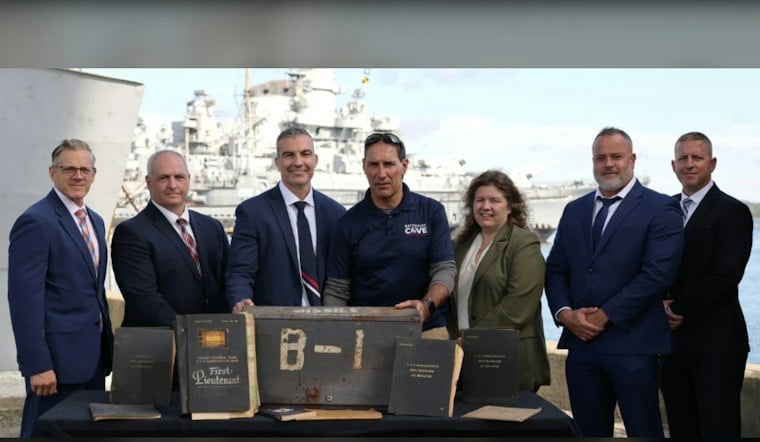
Nine artifacts missing from the USS Massachusetts for three decades are finally back where they belong at Battleship Cove in Fall River, after a Texas family stumbled onto them in their late father's storage unit and voluntarily relinquished them after Fall River police contacted the FBI. The recovered items include a rusted metal explosives crate stamped with a warning label, a folder titled Plan of the Day for 1942, and a booklet of engineering and structural specifications known as A First Lieutenant's Damage Control Book.
The case came together after museum volunteers spotted photos of the missing items posted on social media and alerted Battleship Cove curator Christopher Nardi, according to the FBI. Nardi then contacted the Fall River Police Department, which brought in the FBI's Boston Division to investigate, as reported by The Boston Globe. Nardi, who serves as Battleship Cove's chief operating officer, thanked the FBI for bringing the artifacts home to the museum, according to the Globe's report.
Once the investigation was underway, FBI Boston coordinated with the bureau's Dallas field office, which tracked down a Texas family that had found all nine items among their late father's belongings in a storage unit. The father had worked refurbishing the USS Massachusetts in the 1990s, per the Globe's reporting. The family voluntarily surrendered the items, and agents from both offices worked together to authenticate and secure the return.
Documents Offer a Window Into Wartime Navy Life
The Plan of the Day folder from 1942 contains historically significant documents that the Globe describes as offering a glimpse into Navy operational planning during World War II. The recovered damage control booklet and the explosives crate, marked with a missile hazards warning, round out the haul of nine items now back in the museum's care.
FBI Special Agent in Charge Ted E. Docks, who leads the Boston Division, said the artifacts reflect the courage, sacrifice, and service of the sailors who served aboard the ship nicknamed Big Mamie, according to the Globe. Docks also thanked the Texas family for their honesty, cooperation, and commitment to preserving history, and said the recovery ensures future generations can better understand the legacy of those who defended freedom. He added that the public plays a vital role in identifying and reporting missing and stolen artifacts.
A Ship With Battle Honors on Both Sides of the World
Commissioned in May 1942, the USS Massachusetts holds the distinction of firing both the first American 16-inch combat salvo of World War II, off Casablanca that same year, and the final 16-inch salvo of the war against Kamaishi, Japan, in August 1945, according to Business Insider. The battleship fought in North Africa and later across the Pacific during the war, per the Globe's reporting.
Built at Bethlehem Steel's Fore River Shipyard in Quincy for an original cost of $80 million in 1941, roughly $1.8 billion in today's dollars, the 680-foot South Dakota-class battleship was the heaviest vessel ever launched in Quincy, according to 19FortyFive. When the Navy scheduled the ship for scrap in 1962, WWII veterans and Massachusetts schoolchildren led a public campaign that raised more than $50,000 in spare change to bring the vessel to Fall River, according to 1420 WBSM. The ship has rested at Battleship Cove as a public museum since 1965.
Federal Art Crime Unit Steps In
The Texas family voluntarily surrendered the artifacts, and federal authorities authenticated and returned the items, even though transporting stolen government or cultural property worth $5,000 or more across state lines can carry federal felony penalties under the National Stolen Property Act, according to the Federal Criminal Defense Attorney outline of the law. The case was handled with the involvement of the FBI's Art Crime Team, a unit established in 2004 that has recovered more than 20,000 items worth over $1 billion worldwide, per the FBI.
This isn't the first time FBI Boston has reunited WWII-era artifacts with their rightful home after a family estate discovery. In March 2024, the division recovered and repatriated 22 historic WWII artifacts to Okinawa, Japan, after a local family found looted Asian art and historical records in a deceased relative's home, the FBI noted in its announcement of that case.
A Living Naval Legacy Continues in Boston Harbor
The USS Massachusetts, designated a National Historic Landmark in 1986, remains the centerpiece of Battleship Cove, which houses the world's largest collection of World War II naval vessels, according to Journey With Murphy. The battleship's name lives on in the modern Navy as well: the USS Massachusetts (SSN-798), a Virginia-class nuclear attack submarine, was commissioned in Boston Harbor earlier this year.
For Battleship Cove and the Fall River community, the return of these nine pieces closes out a 30-year gap in the museum's collection, restoring documents and hardware associated with the USS Massachusetts to the museum's collection.




