

























































Inside Nissan's massive Smyrna, Tennessee assembly complex, a fleet of autonomous robots the size of small vehicles is now hauling parts across the body shop floor, capable of carrying roughly 4,190 pounds at a top speed of about 4.5 miles per hour, and calling on each other for backup when one falls behind schedule. The rollout marks the plant's largest cost-reduction initiative of the year and will ultimately replace work currently performed by 64 forklift and tug operators.
The robots, known as autonomous mobile robots or AMRs, are made by OTTO, a company owned by Rockwell Automation, according to Business Insider. Rockwell acquired OTTO's parent firm, Clearpath Robotics, in October 2023 for approximately $600 million, folding the company's autonomous material handling hardware and fleet management software into its factory automation lineup, according to BetaKit. Per Rockwell's website, OTTO AMRs are also used at Ford, GE, Hershey, and Caterpillar plants.
Nissan is deploying the robots inside the Smyrna body shop, where they deliver components to workers who then load them into robotic production cells. The AMRs use LiDAR, cameras, and other sensors to navigate around people and obstacles, adjusting deliveries in real time and recharging themselves when needed. Nissan is currently completing the first of six planned AMR deployment phases, per the company.
Robots That Recognize When to Call for Help
The technology's most distinctive trick is coordination between machines. Nissan's AMRs can recognize when a robotic cell no longer needs a new delivery, and if one robot falls behind on its mission, another can step in to replace it. That capability isn't purely theoretical: Nissan's AMR software has already dispatched two robots to the same place at the same time, a glitch the automaker addressed by partnering with software providers to correct the programming.
Tim Slate, describing the scale of the effort, called it “the top thing on the list” and said the automaker “can't have downtime.” He added that the robots have been reliable so far. JS Bolton offered a more measured view of the rollout, saying, “Of course you wish everything works perfect, out of the box. But, it doesn't,” while also noting that “any year you don't invest, you're leaving savings on the table.”
What Happens to the Forklift Operators
Nissan has said affected workers will remain employed at the company, and the automaker notified employees on both shifts about four months before the transition began. Workers can apply for other positions in the plant, and Nissan may train some of them for roles involving industrial robots and other equipment — positions that could offer upward mobility and potentially higher pay, per the automaker. Forklift operators will also remain available to move parts manually whenever the automated system runs into a problem.
Still, Nissan will not backfill the existing material-handling positions once the transition is complete, a detail that points toward long-term structural savings rather than a one-time efficiency push. Victor Taylor said Nissan wanted to automate mundane tasks that are “really antiquated for a human being to be performing.” Chris Reed framed the effort in broader financial terms, saying Nissan is examining the total cost of producing a vehicle — a calculation that includes supply chain, warranty, development, and labor costs.
A Round-the-Clock Installation Effort
Getting the robots running has required an intense push from Nissan's automation systems integration supplier, Powerhouse Controls, whose employees have worked around the clock at the Smyrna plant, sometimes seven days a week, according to the same Business Insider report. Reed described the pace bluntly, saying, “We're pushing on everything at the same time.” Each unit in the largest OTTO model can also raise its platform about 2.5 inches to lift and transport loads.
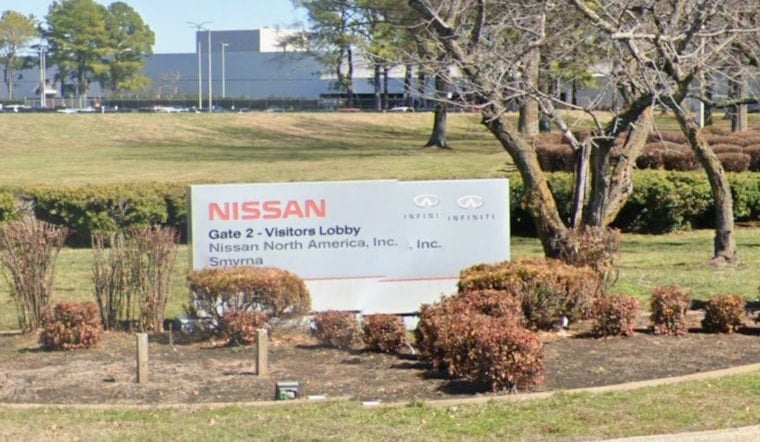
The Smyrna plant, which opened in June 1983 as Tennessee's first automotive assembly facility, spans 6 million square feet across 884 acres and produced its 15 millionth vehicle in March 2024, according to Walser Nissan. The complex currently assembles the Rogue, Pathfinder, Murano, and Infiniti QX60, and Hoodline has previously reported on new SUV production at the same facility, which accounts for roughly 8,500 local jobs.
Wider Push Toward Automated Assembly
Nissan is weighing whether to extend similar automation into general assembly, with such projects potentially beginning as soon as 2027, alongside plans to bring more vehicles to the Smyrna factory that same year. The company is also studying whether AMRs or automated forklifts could take over component handling in Smyrna's stamping operation. Executives believe the resulting efficiency gains could help the plant compete for additional vehicle production down the road.
The investment comes as Nissan reported first-half 2026 sales up 9.6% from the prior year, following a 6.5% drop in deliveries the year before. Any decision to expand automation further depends on the technology proving sufficiently capable, affordable, and integrable, per the automaker.
Part of a Broader Industry Shift
Nissan's bet on mobile robots tracks with national trends. U.S. automotive plants installed 13,500 industrial robots in 2025, keeping the auto sector the largest single market for factory automation as overall U.S. robot installations grew 11%, according to the International Federation of Robotics. Even so, the U.S. ranks only 8th to 10th globally in manufacturing robot density, trailing leaders like South Korea, which has more than 1,000 robots per 10,000 workers compared with roughly 295 to 307 in the U.S.
Mobile robots specifically are gaining ground fast: a September 2026 report by PMMI and Interact Analysis found mobile robots made up 32% of the U.S. packaging and processing robotics market in 2025, a share projected to hit 45% by 2031, as reported by Manufacturing.net. Untethered robots like Nissan's AMRs are permitted to operate near human workers under the ANSI/RIA R15.08 national standard, which mandates safety-rated LiDAR coverage, dynamic risk assessments, and collision-avoidance stops for mobile industrial robots.
Automotive manufacturing remains a cornerstone of Tennessee's economy, supporting more than 144,700 jobs across 88 counties and generating over $5.3 billion in annual exports, according to the Tennessee Department of Economic and Community Development. Rutherford County, home to the Smyrna plant, anchors much of that footprint, with the surrounding Nashville region supporting roughly 88,500 manufacturing jobs and up to 45 million square feet of industrial real estate, as Hoodline has detailed in recent coverage of the county's industrial growth.





