

























































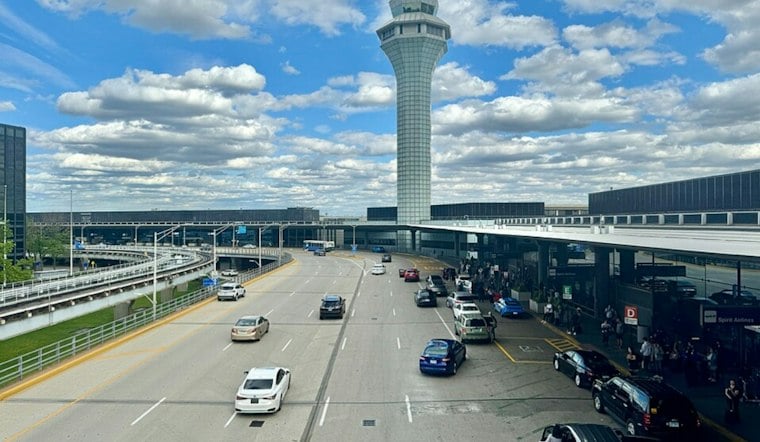
Rideshare drivers circling O'Hare International Airport say they're losing hundreds of dollars a day while waiting their turn in an official queue, even as other drivers illegally park on the Kennedy Expressway shoulder to jump ahead of them. Now, new automated cameras are set to target that shoulder idling with $100 fines, a change drivers hope will finally level the playing field.
Jahanzaib Mawani, a limousine driver working with Uber, told CBS News Chicago that he can lose up to $500 per day when he refuses to idle on the shoulder for safety reasons and instead waits in the designated queue. On a recent Tuesday, Mawani said he went six hours without a ride, and the outlet reported he later went home after waiting at O'Hare all day without a fare or any income. Under Uber's system, drivers are queued on a first-come, first-served basis in the airport's parking lot, per the same report, but some drivers bypass that line entirely by parking on the shoulder instead.
“We will go for 12 hours and go without any paycheck,” Mawani said, describing the toll of standing by in the legitimate queue while others find workarounds. He added that tickets and fines alone will not solve the underlying reason people idle on the shoulder in the first place, according to the same account. Some rideshare drivers say they know the shoulder is off limits but feel they have no choice, while others idle there simply while waiting to pick up family, friends, or personal rides rather than paid fares.
How the Official Queue Is Supposed to Work
Uber and Lyft actually route airport drivers into two separate geo-fenced staging areas — the Alpha Lot off Balmoral Avenue and the Delta Lot at Mannheim Road and Montrose Avenue — which operate on a first-in, first-out virtual queue, according to Lyft. Drivers who leave those geo-fenced lots before receiving a dispatch automatically lose their spot in line, while some drivers instead linger on nearby highway shoulders to stay closer to O'Hare and bypass the system. Some rideshare drivers told CBS News Chicago they believe the coming enforcement will actually help restore fairness to the system, while others fear drivers will simply find new loopholes and continue to cut into their earnings.
The stakes are heightened by O'Hare's sheer volume of travelers. More than 3.36 million travelers were projected to use O'Hare and Midway combined from March 20 through March 31, 2025, according to the City of Chicago, a crush that intensifies competition among drivers for fares and lengthens wait times in the staging lots. According to the City of Chicago, the 2024 travel season was expected to be 8.6% busier than 2023, including a 10% spike at O'Hare. The City of Chicago warned ahead of the Memorial Day 2025 travel period that its airports were preparing to welcome 1.86 Million travelers, with downtown-to-O'Hare travel time potentially ranging from 1-2 hours. Uber has not responded to CBS News Chicago's inquiry about the shoulder-idling issue, while O'Hare has said it works with rideshare companies to address drivers' concerns as they arise.
Cameras, Fines and a Law Years in the Making
Idling on the Kennedy Expressway shoulder near the airport is illegal, and authorities say they will soon photograph the license plates of drivers caught doing it, with cameras slated for installation on the shoulder in the coming months. Illinois enacted a law aimed at preventing drivers from idling there, and violators will be charged a $100 fine once the automated system goes live. That system, the O'Hare Driver Safety Act, was passed after State Representative Brad Stephens introduced it upon observing dozens of vehicles idling dangerously along highway shoulders near the airport, according to The Caucus Blog.
Camera enforcement was supposed to begin the prior year, but the omission of the Illinois Department of Transportation required lawmakers to fix the legislation and pushed the camera rollout back another year. Lawmakers later passed corrective legislation, and state police were authorized to install cameras before deployment could move forward. The enforcement zone will cover a half-mile radius around O'Hare's eastern entrance and includes the Kennedy, Mannheim Road and Balmoral Avenue, per CBS Chicago. Scott's Law provides first-offense fines ranging from $250 to $10,000, while license suspension or revocation applies when a driver fails to move over or slow down and causes serious injury or death, according to the Illinois State Police.
A Free Alternative Sits Largely Unused
For non-rideshare motorists picking up arriving passengers, the Chicago Department of Aviation maintains a free Cell Phone Waiting Lot at 560 N. Bessie Coleman Drive, according to Triply. It offers an off-highway alternative to parking illegally on expressway shoulders, though the pattern of shoulder idling near O'Hare has persisted regardless. The safety risks behind the new enforcement push aren't abstract, either: the Illinois Tollway network recorded at least 29 collisions involving vehicles struck while stopped on highway shoulders in a single monitoring year, a jump of more than 30% year-over-year, according to prior Hoodline reporting on shoulder crashes elsewhere in the region.
Rideshare operations at O'Hare are also governed by city ordinance layered atop state traffic law. Chicago's TNP rules include licensing and vehicle-emblem requirements. The Chicago Department of Aviation has separately invested in easing ground congestion, completing a six-story, 2,600-space garage expansion at Terminal 5 in late 2024 that more than doubled parking capacity and added real-time space tracking.
For drivers like Mawani, though, the immediate concern remains simpler: standing in line for hours while others find a way around it. As the cameras prepare to go up along the Kennedy shoulder, drivers who play by the rules are hoping the fines finally close the gap between the drivers who wait and the drivers who don't.




