

























































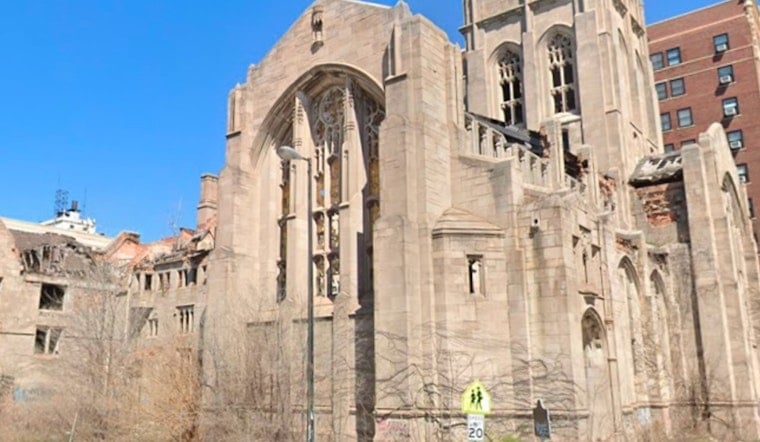
The roofless shell of City Methodist Church, once the largest Methodist church in the Midwest, is finally coming down. The Northwest Indiana Regional Development Authority awarded a $5.343 million demolition contract to Homrich Wrecking on September 2, closing the book on a structure that has sat gutted and exposed to the elements at 577 Washington Street in downtown Gary for half a century.
The contract covers more than just the church — it also includes the former St. Mary Mercy Hospital building at 540 Tyler Street, according to documents from the Indiana Regional Development Authority. As the Chicago Sun-Times reports, Homrich Wrecking estimated demolition costs at $5.3 million for the long-blighted downtown parcel. Demolition will begin once the contract is finalized, according to David Wellman, as cited in the Sun-Times report.
A Grand Vision Undone by Decline
Built in 1926 under founding pastor Rev. William G. Seaman, City Methodist Church was constructed over 21 months by Chicago architectural firm Lowe & Bollenbacher, per Autopsy of Architecture. The English Gothic Revival complex included a 3,000-seat main sanctuary and a 1,000-seat theater called Seaman Hall, along with a gym, music studio, cafeteria, and commercial space, the Sun-Times notes. U.S. Steel funded $350,000 of the original construction — a sum equivalent to roughly $6 million today, per the Sun-Times report. The building's intricate limestone work and terra cotta detailing made it a central meeting place in Gary during the city's steel-boom heyday.
That heyday didn't last. The congregation swelled past 3,000 members during the 1950s steel boom but collapsed to about 300 by 1973 as industrial jobs disappeared, according to Autopsy of Architecture. Church leaders decided to close the doors in 1975, on October 5 of that year. Notably, congregation leaders attempted integration efforts in the 1950s, but the Sun-Times reports the church's congregation was segregated and that a white congregation opposed those integration efforts — a tension traced back to Seaman himself, who faced backlash from white parishioners for welcoming Black residents and immigrants into church programs during the 1920s, a conflict that ultimately led to his forced transfer to an Ohio ministry, according to Autopsy of Architecture.
From Arson to Collapse
The vacant complex suffered a major arson fire on October 12, 1997, which destroyed the third-floor gymnasium roof and accelerated structural decay, according to RestoreWorks. That damage is tied to the eventual collapse of the main sanctuary roof around 2011, per the same account. The building has been damaged by the elements ever since, according to the Sun-Times.
Despite the deterioration, the ruin found an unlikely second life as a filming location. Its roofless Gothic interior appeared in Transformers: Dark of the Moon, the 2010 remake of A Nightmare on Elm Street, and the Netflix series Sense8, according to a report from Film Locations.
Preservation Efforts That Couldn't Find Funding
Gary spent years trying to save at least part of the ruin rather than clear it entirely. In June 2017, the city received a $163,000 Knight Cities Challenge grant from the John S. and James L. Knight Foundation to study converting the site into an open-air public ruins garden, according to Lakeshore Public Media. Gary city officials also worked with Bailey Edward on a 2018 redevelopment plan proposing an open-air ruins project built around the church's remaining structure, per the Sun-Times. But those ruins-garden plans were ultimately dropped.
More recently, Gary and the University of Notre Dame's Housing and Community Regeneration Initiative developed a 2025 vision to preserve the bell tower within a planned City Renaissance Park, itself part of a broader strategic plan to revive downtown Gary, the Sun-Times reports. The Gary Redevelopment Commission approved $112,500 for a bell tower and cathedral stabilization plan this year, but the full stabilization effort would have cost $4.2 million — and the city failed to find a funding partner to cover it, according to the Sun-Times.
Safety Concerns Sealed the Decision
City Methodist Church was deemed unsafe and unrecoverable, according to Steve Segura, as cited by the Sun-Times. Segura said the city's foremost responsibility was ensuring the safety and well-being of nearby students and vulnerable residents — a notable concern given the church's proximity to 21st Century Academy Charter School and the Genesis Towers senior housing complex. Gary leaders decided to move forward with demolition, according to Segura's comments reported by the Sun-Times.
Genesis Towers, incidentally, opened as Hotel Gary in 1926 — the same year City Methodist Church was built — before being converted into senior housing in the 1970s, per the Sun-Times. The nearby Genesis Convention Center, which once hosted performers including Whitney Houston and Prince, is also slated for demolition, to be followed by site redevelopment, the Sun-Times reports.
Not everyone is ready to see the site erased without a trace. Lauren Pacheco said the church's scale reflected Gary's confidence and ambition, and she hopes materials from the building can be saved for a sculpture or similar display, according to the Sun-Times. Pacheco also said the site could become a new civic space, potentially a location for open-air painting or photography once cleared.
Part of a Larger Blight-Clearing Push
The demolition funding flows through the Gary Blight Elimination Program, established by 2023 Indiana state legislation authored by Gary Mayor Eddie Melton while he was still a state senator, according to GreatNews.Life. The program combines $12 million in local and regional funds with $15 million in READI 2.0 grant funding from the Indiana Economic Development Corporation. Earlier remediation at the church site included a $100,000 asbestos removal project managed by the Regional Development Authority in 2019, though a 2022 application for $400,000 in EPA Brownfields Cleanup grant funding was denied in May 2023, according to Atlas Obscura.
City Methodist Church has eluded redevelopment since its closure, and its removal now fits into a wider transit-oriented push in downtown Gary that includes more than $90 million invested in a new multi-modal Gary Metro Station hub and an $85 million mixed-income housing conversion at the historic Palace Theater on Broadway, according to a report from Chicago YIMBY. Other Gary landmarks have already met the wrecking crew in recent years — the Gary Water Tower and Gary Memorial Auditorium were both demolished in 2020.





