

























































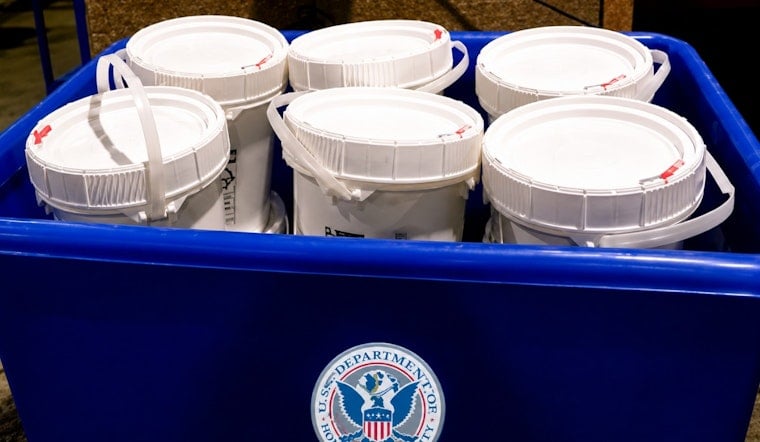
U.S. Customs and Border Protection officers at the Otay Mesa Cargo Facility intercepted 872.12 pounds of liquid methamphetamine hidden inside the gas tank of a commercial truck, the agency announced this week. It is the latest in a string of nearly identical busts at the same San Diego port of entry, where liquid meth concealed in vehicle fuel systems has become a recurring smuggling tactic.
Director of Field Operations Sidney Aki announced the seizure in a post on X, calling it a “big catch” and crediting officers with “keeping our borders, homes, and streets safe, one seizure at a time.” According to the post from the San Diego Field Office director, the liquid drugs were found hidden in the truck's gas tank at the Otay Mesa Cargo Facility, though the post did not detail the driver's identity, nationality, or how officers were tipped off to search the tank.
Big catch alert! 🚨 Our officers intercepted 872.12 lbs of liquid methamphetamine hidden in the gas tank of a commercial truck at the Otay Mesa Cargo Facility. Keeping our borders, homes, and streets safe, one seizure at a time! 🛡️#SanDiegoFieldOffice #OtayMesaCargo #CBP pic.twitter.com/3dTB6ItZQC
— Director of Field Operations Sidney Aki (@DFOSanDiegoCA) September 2, 2026
A Familiar Pattern at the Same Crossing
This is far from the first time CBP has pulled liquid methamphetamine out of a commercial rig's fuel tank at Otay Mesa. In March, officers at the facility intercepted 944 pounds of liquid meth concealed inside 29 five-gallon buckets mixed into a tractor-trailer's diesel tank, according to U.S. Customs and Border Protection. That case involved a 26-year-old Mexican citizen driving the rig, who was referred to secondary inspection before officers probed the fuel tank and extracted a gel-like substance.
Go back further, and the pattern holds. In October 2023, CBP officers at the same facility seized 942 pounds of liquid methamphetamine valued at nearly $1.5 million from the fuel tanks of a commercial tractor driven by a 49-year-old female border crossing cardholder, the agency said in a prior release, a bust Hoodline previously covered. The near-identical weights and concealment methods across nearly three years point to a persistent tactic rather than a one-off scheme.
Why Smugglers Turn Meth Into Liquid
The reason drug networks go to the trouble of dissolving crystal methamphetamine into liquid form comes down to evading detection. Cartels dissolve the drug into solutions that can be mixed into fuel tanks or fluid containers to bypass standard border screening, according to the Drug Enforcement Administration. Once the liquid crosses the border, it typically heads to domestic “conversion laboratories,” where it is re-crystallized using volatile, highly flammable solvents like acetone — a process the DEA says creates severe chemical fire hazards and hazardous waste inside the communities where those labs operate.
Otay Mesa is a prime target for this method because of sheer volume. The facility is the primary commercial land port of entry on the California-Mexico border and ranks as the second-busiest commercial truck crossing along the entire U.S.-Mexico border, according to the San Diego Association of Governments, handling immense freight tied to regional manufacturing, e-commerce, and cross-border trade. That volume gives federal inspectors a genuine needle-in-a-haystack problem, even with non-intrusive scanning and K-9 teams working the lanes.
Part of a Region-Wide Surge in Seizures
The Otay Mesa fuel-tank method isn't isolated to one crossing. In April, CBP officers at the nearby Calexico East Commercial Facility seized over 1,000 pounds of liquid methamphetamine hidden inside another commercial tractor-trailer, part of what Aki described as a surge in heavy-weight drug seizures across Imperial and San Diego county ports, as Hoodline reported at the time.
The scale of the region's interdiction effort has been staggering in recent months. Between October and December 2025, CBP officers under the San Diego Field Office seized nearly 33,000 pounds of illicit narcotics valued at $111 million across regional ports of entry, including 309 pounds of fentanyl extracted from a tractor-trailer at Otay Mesa during that same quarter. The month of August 2025 alone saw the San Diego Field Office record 155 contraband seizures totaling nearly 10,000 pounds of dangerous drugs worth an estimated $24 million, a haul that included 1,352 pounds of meth hidden in furniture at Otay Mesa and 241 pounds concealed in a bus fuel tank at Calexico.
Federal Operation Behind the Crackdown
These interdictions fall under Operation Apollo, a federal counter-narcotics framework Customs and Border Protection launched in Southern California in October 2023 and later expanded border-wide as Operation Apollo X in mid-2024, according to the U.S. Department of Homeland Security. The initiative is built around surging intelligence sharing and interagency coordination to disrupt synthetic drug supply chains through targeted secondary inspections.
Otay Mesa's role in regional trafficking extends well beyond border-crossing seizures. In June 2025, federal agents under Homeland Security Task Force San Diego seized approximately 7,704 pounds of methamphetamine being offloaded from a semi-truck in an Otay Mesa parking lot, watching as bundles were transferred directly into panel vans and a pickup truck — a case that led to conspiracy charges against three foreign nationals, as Hoodline detailed in its coverage of the four-ton bust. That case illustrates how the same corridor functions not just as a crossing point but as a staging ground for onward distribution.
As of this report, CBP has not released details on the driver of the truck involved in the 872.12-pound seizure, nor confirmed whether federal criminal charges have been filed through Homeland Security Investigations or the U.S. Attorney's Office. Those specifics remain unaddressed in the agency's initial announcement of the bust.





