

























































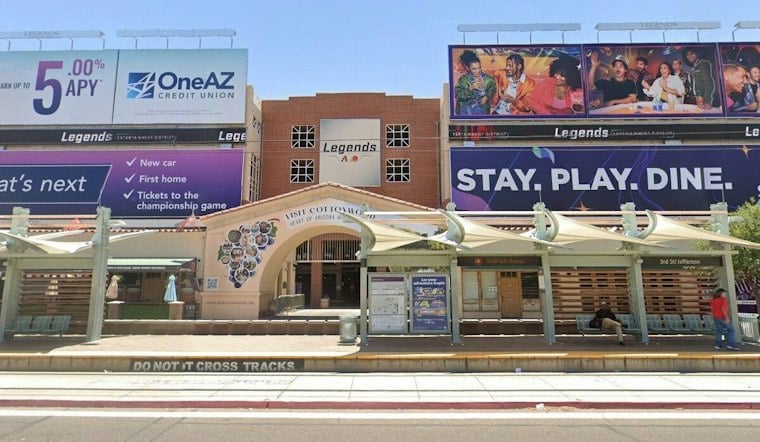
Mitchell Geary was on his way to a cardiologist appointment with his son on Sept. 4 when his motorized wheelchair's rear wheels spun off the edge of the Downtown Phoenix Hub Station platform, sending him backward onto the concrete about a foot below. The 58-year-old Phoenix man died Sept. 13 in the hospital, and his sister is now pushing for changes she believes could have saved his life.
Maryann Beausoleil, 57, said Geary's death has left her determined to see additional safety measures added to Valley Metro platforms. The account, originally published by the Arizona Republic, appeared on Yahoo News and was also published by the Modesto Bee. Beausoleil wants to push for further platform safety so nobody else has to experience the same thing. The Maricopa County Office of the Medical Examiner listed blunt force trauma as her brother's cause of death.
Geary became reliant on a wheelchair and also had glaucoma, according to his sister. Beausoleil suspects Geary did not detect the platform's tactile paving as he tried to pivot away from the edge, and that his wheelchair went in reverse instead, sending him over the side. She thinks the use of guardrails throughout the platform would have helped prevent the accident that proved fatal.
A Bystander Jumped Onto the Tracks
Daniel K. Auna, a 42-year-old health and fitness businessman, saw Geary close to the platform edge before he fell backward at the Downtown Phoenix Hub Station, located on Jefferson Street between 1st and Central avenues. Auna jumped onto the tracks to render aid as a light rail train approached. Geary was faintly breathing and barely had a pulse, and he remained unconscious for about 10 minutes.
Valley Metro confirmed that an individual using a motorized wheelchair fell from the platform. Spokesperson Juliana Vasquez-Keating expressed condolences to Geary's family and said the agency's rail stations are compliant with the Americans with Disabilities Act and include detectable warning surfaces along the platform edges.
Geary was remembered as a widowed father of two, a diesel mechanic instructor and a lifelong outdoorsman. Beausoleil hopes that her family's loss will help implement new safety measures at Valley Metro stations.
How Other Transit Systems Are Responding
The question of platform barriers is not unique to Phoenix. In New York City, the Metropolitan Transportation Authority had installed waist-high guardrails at 158 subway stations by the end of June, according to a policy brief from the MTA. The agency says stations with the barriers, which sit in front of the yellow strip near train entry and exit points, have seen an 11% decrease in accidental or unintentional track-trespassing incidents.
The MTA's in-house crews fabricated more than 1,800 of the barriers in 2025 alone, and the agency estimates installing them costs roughly $100,000 per station in-house versus $300,000 through an outside contractor. In the agency's May 2026 Pulse survey, three out of four riders reported feeling safe in stations and on trains.
Boston's transit system is weighing similar steps after a separate tragedy. The MBTA is evaluating protective platform barriers for some of its subway stations following the death of 19-year-old Frankey Wright, who fell onto an electrified third rail at Forest Hills Station, as reported by Boston.com. A 19-year-old woman who also fell onto the tracks in that incident remained in critical condition. Those third rails carry 600 volts of electricity and power trains on the Orange Line, Red Line and part of the Blue Line.
The MBTA is seeking proposals for a pilot barrier program at a yet-to-be-determined Orange Line or Red Line station, the outlet's report notes. New York transit officials previously found that only 27% of stations could even accommodate full-height platform screens, at an estimated cost of around $7 billion.
What Federal Guidance Says About Platform Warnings
Detectable warning surfaces like the ones Valley Metro says it maintains provide a tactile cue that a person is approaching a platform edge, particularly for people with impaired vision. Separate federal review material states that where an existing station cannot provide required clearance because of an insurmountable gap or physical structure, barriers must be used to prevent pedestrian traffic through the narrower area.
For now, there is no indication of whether Valley Metro is considering guardrails or other physical barriers at the Downtown Phoenix Hub Station or elsewhere in its system. Beausoleil's push comes as her family continues to grieve a man remembered for his years teaching diesel mechanics and his love of the outdoors, hoping his death might still spare another family the same loss.





