

























































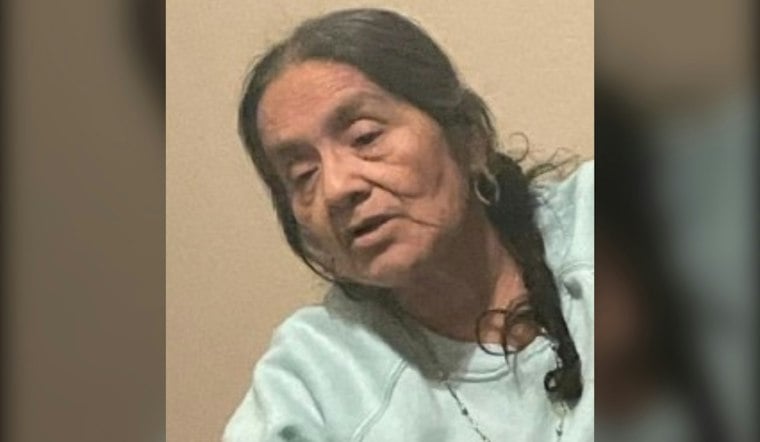
Phoenix police have issued a SAFE Alert for Yolanda Garcia, a 72-year-old woman last seen on foot near Durango Street and 99th Avenue at about 8:15 a.m. Saturday. Garcia has a medical condition that can cause confusion and make her easily lost, and a possible sighting placed her nearly five miles away in Avondale later that same morning.
According to KTAR News 92.3 FM, the possible sighting occurred at approximately 11:30 a.m. near South Avondale Boulevard and West Buckeye Road. That location is near West Buckeye Road, which connects Phoenix's Estrella Village through Tolleson into Avondale, according to the Maricopa Association of Governments. Garcia is described as Hispanic, standing 5 feet 2 inches tall and weighing around 110 pounds, with brown hair and brown eyes. She was last seen wearing a blue shirt with a white graphic, black capri-style pants, and flip flops.
Anyone with information on Garcia's whereabouts is asked to contact the Phoenix Police Department Missing Persons Unit at 602-534-2121, or email the detective assigned to the case, Daniel Nonnemacher, at [email protected], the station's report notes.
How Arizona's SAFE Alert System Works
SAFE Alerts replaced Arizona's Silver Alert framework a year ago Friday, on September 26, 2025, expanding the state's missing-person notification system beyond seniors to include people of any age with cognitive or developmental disabilities, according to the Arizona Department of Public Safety. The system was codified under House Bill 2894, now A.R.S. § 41-1728. Per the same statute, law enforcement agencies are explicitly barred from delaying or denying a SAFE Alert request once criteria are met, and officers must undergo mandatory biannual training on the alert protocols.
Before requesting a statewide alert, investigating officers must confirm five conditions: that the missing person is 65 or older or has a cognitive or developmental condition, that local search resources such as hospitals, jails, and relatives have been exhausted, that the disappearance is unexplained or suspicious, that the person is believed to be in peril, and that public notice could aid recovery, per the department. SAFE Alerts can reach the public through Wireless Emergency Alerts and broadcast media; when the missing person is believed to be in a vehicle, alerts may also appear on Valley ADOT highway message boards—108 in the Phoenix metro area, part of a statewide network of 193 signs—according to the department's alert system page.
Why Speed Matters in Wandering Cases
The urgency behind these alerts is rooted in medical research. Up to 60 percent of people living with Alzheimer's disease will wander away from home or care settings at least once during their condition, according to the Alzheimer's Association. The stakes climb quickly the longer someone remains missing: roughly 50 percent of missing dementia patients not found within the first 24 hours of wandering suffer severe physical injury or death, per the Cleveland Clinic.
Arizona's prior Silver Alert framework maintained a 98 percent recovery success rate historically, with most disoriented missing adults located safely within 18 hours of activation, according to Axios Phoenix. The Phoenix Police Department's Missing and Unidentified Persons Unit, which handles thousands of reports each year, maintains no mandatory waiting period before a report can be filed, according to the City of Phoenix.
Arizona's alert infrastructure also includes the Turquoise Alert, a companion system for missing endangered people under 65, including tribal members, according to the Office of the Governor.




