

























































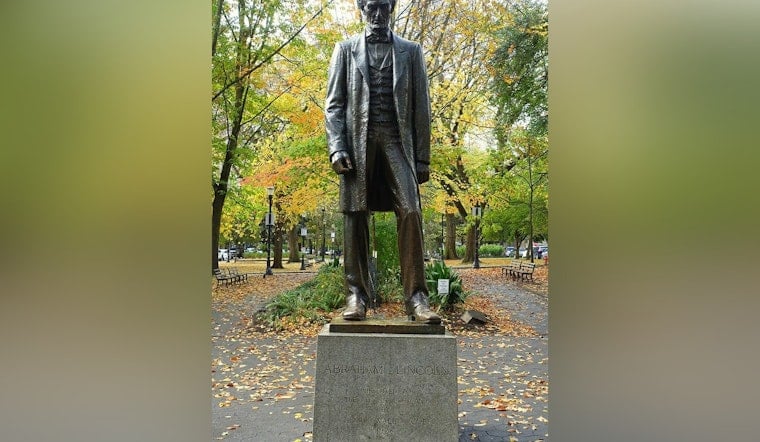
Six years after protesters pulled it down, Portland's bronze Abraham Lincoln statue is fully repaired and waiting in storage — but where and how it stands when it returns in 2027 has become the city's fiercest public art fight in years. The 10-foot monument, toppled during an Indigenous Peoples Day of Rage demonstration on October 11, 2020, is now at the center of a battle between city officials pushing accessibility and community input, and business leaders demanding the statue go back exactly as it was.
Demonstrators spray-painted “Dakota 38” on the pedestal when they brought Lincoln down, a reference to the 1862 execution of 38 Dakota men that Lincoln authorized, according to The Guardian. Less prominently discussed at the time was that Lincoln, during that same review of the Dakota War tribunal, commuted the death sentences of 264 other condemned Dakota warriors after personally examining their individual trial records, according to Building on History, which notes Lincoln approved execution only for those proven to have taken part in civilian massacres. As KOIN reports, the planned interpretive presentation for the returning statue will address both Lincoln's Civil War leadership and his administration's dealings with tribal communities, alongside his connections to Oregon.
From City Council Vote to a Storage Unit
The statue's fate has moved slowly through Portland's bureaucracy since it fell. The Portland City Council unanimously approved Ordinance #16149 in March 2024, formally authorizing the restoration and eventual reinstallation of four toppled historical monuments, including Lincoln, capping an initial public engagement phase that began in late 2023, per Portland.gov. Conservation and structural repair work on the bronze figure began that November and wrapped up by August 2025, meaning the statue itself has sat fully restored in storage for over a year while the city hashes out site planning, according to the same city account.
That repair effort falls under the city's Portland Monuments Project, which is assessing, repairing, and reframing seven damaged or removed public statues with support from grant funding tied to the Andrew W. Mellon Foundation's national initiative for reimagining civic monuments. Per KOIN's reporting, the statue could return to the South Park Blocks — its original 1928 home — as soon as next year, and the city plans to continue community engagement through the rest of 2026 ahead of a planned 2027 reinstallation.
A Lower Pedestal Sparks Backlash
The plan that has drawn the sharpest criticism emerged in May, when Portland revealed a proposal to place Lincoln on a smaller, lower base positioned closer to the public, according to KOIN. The Portland Office of Arts & Culture frames the move as an accessibility upgrade paired with multi-perspective interpretive signage covering Lincoln's legacy on race and his relationship to Native American tribes, a vision The Chronicle also describes as central to the city's redesign.
That framing has not landed well with everyone. In July, a coalition of 43 prominent Portland business and civic leaders sent a formal letter to Mayor Keith Wilson demanding the monument be returned to its original high pedestal, calling the lower-base plan a demeaning gesture, as The Chronicle reported. Signatories included Columbia Sportswear CEO Tim Boyle and businessman Jordan Schnitzer. At a public meeting Tuesday night about the statue's return, resident Aubrey Russell said a new plan was developed but argued the public never actually got to weigh in on how Lincoln should be displayed, going further to call the proposed change a demotion rather than a redesign, per KOIN.
Survey Results the City Set Aside
Adding fuel to the dispute, a public survey of more than 5,000 Portland residents conducted by the Portland Monuments Project between late 2023 and early 2024 found a majority favored restoring damaged statues to their original perches — but city staff set those results aside after declaring the survey's methodology flawed, according to Building on History's later reporting. Critics have argued that officials disregarded popular sentiment in favor of curated focus-group feedback instead. Russell told the Tuesday meeting that Portlanders are urging Mayor Wilson to restore Lincoln as he stood before, and that the city should instead embrace and project a message of lifting everyone up, per KOIN's account.
The statue's long absence has fueled friction beyond city limits, too. Back in July 2021, while Portland officials remained undecided on the statues' fate, Mayor Stan Pulliam of nearby Sandy, Oregon, formally offered to take and reinstall Portland's displaced Lincoln, Roosevelt, and Washington statues in his own city, according to Wikipedia's account of the episode — a sign of how several suburban communities viewed Portland's delay. The empty pedestal outside the Portland Art Museum stood bare for six years, per KOIN.
A Precedent Down the Street
Portland has one recent example of how this restoration pipeline can actually finish. The historic Thompson Elk Fountain, a 1900 bronze removed after fires damaged its granite base during the 2020 demonstrations, was fully restored with seismic and plumbing upgrades and reinstalled on SW Main Street in April 2026, according to Portland.gov. Hoodline covered the elk's restoration launch and later its return to downtown, offering a template — if not a guarantee — for how Lincoln's own path back to the South Park Blocks might unfold.
For now, the statue itself is finished. What remains is a decision over height, placement, and framing that Portland's leaders have been unable to resolve through more than two years of hearings, letters, and a disputed survey. The Office of Arts & Culture says the city developed its current plan after years of community engagement, even as some of that same community insists it never got the choice it was promised.



,_dedicated_1928_-_Portland,_Oregon_-_DSC08369.jpg)