

























































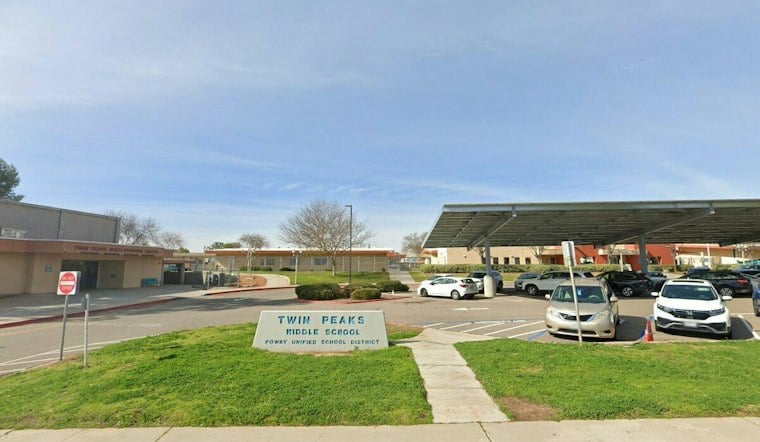
Drivers cruising Scripps Poway Parkway between the western city limit and Community Road will soon have to ease off the gas, as Poway's City Council has given preliminary approval to lower speed limits on 10 street segments across the city. The move follows a review of 55 road segments and comes after a parent's account of a near-miss involving his son outside Twin Peaks Middle School pushed traffic safety into the spotlight at recent council meetings.
The council unanimously approved the 2026 Engineering and Traffic Survey on September 15, and members plan to formally adopt the underlying ordinance at their October 6 meeting, according to Pomerado News. Nine of the 10 segments will see speed limits drop by 5 mph, while Scripps Poway Parkway takes the steepest cut, falling from 55 mph to 45 mph on its western stretch even though most traffic there currently travels around 50 mph.
Which Streets Are Getting Slower
Beyond Scripps Poway Parkway's two adjusted segments, the list includes Camino Del Norte, which drops from 50 mph to 45 mph between the western city limit and Pomerado Road, and Danielson Street and General Atomics Way, both falling from 35 mph to 30 mph between Community Road and Kirkham Way. Kirkham Road will see two separate reductions along different stretches, while Kirkham Way, Twin Peaks Road, Lake Poway Road, Oak Knoll Road, and Stowe Drive round out the rest of the list, per the same report.
Not every street is changing, though. Midland Road will keep its current limits — 35 mph on segments north and south of downtown, and 25 mph from Aubrey Street to Edgemoor Street near Old Poway Park — after collected data supported maintaining the status quo there. Poway's Director of Development Services, Julie Procopio, told the council that lowering Midland Road's limit would make it harder for law enforcement to justify speed-limit tickets on that stretch.
Why the Survey Had to Be Redone
Poway's last citywide traffic survey was prepared in 2019 and approved by the council in 2020. Under California law, that kind of engineering and traffic survey is only valid for five years — and can be extended to seven or 14 years only if specific conditions are met — meaning the city needed a fresh review to keep its legal footing. California Vehicle Code § 40802 defines what counts as an unlawful speed trap and can invalidate radar speed enforcement in traffic court unless a roadway's posted limit is backed by a survey completed within that window, subject to statutory exceptions for local streets, school zones, senior zones, business activity districts and certain speed limits, according to Justia Law.
Councilmember Christopher Pikus said the survey must be approved for a ticket to hold up in court, per Pomerado News. Kimley-Horn traffic engineer Zachary McFann, who served as the city's consultant, said the evaluations weighed collision data, roadway characteristics, average daily traffic volumes, and radar-tracked speeds, while also factoring in the California Vehicle Code and the California Manual on Uniform Traffic Control Devices.
A Shift Away From the Speed of Traffic Itself
For decades, California required speed limits to track the 85th percentile speed of drivers — the speed at or below which 85% of motorists travel — effectively locking cities into higher limits if drivers simply drove fast. That changed with Assembly Bill 43, approved by the Governor's office in 2021, which gave local jurisdictions explicit flexibility to lower speed limits below that percentile in safety corridors and areas with heavy pedestrian or bicyclist activity, according to LegiScan. Assembly Bill 1938, approved in 2022, further changed the framework for setting speed limits. The California Manual on Uniform Traffic Control Devices was itself revised in 2026 to modify allowable speed-limit reductions, and municipalities have been able to retain or restore adopted speed limits effective January 1, 2023, under the newer framework.
Caltrans' California Manual for Setting Speed Limits is targeted for a March 2026 update to integrate a Safe System Approach that weighs injury prevention alongside driver speed percentiles, rather than percentiles alone.
Parent's Warning About Near-Misses Near Twin Peaks Middle School
The push for slower streets carries a personal edge for at least one Poway parent. Adam Phenis, who lives near Twin Peaks Middle School, told the council his son was nearly struck by a right-turning driver using a cellphone at Country Creek and Tierra Bonita roads in mid-August, and that he has witnessed similar close calls at that intersection and at Espola and Twin Peaks roads. Phenis emailed his concerns to Mayor Steve Vaus, Councilmember Peter De Hoff, and former Poway sheriff's Capt. Claudia Delgado, asking the city to extend school-zone signage along Tierra Bonita Road, enforce the rule against stopping or parking within 20 feet of a crosswalk, and lower school-zone speed limits from 25 mph to 20 mph.
City Engineer Tracy Beach said excessive speeds can cause collision-related deaths and serious injuries, noting that higher driving speeds increase both the likelihood of a crash and the severity of resulting injuries, Pomerado News reported. Poway Sheriff's Capt. Nanette McMasters said six deputies patrolled the neighborhood around Twin Peaks Middle School during the first two days of the school year in mid-August, during which deputies cited drivers for 28 law violations and issued additional verbal warnings. Sheriff's officials are also planning an educational campaign discouraging cellphone use behind the wheel, since it remains a ticketable violation.
What Drivers Should Expect Once Signs Go Up
Once the new limits take effect, drivers will need to adjust to the new postings.
Despite the safety concerns raised at recent meetings, Poway has a lower accident rate than the statewide average, according to Pomerado News. Still, regional data underscores why inland San Diego County communities keep a close eye on arterial speeds: the county's North Inland region recorded the highest age-adjusted motor vehicle injury death rate in the county in 2021, at 12.9 per 100,000 residents, according to Perry Personal Injury Lawyers. Adopting the updated survey gives Poway's deputies the legal authority to use radar for speed enforcement and to have citations hold up if challenged in court, setting the stage for the council's expected final vote on October 6.





