

























































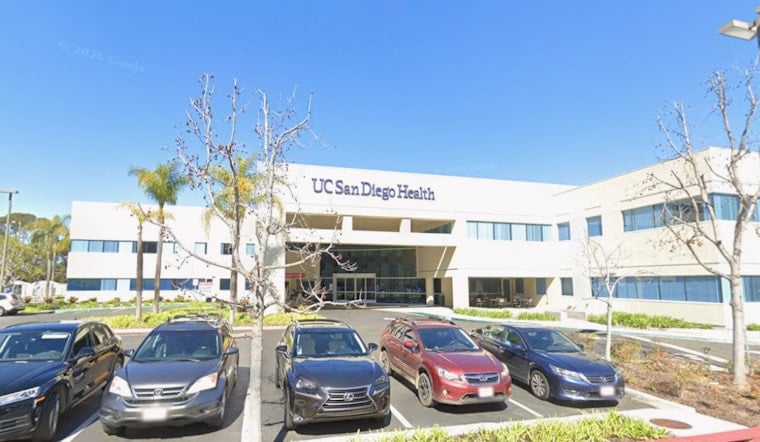
UC San Diego Health has significantly scaled back its long-planned medical facility near Interstate 15 in Rancho Bernardo, cutting the project from a five-story, 150,000-square-foot building down to a three-story, roughly 89,000-square-foot facility. The opening date has also slipped by about three years, from an original fall 2026 target to 2029, according to the health system.
The project, sited on a 3.09-acre undeveloped parcel north of Bernardo Center Drive and west of Interstate 15, was originally planned to be nearly three times the size of the Via Tazon facility it is meant to eventually replace, as reported by The San Diego Union-Tribune. UC San Diego Health has said demand at the Via Tazon center necessitated a larger Rancho Bernardo building, and the estimated project cost has been reduced from a range of $175 million to $225 million down to $160 million to $200 million, per the same report. Officials attributed the changed timeline to delays related to COVID and further refinement of the programmatic offerings planned for the site.
What Gets Cut, What Stays
The scaled-back plan will still provide primary and specialty care, express care, imaging and radiology, lab services, pharmacy, and rehabilitation services, according to the Union-Tribune's reporting. UC San Diego Health had planned to expand medical and surgical oncology subspecialties and add MRI, CT, PET CT scanning, expanded infusion capacity, an ambulatory surgical center, and radiation oncology, along with pulmonary, sleep medicine, and rheumatology outpatient clinics. The original plan also called for outpatient surgeries, expanded imaging, and some cancer treatments, but UC San Diego Health has not announced how many of those previously planned offerings remain in the smaller facility's design.
The current Via Tazon location, a nearly 55,000-square-foot space UC San Diego Health has leased since 2018, served more than 12,400 patients annually through nearly 16,000 visits in 2024. That facility offered 15 specialties last year, ranging from neurosurgery, oncology, optometry, ophthalmology, and orthopedic surgery to sports medicine, primary care, urology, allergy, cardiology, colorectal surgery, dermatology, endocrinology, ENT and head and neck surgery, gastroenterology, general surgery, obstetrics and gynecology, and neurology, alongside express care, occupational medicine, infusion, lab services, rehabilitation, and pharmacy. UC San Diego Health had planned to completely vacate Via Tazon once the new building opened, but the health system has not announced the fate of that facility now that the Rancho Bernardo project has shrunk.
Regional Partnerships Reshape the Math
The downsized plan follows a major regional shift for UC San Diego Health. In July, the health system finalized a Joint Powers Authority agreement with Palomar Health, forming Palomar UC San Diego Health and creating operational ties to Palomar Medical Center Poway, located near Rancho Bernardo, as well as Palomar's Escondido campus. That partnership, detailed by The Coast News, gave UC San Diego Health new North County capacity that a standalone Rancho Bernardo specialty buildout would otherwise have needed to provide on its own.
The partnership arrived after UC San Diego Health's earlier attempt at North County expansion through merger talks with Tri-City Medical Center ended without an agreement in 2024, according to Wikipedia. UC San Diego Health CEO Patty Maysent said in July that the system's main campuses in La Jolla and Hillcrest were effectively out of capacity for complex medical care, a constraint reported by Becker's Hospital Review that is pushing the system toward regional partnerships and outpatient growth rather than singular, oversized campuses.
Aging Population Still Drives the Project
UC San Diego Health has said the new facility would respond to patient needs and the area's aging demographic, and that it would help patients make fewer trips to La Jolla or Hillcrest for care while relieving demand at those two medical centers. Rancho Bernardo has a long-standing research relationship with the university through the Rancho Bernardo Study of Healthy Aging, an NIH-funded observational project established in 1972 that tracked over 80 percent of local adult residents across five decades, according to a study published on PMC. That demographic focus also lines up with UC San Diego Health's broader institutional push into elder care; the system launched a $40 million West Health Accelerator initiative in August aimed at coordinated outpatient and senior care models, citing projections that one in five Americans will be 65 or older by 2030, per UC San Diego Today.
UC San Diego Health has already started site grading for the new facility and will likely hold a groundbreaking ceremony this fall. The health system is set to present a project update at the Rancho Bernardo Community Council meeting Thursday at 6:30 p.m., held virtually via Zoom.
A System Juggling Billions in Projects
The Rancho Bernardo scale-back is unfolding alongside other major capital commitments across UC San Diego Health, which operates 1,101 licensed hospital beds across four major medical campuses and was named the region's top hospital system for 2025–2026 by U.S. News & World Report. The system completed a $200 million purchase of the 302-bed Alvarado Hospital Medical Center, now East Campus Medical Center, in December 2023, a deal Hoodline previously reported doubled the hospital's patient volume within two years. UC San Diego Health is also currently executing a multibillion-dollar revitalization of its Hillcrest Medical Center campus to build new hospital towers ahead of state 2030 seismic compliance deadlines, according to Wikipedia, one of several competing budget pressures across the system as it reworks smaller projects like Rancho Bernardo's.





