

























































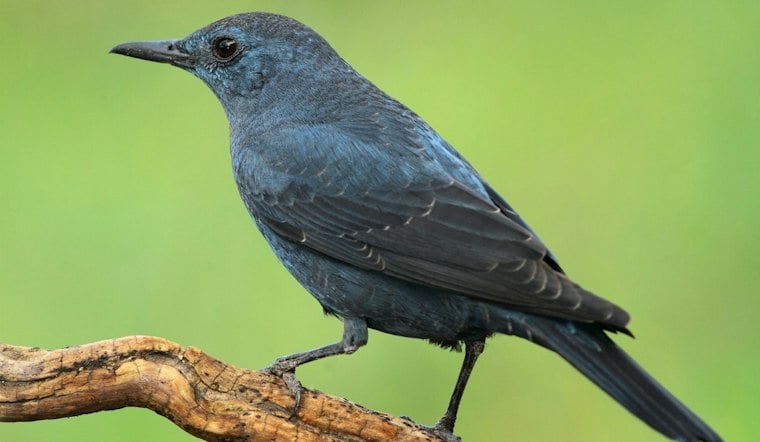
A songbird that has no business being anywhere near Oregon has turned up along the Columbia River in North Portland, and local birdwatchers are scrambling to catch a glimpse before it moves on. The male Blue Rock Thrush, a species native to Asia, was first documented at Broughton Beach on Sunday, September 13, before working its way westward along the shoreline toward the Columbia Slough corridor.
The sighting marks the fourth documented occurrence of the species in the United States and the third recorded occurrence in the region, according to Mike Maskell, conservation director at the Bird Alliance of Oregon, who was quoted by KPTV. Maskell said plainly that the species should not be in the region at all, and the sighting has already drawn local birdwatchers and conservationists eager to see the bird for themselves. The Bird Alliance of Oregon has since confirmed the bird is a male of the East Asian subspecies *Monticola solitarius philippensis*, identifiable by a chestnut-rufous belly that contrasts with its deep blue head and back, according to a report shared on Bluesky.
A Bird Thousands of Miles Off Course
According to KPTV, the Blue Rock Thrush was migrating southward from the Arctic when it somehow ended up along the Columbia River and Columbia Slough in North Portland. Conservationists suspect the bird may have encountered a storm or other weather disturbance that steered it down the Pacific Flyway of North America, per the station's report — a notable detour, since the species usually migrates along the Asian coastline rather than crossing the Pacific Ocean.
The Bird Alliance of Oregon also points to another possible explanation: ship assistance, in which migrating birds rest aboard trans-Pacific commercial cargo vessels before continuing their journey, according to the same Bluesky account. The same account presents ship assistance as a possible way the bird could have traveled partway across the ocean. Despite the ordeal, the bird appears healthy and settled, per the same account.
An Extreme Rarity by Any Measure
The American Birding Association classifies the Blue Rock Thrush as a Code 5 rarity, a designation used for birds seen five or fewer times within official ABA checklist territory, as noted in documentation shared by the American Birding Association. The Portland sighting follows two other landmark West Coast appearances. In April 2024, an amateur photographer unexpectedly captured images of a Blue Rock Thrush at Hug Point State Park on the Oregon coast, marking the first confirmed U.S. record of the species, as reported by Smithsonian Magazine.
A later sighting on Southeast Farallon Island was reported as California's first record, though the report had not yet been vetted by a records committee. An earlier sighting in June 1997 in British Columbia, Canada, is sometimes cited as North America's earliest record, but the American Birding Association did not include it on official checklists over concerns about the bird's provenance, even though provincial authorities in British Columbia accepted the record.
Watching Responsibly Along the Slough
The Portland discovery has already prompted interest well beyond the metro area, with social media reports from local birding observers noting that out-of-state birdwatchers have flown into Oregon specifically to view the rare bird. Birdwatchers have traveled to see the bird.
Wildlife officials are urging anyone hoping to see the thrush to observe it responsibly and keep a respectful distance, allowing it to feed and rest without disruption, according to KPTV. Visitors should follow that guidance and avoid disturbing the bird. For now, the bird remains along the Columbia Slough corridor, its next move as uncertain as the journey that brought it there.





