

























































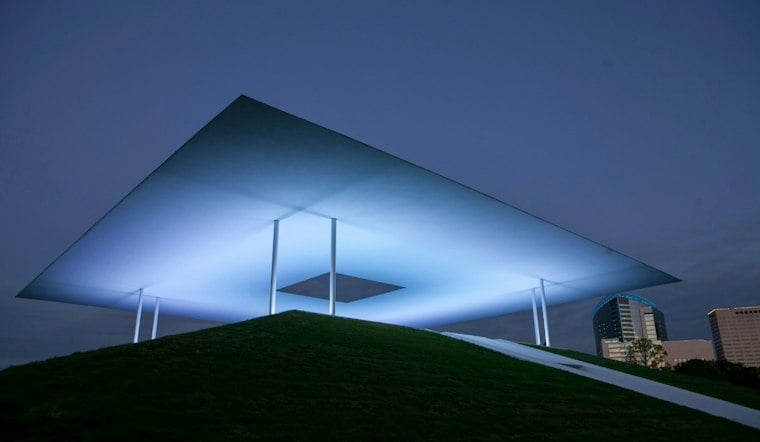
James Turrell's Twilight Epiphany Skyspace, the pyramid-shaped pavilion that draws thousands of visitors to Rice University's Houston campus each year, will glow again on Tuesday for the first time since 2024. The installation's sunrise and sunset light sequences went dark for 28 months while crews upgraded its lighting system and the university pushed forward with a major construction project next door.
Rice officials say the Skyspace welcomed an estimated 20,000 visitors annually before its temporary closure, according to Rice News. As Community Impact reports, the closure began in 2024 and coincided with construction of the Asha and Farid Virani Hall, the university's new business school building. The site is scheduled to reopen on September 15.
The lighting overhaul itself moved quickly. Per the Houston Chronicle, the project cost approximately $500,000, split evenly between Rice University and the Moody Center for the Arts, and the new LED fixtures took only a few weeks to install under the supervision of Turrell's own studio. Yet the Skyspace stayed shuttered far longer than that installation window required.
Why the Closure Stretched Past Two Years
University administrators kept the Skyspace closed for the full 28 months specifically to shield visitors from the noise and disruption of the neighboring Virani Hall construction site, the Rice Thresher reports. Officials prioritized preserving the installation's quiet, meditative atmosphere over reopening as soon as the physical lighting work wrapped up. The new business building itself spans 112,000 square feet and sits alongside McNair Hall, according to Rice News.
The Skyspace sits inside the Suzanne Deal Booth Centennial Pavilion, named for the Rice alumna and trustee whose $5 million gift originally commissioned the structure in 2012. Booth had previously worked as an assistant to Turrell early in her career, and the Houston Chronicle notes the naming doubled as a tribute tied to Rice's centennial. The pavilion sits adjacent to the Shepherd School of Music, and per Community Impact, the location was deliberate, since the Skyspace also functions as a performance laboratory for Shepherd students.
A Pyramid Built for Light and Sound
Architect Thomas Phifer and Partners designed the truncated pyramid, built by contractor Linbeck on a grass berm roughly 12 feet 8 inches tall. Architectural Record reports that lower-level benches carved from Texas pink granite quarried in Marble Falls seat 44 people, while upper-level concrete benches accommodate another 76, putting total capacity around 120 visitors per Community Impact. The roof forms a 72-foot square with a 14-by-14-foot aperture cut into its center, framed by a carbon-steel knife-edge that gives the ceiling a paper-thin visual profile, according to Architectural Record.
That geometry is central to the experience: as daylight shifts, the aperture appears to flatten into the plane of the ceiling, and LED projections wash color across the white surface above. Community Impact describes the resulting show as a sequence of light and naturally occurring sky light, a combination the Moody Center for the Arts says produces the piece's shifting tones. ArchDaily notes the pavilion was engineered as Turrell's first Skyspace built specifically for live music, with 12 speakers hidden inside its plaster walls to support the Rice Electroacoustic Music Labs — though the music stays off during the standard daily twilight sequences and is reserved for custom performances.
What Comes With the Upgrade
The Moody Center for the Arts installed updated controls alongside the new fixtures, and Community Impact reports the modern LED system is designed to expand support for future performance customizations while preserving the installation's original artistic identity. Rice University students will continue staffing the site during weekday sunset sequences through the James Turrell Skyspace Docent Program, run by the Moody Center, answering visitor questions and providing historical context on-site.
Joel Thompson said the profile and popularity of the Skyspace cannot be overstated, according to Community Impact. Turrell has designed more than 100 Skyspaces worldwide, and Rice's version remains the only two-story example among them. Texas Highways notes it stands alongside two other major Turrell installations in the state — The Light Inside, a subterranean tunnel at the Museum of Fine Arts, Houston, and The Color Inside, a rooftop Skyspace at the University of Texas at Austin — each relying on computer-controlled LED illumination to reshape how visitors perceive light and space.
Admission remains free and no reservations are required. The Skyspace, built from grass, concrete, stone and composite steel at 6100 Main St. in Houston, stays open throughout the day, seven days a week, though the signature light sequences are timed to sunrise and sunset. Community Impact advises visitors to check sunrise and sunset times before arriving, since the sunrise sequence begins about 40 minutes before sunrise and the sunset sequence starts roughly 10 minutes before sunset.





