

























































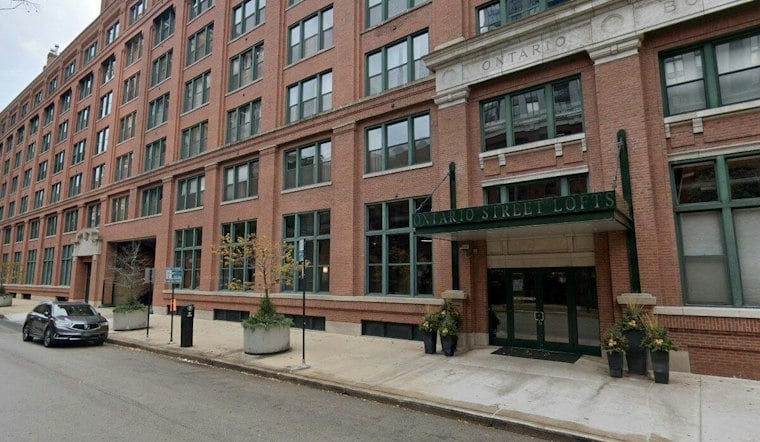
A four-story office building at 401 W. Ontario St. in River North has received a renovation permit to convert into 57 residential units, marking the next step for a project that developer Monroe Residential Partners LLC has spent months lining up. The building, tucked midblock between N. Orleans St. and N. Kingsbury St., will lose its ground-floor retail and upper-floor office space entirely in favor of apartments branded as Birken Lofts.
The permit follows a distressed sale: Monroe Residential Partners bought the 48,000-square-foot building for $5.4 million out of financial receivership, according to REBusinessOnline. Former owner Conlon & Co. had paid $6.5 million for the property back in 2015, but faced an October 2024 foreclosure lawsuit over a $6.4 million commercial mortgage before agreeing to a lender-approved sale, as detailed by CoStar News. The building had faced high vacancies and property-tax pressures before the sale went through.
Design work on the conversion comes from Westfield Architects, according to Urbanize Chicago, which first reported details of the permit. The residential entry and a loading dock will both face W. Ontario St., while the building's basement level is set to house a resident lounge, a separate TV lounge, a fitness room, and a bike room with 57 bike parking spaces.
How the Units Break Down Across Four Floors
The ground floor will hold 12 residential units, including four duplex-down units that extend into the basement, per the same Urbanize Chicago report. Each of the upper floors is planned to contain 15 units apiece. Overall, the unit mix calls for 42 one-bedroom apartments, 12 two-bedroom units, and three studios.
Notably, the project will include zero car parking spaces. That's possible because Monroe Residential Partners recently secured Zoning Board of Appeals approval for several project variations, including a reduction of the minimum required off-street parking from 40 spaces to zero at the transit-served location. The ZBA approval also allowed alternative compliance with the minimum required 2,252 square feet of on-site open space and established residential use below the second floor, according to Urbanize Chicago's reporting.
A Nod to River North's Industrial Past
The Birken Lofts name honors the building's original 1905 construction as the timber-and-brick headquarters of scrap merchant S. Birkenstein & Sons, which added a fourth story in 1912, according to Birken Lofts' own project history. The structure reportedly spent decades functioning as a scrap and paper warehouse before its late-20th-century conversion into office space — a detail that ties the coming apartments back to River North's industrial-era identity as what was once known as “Smokey Hollow.”
Monroe Residential Partners has budgeted roughly $20 million in total development costs for the conversion, with construction expected to start in October, according to CoStar News, after all remaining office tenants have moved out. 3F Construction, the project's general contractor, will handle the conversion through completion now that the permit has been issued.
Birken Lofts is planned as a residential conversion. Monroe Residential Partners and 3F Construction are co-owned by principals Drew Friestedt and Michael Obloy, who specialize in adaptive reuse projects around Chicago, according to CoStar News.
Part of a Wider River North Building Boom
The same development team is simultaneously working with Mo2 Properties on another River North conversion at 116-122 W. Illinois St., turning the 1913 Boylston Building into 36 apartments. That project sits within a growing cluster of office-to-residential conversions in the neighborhood, which Hoodline has tracked closely, including a July acquisition at 226 W. Ontario St. to add two residential stories.
The trend extends well beyond River North. Chicago's Central Business District office vacancy rate has remained in the mid-20% range in early 2026, while commercial landlords have faced heavy debt and property tax liabilities.
For a building like 401 W. Ontario, that broader financial pressure translated into a very specific outcome: a century-old timber loft, once headed toward foreclosure, now positioned to house dozens of new River North renters within a year.



