

























































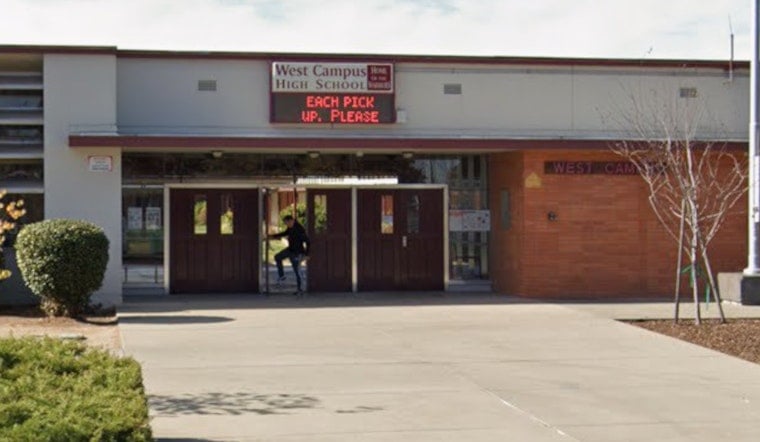
Seven Sacramento schools are getting new crosswalks, upgraded traffic signals and pedestrian islands after the City Council approved $2.25 million for road safety improvements around their campuses. The project targets streets near West Campus High School, Natomas High School, Father Keith B. Kenny Elementary, William Land Elementary, Smythe Academy of Arts and Sciences, St. HOPE Public School PS7 and The Met Sacramento High School.
Pacific Excavation Inc. will handle construction under a contract worth nearly $1.7 million, after submitting the lowest bid in June, according to the Sacramento Bee. The work includes new or upgraded crosswalks, pavement markings, curb ramps, traffic signs, traffic-signal modifications, bicycle-lane treatments and student loading areas. Near West Campus High School and Mark Twain Elementary, crews will also install a pedestrian island for children walking to class. The city separately awarded a professional engineering services agreement worth up to $416,535 to UNICO Engineering, Inc. to help oversee the redesigns, according to city records filed under File 2026-01440.
The improvements trace back to a 2021 school safety study that evaluated conditions at 20 campuses citywide, with locations for the current round of work selected based on that analysis, per the Bee. The Sacramento City Council formally adopted the resulting Resolution No. 2021-0042 on February 16, 2021, laying out short- and long-term infrastructure recommendations. Roughly $1.7 million of the project's funding comes from federal Community Project Funding, while $550,000 draws from the city's Major Street Construction Fund.
A Federal Earmark Years in the Making
The federal money behind the project stems from a request by Rep. Doris Matsui, who secured $2.2 million in Community Project Funding for Sacramento's Vision Zero school safety program as part of the FY2022 federal appropriations package passed in March 2022, according to Matsui's office. That earmark helped translate the 2021 study's recommendations into an actual construction budget years later.
The seven-school project is also just one phase of a larger push. The council adopted Resolution 2025-0143 in May 2025, launching a Vision Zero School Safety Project Phase 2 to evaluate and design upgrades for 11 additional campuses, including Bret Harte Elementary and Sacramento Charter High School, according to city records. Phase 2 planning relies on local Safety Streetscape Bicycle and Pedestrian funds rather than the federal dollars behind the current round, illustrating how the city is tackling campus safety incrementally rather than in one comprehensive overhaul.
A Councilmember Says Enforcement Isn't the Whole Answer
Councilmember Eric Guerra, whose southeastern district includes Tahoe Park, said safety concerns remain even as the new contract moves forward. Guerra told the Bee that people are not yielding at intersections and asked drivers to pay attention on the road. He said the city needs to do more with the federal and city dollars already available, even as the Department of Public Works remains reliant on competitive grants to fund each phase of work.
The stakes behind that frustration are personal for the Fruitridge Manor neighborhood. In 2012, 16-year-old West Campus High School student Michelle Murigi was struck and killed near Fruitridge Road and 58th Street, less than half a mile from her school, according to the Bee. The city and Sacramento City Unified School District spent $400,000 that year to install traffic signals at that same intersection, a reminder that safety fixes near schools have been decades in the making even as new deaths continue to mount.
The Broader Toll on Sacramento Streets
At least 28 people have died on Sacramento streets so far in 2026, per the Bee's reporting, even as the city says it remains committed to improving road safety but has yet to change its underlying funding structure. Sacramento first adopted its Vision Zero pledge in 2017, aiming to eliminate all traffic deaths and serious injuries by 2027 — a deadline now just months away with fatalities still climbing.
The city's own traffic safety data show why officials keep returning to school corridors specifically: 77% to 80% of all fatal and severe-injury collisions occur on Sacramento's designated High Injury Network, a set of streets that makes up just 14% of the city's total road mileage, as Hoodline has previously reported. That concentration is part of why the region continues to rank poorly nationally — Smart Growth America's 2026 “Dangerous by Design” report tied the Sacramento–Roseville–Folsom metro area for 19th deadliest in the country for pedestrians and other vulnerable road users, according to KCRA.
Bicyclists have borne a disproportionate share of that danger too. UC Berkeley SafeTREC research analyzing California Highway Patrol collision records found Sacramento County recorded 16 bicyclist fatalities in 2023, the third-highest count of any California county behind only Los Angeles and San Bernardino. Citywide, Sacramento traffic records show 332 traffic fatalities and more than 1,300 serious injuries occurred on city streets between 2015 and 2024, a decade-long toll that has driven advocate calls for physical road redesigns rather than relying primarily on enforcement.
Other Efforts to Ease Pressure on School Streets
Beyond the construction contracts, the city has leaned on other tools to reduce vehicle traffic around campuses. Sacramento established 15-mph speed limits near 115 schools back in 2019, lowering posted speeds on 225 two-lane residential streets under state vehicle code provisions. Sacramento Regional Transit also offers fare-free transit to all TK-12 students through its RydeFreeRT program, which logged more than 5 million youth rides in fiscal year 2025 — an effort aimed at cutting down on the car drop-off congestion that contributes to conflicts near school gates.




