

























































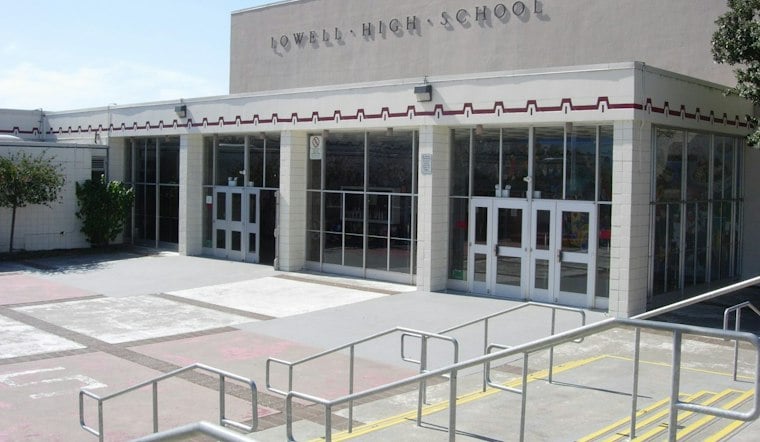
More than 30,000 San Franciscans identify as both Asian and white, giving the city nearly a 4% share of that multiracial identity — the highest of any U.S. county outside Hawaii. At Lowell High School, that demographic reality has taken the shape of a weekly club where 10 to 15 students gather every Monday to talk about growing up mixed-race in a city where it is increasingly the norm rather than the exception.
The Lowell Hapa Club serves multiracial Asian students, though co-president Nelly Rauseo, 17, says it is open to anyone, according to the San Francisco Chronicle. Earlier this year, the club organized a presentation on Alysa Liu, a figure skater from Oakland who is half-Chinese and half-white.
San Francisco's numbers help explain why. The city's population is roughly 40% Asian, and among residents under age 10, nearly 16% identify as both Asian and white — up from a 3% share among school-aged children generally, edging past 12% in some measurements, per the Chronicle's reporting. San Francisco's overall Asian-and-white share is triple the percentage found in the U.S. as a whole, a gap that reflects decades of demographic and legal change.
From Census Boxes to TikTok Trend
None of this visibility existed on paper before 2000. The U.S. Census Bureau's 1997 revision to Statistical Policy Directive No. 15 allowed Americans, for the first time, to select more than one race on federal forms — an option first implemented in the 2000 Decennial Census, according to the U.S. Census Bureau. Before that, respondents were forced to pick a single racial category, obscuring multiracial Asian identity in official statistics entirely.
UC Berkeley students played a direct role in that shift. Multiracial students at the university formed the Hapa Issues Forum in the 1990s, advocating for acceptance of mixed-race people within the wider Asian American community and helping secure the Census Bureau's allowance for respondents to self-identify as multiple races, per the Chronicle. As Hyphen Magazine has documented, the group was founded in 1992 in part as a response to exclusion within Japanese American communities and dissolved after 15 years.
The demographic engine behind the trend runs deeper than any single policy change. A 2017 analysis from the Pew Research Center found that 46% of U.S.-born Asian newlyweds married someone of a different race or ethnicity, compared to just 24% among foreign-born Asian newlyweds — nearly double the rate.
Where ‘Hapa’ Gave Way to ‘Wasian’
The vocabulary itself has shifted alongside the demographics. Hapa entered the Hawaiian language in the early 1800s as a transliteration of the English word half, originally used in phrases like hapa haole to describe people of part-European or white ancestry, according to a summary on Wikipedia. As the term spread to mainland college campuses in the 1990s, Native Hawaiian scholars and activists raised concerns about cultural appropriation and erasure — a tension that persists in how the Lowell club and others like it choose their name.
Wasian, a portmanteau of white and Asian, gained widespread Gen Z popularity through the late-2019 viral TikTok trend #WasianCheck, created by user Niko Katsuyoshi, which amassed over 1.7 billion views by 2022, according to Joy Sauce. The digital publication Hapa Mag, founded in 2017, changed its name in 2021 to Mixed Asian Media to reach a broader audience. Wasian meetups have since emerged in cities including San Francisco and New York, and Bay Area high schools beyond Lowell are creating similar clubs for multiracial Asian students, per the Chronicle.
Lisa Tsubouchi founded Mixed Kids Meetups, a Bay Area social group for mixed-race people, in 2021. She said she wished, back in high school, for a community sharing the same experience she was navigating alone. Yoshio Boris, 29, who grew up in Marin County as the son of a Japanese mother and a white father, said he eventually found that community through mixed-race Asian meetups as an adult — the kind of gathering younger San Franciscans like the Lowell students no longer have to wait for.
Questions About Representation Persist
The rise of visible Wasian celebrities — including Charli XCX, Olivia Rodrigo, Hudson Williams and Lola Tung — has coincided with growing interest in biracial celebrities, the Chronicle reported. Rebecca King-O’Riain, a sociology professor in Ireland, has discussed labels and shared experiences among mixed-race people.
San Francisco's concentration of young mixed-race residents fits a broader national pattern. U.S. Census Bureau data from 2020 found multiracial Americans had the youngest median age of any racial group, at 29.5 years, with 32.5% of the multiracial population under 18, according to the U.S. Census Bureau. For 15-year-old Lowell sophomore Phoebe Paek-Micone and her peers, that statistical trend now has a name, a Monday meeting time, and a room at their own high school.




