

























































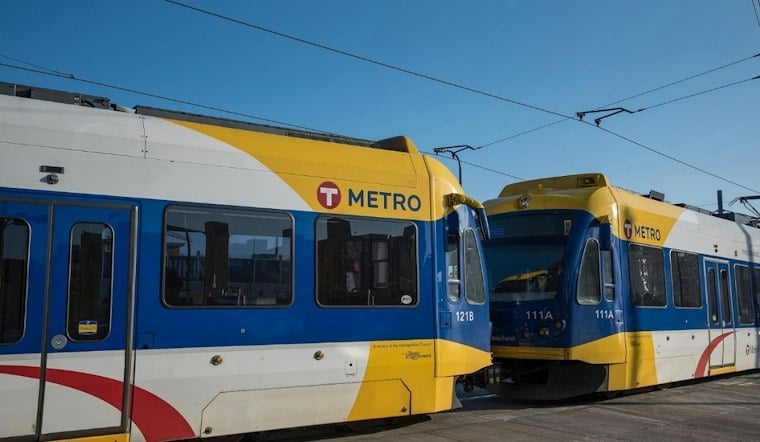
A person was struck and killed by a Metro Blue Line train at the 46th Street Station in Minneapolis on Saturday morning, marking the second light-rail fatality in the Twin Cities in as many days. Metro Transit Police responded to the scene shortly after 10 a.m., and the person was pronounced dead there. Buses were temporarily substituted for trains between the Fort Snelling and Franklin Avenue stations while investigators worked the scene.
According to Metro Transit, the Blue Line train struck a person on the tracks at the station, and Metro Transit Police are now investigating the collision, as first reported by the Minnesota Star Tribune. The crash came less than a day after a Green Line train struck and killed another person near University and Prior avenues in St. Paul on Friday night, an incident Hoodline previously reported forced temporary bus replacements between the Snelling and Raymond avenue stations. Authorities responded to that scene around 8:30 p.m., where first responders attempted lifesaving measures before the person died. The Green Line victim's identity has not been released, and Metro Transit Police are investigating both collisions.
State Oversight Kicks In Automatically
Under Minnesota's Rail Safety Oversight program, Metro Transit must notify the Minnesota Department of Public Safety's Office of State Safety Oversight within two hours of any fatal transit incident, a requirement that applies across every light-rail line in the Twin Cities, according to state documentation from the Minnesota Department of Public Safety. That means both Saturday's Blue Line crash and Friday's Green Line death triggered the same mandatory state-level review process, layered on top of the investigations Metro Transit Police are conducting into the collisions.
The back-to-back fatalities also land against a backdrop of rising pedestrian deaths statewide. State safety reporting has shown pedestrian traffic fatalities climbing across Minnesota, per KARE 11.
46th Street Station's History of Safety Concerns
The Blue Line fatality also occurred at a station with a documented history of neighborhood safety complaints. Residents and business owners near the 46th Street station petitioned Metro Transit in June 2025 to address persistent drug use and crime around the platform, even asking the agency to consider closing an adjacent footpath, the Minnesota Star Tribune reported at the time. That same reporting noted that nearly 70% of surveyed riders opposed closing the footpath despite the concerns raised.
Metro Transit has been in the middle of a broader infrastructure push along the corridor. The agency launched its multi-year “Renew the Blue” initiative in May to replace worn track components and modernize signal systems on the Blue Line, which first opened in 2004, work Hoodline detailed in earlier coverage of weekend shutdowns tied to the program. The maintenance schedule has included full-line weekend and summer service closures as crews work through the upgrades.
Crossing Rules and Fare Enforcement Shifts
Minnesota law draws a clear line between how vehicles must treat freight rail crossings versus light-rail crossings. State statute requires passenger vehicles and school buses to stop at railroad grade crossings, but explicitly waives that requirement at light-rail crossings located at signalized public street intersections with posted warning signs, according to the Minnesota Revisor of Statutes. Local road authorities determine the signage at those signalized intersections.
Separately, Metro Transit has shifted how it handles fare violations on light rail. In 2023, the agency replaced police-issued criminal misdemeanor charges for fare evasion with administrative citations, a change that led to a sharp rise in administrative violations and a drop in criminal charges, mirroring fare enforcement models adopted by transit systems elsewhere in the country.
Metro Transit is simultaneously expanding its light-rail footprint. The agency began live track testing in September 2025 on the 14.5-mile Green Line extension to Eden Prairie, a project that will add 16 new stations across the southwest metro ahead of a planned 2027 opening. Safety documentation Metro Transit has presented to Operation Lifesaver outlines the engineering measures already deployed at Twin Cities platforms, including cantilevered blankout warning signs, “wigwag” vehicle headlights, and multilingual outreach campaigns aimed at platforms with heavy foot traffic and histories of near-misses.





