

























































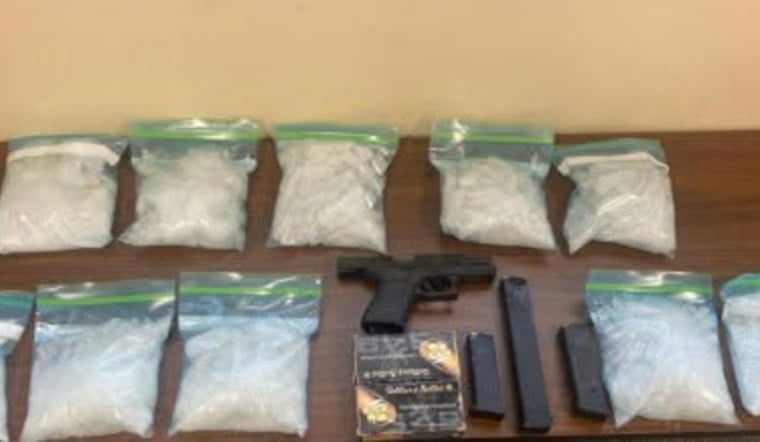
A methamphetamine and fentanyl trafficking ring that ran drugs and guns between Dayton, Ohio, and Seymour, Indiana, has ended with seven people sentenced to federal prison, including a ringleader who got more than 19 years and an unlawfully present El Salvadoran national who will be deported after his release. The case capped a nearly three-year investigation that seized 12 kilograms of methamphetamine, a kilogram of fentanyl, 25 firearms, and $11,250 in drug proceeds.
The sentences were announced in a release from the U.S. Department of Justice, which credited the U.S. Attorney's Office for the Southern District of Indiana with leading the prosecution. According to the Seymour Police Department, the case was titled “Seven, Including El Salvadoran National, Sentenced to Federal Prison for Armed Drug Trafficking Ring Crossing State Lines” and involved seven defendants sentenced for their roles in the armed conspiracy.
Ringleader Jose Buval, 35, of Seymour, was sentenced to 19 years and 2 months in prison and five years of supervised release after pleading to two counts of possession with intent to distribute methamphetamine and possession of a firearm in furtherance of drug trafficking. Prosecutors said Buval directed the trafficking activities of his co-conspirators, orchestrating distribution of large quantities of methamphetamine and fentanyl throughout Indianapolis, southern Indiana, and Ohio while supplying his network with both drugs and firearms.
The Ripley County Traffic Stop That Cracked the Case
The investigation's key break came on September 21, 2023, when Indiana State Police stopped a vehicle driven by Cesar Melendez-Martir in Ripley County, Indiana, just west of Cincinnati, according to WHAS11. Officers recovered approximately 2,854.7 grams of methamphetamine and a handgun that Buval had provided, after law enforcement had observed Buval and his co-conspirators traveling from Indiana to the Dayton, Ohio, area and obtaining more than 2,800 grams of methamphetamine there that same day.
Melendez-Martir, 27, of El Salvador, was charged with possession with intent to distribute methamphetamine and carrying a firearm during and in relation to a drug trafficking crime. He took possession of the methamphetamine obtained in Dayton and was sentenced to 15 years in prison and five years of supervised release. He was unlawfully present in the United States at the time of the offenses and will be deported to El Salvador after completing his sentence.
The Rest of the Network Faces Years Behind Bars
Jorge Santana-Martinez, 30, of Indianapolis, was sentenced to 13 years for distribution of 50 grams or more of methamphetamine. Jonathan Ojeda, 32, of Columbus, Indiana, received 10 years on the same charge, and Brandon Bowman, 32, of Seymour, was sentenced to 10 years after being charged with making a false statement during a firearm purchase alongside distributing 50 grams or more of methamphetamine — a straw-purchase offense that federal law treats as a felony meant to keep guns out of the hands of prohibited buyers, per the Justia Law summary of federal firearm statutes.
Robert Zambrano, 50, of Columbus, Indiana, was sentenced to 5 years after being charged with possession with intent to distribute 50 grams or more of methamphetamine, while James McMillian, 49, of Columbus, Indiana, received 4 years for possession with intent to distribute methamphetamine. U.S. District Judges James P. Hanlon, Jane Magnus-Stinson, and Tanya Walton Pratt imposed the sentences across the seven cases.
Why a Small-Town Department Needed a Federal Task Force
Seymour Police Chief Greg O’Brien said the case succeeded through partnership among the Department of Justice, the DEA, and local law enforcement task force officers. WHAS11 reports that small, rural municipal departments like Seymour's rely heavily on federal Task Force Officers to supply the financial, technical, and personnel resources that complex, multi-year drug investigations demand — resources local budgets typically can't cover on their own.
That reliance shows in the sheer number of agencies involved: beyond the DEA and HSI, the investigation drew on the ATF, U.S. Postal Inspection Service, IRS Criminal Investigation, the Jackson County Sheriff's Department, the Hamilton/Boone County Drug Task Force, the Shelbyville Police Department, and the Ripley County Prosecuting Attorney's Office, according to the Department of Justice. The Columbus-area co-defendants were investigated in part through the Joint Narcotics Enforcement Team, a task force the City of Columbus, Indiana says was formed in 2015 by combining Columbus Police Department officers, Bartholomew County Sheriff's deputies, and Bartholomew County prosecutors to aggressively target regional drug dealing.
Federal Officials Tie the Case to a Broader Task Force Mission
U.S. Attorney Tom Wheeler said armed drug traffickers who flood communities with methamphetamine and fentanyl will face serious federal consequences, and he thanked Assistant U.S. Attorney Patrick Gibson for prosecuting the case. HSI Chicago Special Agent in Charge Matthew Scarpino said armed trafficking networks moving fentanyl and methamphetamine across state lines put communities at serious risk. IRS Criminal Investigation Chicago Field Office Acting Special Agent in Charge Robert J. Kuszynski said IRS special agents trace drug proceeds and use them as evidence against people profiting from illegal drug enterprises — work reflected in the $11,250 in drug proceeds seized during the investigation, alongside 890 grams of cocaine also recovered.
The prosecutions are part of the Crossroads Homeland Security Task Force initiative, which the Seymour Police Department's Facebook post describes as a whole-of-government partnership targeting criminal cartels, foreign gangs, transnational criminal organizations, and human smuggling and trafficking rings. The task force comprises agents and officers from federal, state, and local law enforcement agencies. It was established under Executive Order 14159, “Protecting the American People Against Invasion,” signed by President Donald Trump on January 20, 2025, which mandated statewide multi-agency task forces to combine immigration, drug, and weapons enforcement, according to the Federal Register.
The Statutes Behind the Long Sentences
The lengthy prison terms trace back to specific federal statutes rather than judicial discretion alone. Under 21 U.S.C. § 841, drug trafficking offenses involving 50 grams or more of actual methamphetamine carry a mandatory minimum of 10 years and up to life in prison, according to the Cornell Law School Legal Information Institute. Separately, 18 U.S.C. § 924(c) requires an additional five-year minimum sentence — which must run consecutively, not concurrently, with the underlying drug conviction — for anyone who possesses or carries a firearm in furtherance of a drug trafficking crime, per Deandra Grant Law. Those stacked mandatory minimums help explain why armed defendants like Buval and Melendez-Martir received sentences well beyond a decade.
Under Department of Justice enforcement policy, noncitizens convicted of federal drug trafficking felonies face mandatory removal proceedings once they finish their prison terms and must surrender directly to Immigration and Customs Enforcement — the pipeline that will send Melendez-Martir back to El Salvador after his 15-year sentence concludes.
This is not Seymour's first brush with large-scale meth enforcement this year. Hoodline previously reported on a 400-gram meth seizure during a local probation check in August, and on a Noble Street drug bust that turned up a $20,000 meth stash in June. Southern Indiana has also seen larger regional busts: the Daily Journal reported that in July 2025, federal prosecutors in the Southern District of Indiana sentenced 22 people in a separate network that laundered $3.58 million and used couriers to move methamphetamine to distributors in Seymour and Columbus.





