

























































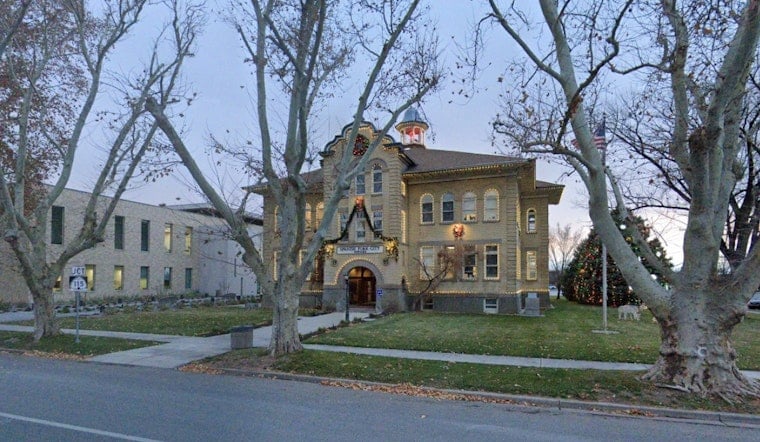
Spanish Fork residents are furious with their mayor after he publicly backed a $1 billion proposal to turn the long-vacant Fingerhut warehouse into a self-powered artificial intelligence data center, a plan the city council tabled following a public hearing that stretched past six hours. Mayor Mike Mendenhall said the project, pitched by Provo-based Volition Industries, represents an opportunity for the city, even as neighbors packed council chambers to voice opposition.
The hearing on August 18 drew residents who argued the company, led by CEO Jeff Chavez, had failed to provide enough data or supporting evidence for its claims of minimal community impact, according to KSL News. The city council ultimately tabled a proposed text amendment that would have established rules for data centers with onsite power generation, rather than voting it up or down that night. Volition wants to redevelop the roughly 1.1-million-square-foot former Fingerhut warehouse at 4000 E. U.S. Highway 6, a structure built in the mid-1990s that has sat mostly underutilized since the catalog retailer's business declined, according to REBusinessOnline.
Mayor's Support Sparks Backlash Online
Mendenhall told residents he had researched the proposal and consulted independent people in different fields before deciding a private business could deliver on its promise for the existing million-square-foot building, per the KSL report. He said he had read all residents' emails and would continue reading them, and argued that if the project proceeds, city regulations should protect the community. That did not sit well with everyone in the room.
Resident Teresa Pierce told the council that residents are not lab rats. Heather Palmer said Mendenhall did not take constituents' opinions, research, and concerns seriously, and she called for him to be impeached. Madi Bringhurst said residents' emails and concerns felt meaningless, while a resident identified only as Bringhurst asked the city to consider a law holding companies accountable for promises made during sales pitches. The mayor's social media post supporting the project reportedly drew hundreds of comments questioning his stance, the outlet noted.
Volition's Off-Grid Pitch
Volition's pitch hinges on a technical workaround for two of the most common data center complaints nationwide: grid strain and water depletion. The company plans to partner with Bloom Energy to power the facility off-grid using natural-gas-fueled solid-oxide fuel cells paired with closed-loop cooling, according to municipal records compiled by OpenUtah. Chavez has said the goal is a sustainable data center that solves problems created by existing facilities, and that Volition's approach is innovative compared with other data centers. The company says its facilities do not connect to the existing power grid, require significantly less water than traditional data centers, and produce substantially lower emissions and heat.
Those claims come with a track record. Chavez previously sought to build a 30-to-40 megawatt fuel-cell-powered data center in nearby Provo before pivoting to Spanish Fork after facing local pushback there, KSL News has reported. Tom Thomas told the council that residents deserve more than unsubstantiated promises, hypothetical projections or anecdotal opinions, and he called on elected officials to honor residents' opposition. Thomas said plainly that residents do not want a data center in Spanish Fork.
Zoning Rules Meant to Contain Expansion
City planners have drafted a Title 15 zoning amendment that would require off-grid data centers to operate in permanent electrical isolation from the municipal grid and cap the city at no more than two such sites within its limits, according to KSL News. The proposed regulations would also impose strict standards on water use, air quality, and noise. City officials say those provisions are meant to prevent unconstrained expansion if the Volition project or others like it move forward.
The proposal's scale is significant for a city of Spanish Fork's size. OpenUtah's city council presentation records put the project's estimated value at roughly $1 billion, with the potential to house up to $4 billion in server and computing equipment inside the building. The Fingerhut site also sits adjacent to Spanish Fork's 2,681-acre Verk Industrial Park, where a local infrastructure district authorized $66.8 million in bonds for roads, substations, and utilities under the Utah Inland Port Authority. Separately, the state allocated $13 million in 2025 through Senate Bill 39 for road construction to connect Fingerhut Road over railroad tracks to U.S. Highway 6, according to the Utah State Legislature.
A Broader Utah Reckoning Over Water and Power
Water usage remains a flashpoint for data center opposition statewide. The Utah Legislature passed House Bill 76 in April, a water transparency law requiring all commercial data centers operating in the state to publicly report their annual water consumption, as reported by KUTV 2News. Eagle Mountain City offers one regional benchmark for how a data center's water footprint can be managed: the city completed a joint infrastructure project with Meta in June 2024 that recycles server-cooling discharge water from Meta's $1.5 billion Eagle Mountain data center into treated effluent used to irrigate Cory Wride Memorial Park, according to Eagle Mountain City records.
Frustrated Spanish Fork residents have organized a Change.org petition titled Protect Spanish Fork, gathering hundreds of signatures demanding the city council reject the Title 15 zoning amendment and deny Volition's project outright. Opponents argue that off-grid natural gas facilities pose noise, heat, and air quality risks too close to residential zones near the mouth of Spanish Fork Canyon. The city council is scheduled to revisit data center requirements and a potential development agreement with Volition on Tuesday.
The fight in Spanish Fork mirrors a similar clash in Cedar City, where residents have pushed back against a proposed AI data center over resource drain and environmental concerns, as per Hoodline. Whether Spanish Fork's proposed regulatory safeguards will be enough to satisfy residents, or whether the council will ultimately side with the mayor's economic case, remains unresolved as the debate heads back to city hall.





