

























































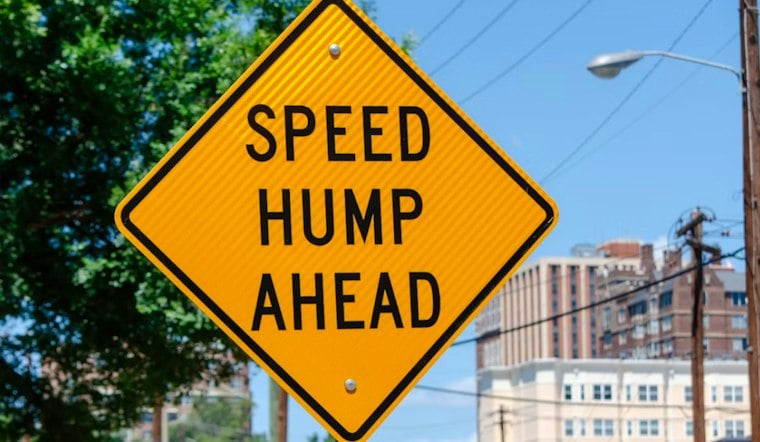
St. Louis leaders are pushing a bill that would let neighbors request speed humps and other traffic-calming fixes without waiting for the entire Board of Aldermen to pass a standalone ordinance for every single block. Alderman Michael Browning introduced Board Bill 75, titled Traffic Calming, and plans to bring it before the Board of Aldermen on Friday. The measure would replace a patchwork, block-by-block legislative process with a single administrative system for evaluating and approving requests.
Under the city's current approach, getting speed humps installed has meant clearing a steep bar: residents needed signed petitions from representatives of at least two-thirds of the properties on a block just to get their street evaluated, according to the City of St. Louis. Even after clearing that threshold, every individual project still required its own ordinance passed by the full Board of Aldermen — a process illustrated by Board Bill 16, or Ordinance 72014, which the board approved in July 2025 to authorize speed humps on specific blocks in the 5th Ward, per city records. As reported by First Alert 4, that meant residents, neighborhood associations, community improvement districts, ward alderpersons, and even police captains all had separate paths to request traffic calming, but no single, faster mechanism to get it approved.
A Bridge to the City's Future Transportation Department
Board Bill 75 would remove the requirement that an ordinance be passed for each project, instead creating what First Alert 4 describes as a centralized way for neighborhood traffic calming requests to move forward. Browning said the change means residents will be able to organize with neighbors to request traffic calming when streets feel unsafe, according to the outlet's report. If the bill passes, the new process would take effect July 1, 2027.
The bill builds on Proposition T, the city charter amendment St. Louis voters approved in November 2024 to consolidate street design, safety, and maintenance under a single Department of Transportation, according to Ballotpedia. That full charter transition, however, does not take effect until July 2029, per the City of St. Louis. Scott Ogilvie, the city's transportation planning executive, called the bill one of many steps toward that Department of Transportation transition, First Alert 4 reported.
Until the new department consolidates funding, ward capital accounts will continue paying for traffic calming projects, per the outlet's report. That funding model dates back to a half-cent capital improvement sales tax established in 1993, which generates roughly $8 million annually split equally among ward accounts controlled by individual alderpersons, according to NextSTL — providing about $300,000 per ward each year for local street and sidewalk repairs.
Tracking Map Aims to Add Accountability
Board Bill 75 also includes an online map that would show traffic calming activity and funding requests, updated monthly, First Alert 4 reported. The map is designed to show which entities are not funding traffic calming requests, adding a layer of accountability for alderpersons who control ward spending. Ogilvie said funding should be directed to areas that need it most, with transportation funding priorities including roadways with poor physical conditions or bad safety records, according to the outlet.
Jenn DeRose, a St. Louis resident, cyclist, and member of the St. Louis Coalition to Protect Cyclists and Pedestrians, said she supports the transparency portal and the broader push to streamline the process for neighborhood traffic calming, per First Alert 4's report. DeRose said St. Louis needs traffic calming measures immediately, and warned that delaying common-sense traffic calming could increase deaths and business closures, the outlet reported.
Pedestrian Deaths Concentrated on a Few Dangerous Corridors
The urgency behind the bill is grounded in state crash data. Of the 139 pedestrian traffic fatalities recorded across Missouri in 2025, 70 occurred within the city of St. Louis, according to the Missouri Department of Transportation. Browning said people are losing lives on city streets, and that the bill will help residents get traffic calming results faster, per First Alert 4.
A June 2026 street safety report from local advocacy group Trailnet identified Gravois Avenue as St. Louis's most dangerous corridor for vulnerable road users in 2025, finding that 56% of pedestrian crashes and more than 80% of pedestrian deaths occurred on arterial roads. Separately, a July 2026 analysis of city crash records published by Mound City Messenger found that the most common location for vulnerable road user collisions in the city falls between 50 and 200 feet from an intersection, rather than inside marked crosswalks — pointing to midblock segments where drivers tend to accelerate.
St. Louis has moved on other street infrastructure fronts this year as well. In July, the Board of Aldermen passed Board Bill 62, also sponsored by Browning, appropriating $6 million from the Street Improvement Fund for citywide street resurfacing and sidewalk reconstruction under the 2026 St. Louis Works and 50/50 Sidewalk programs. Neighboring St. Louis County has taken its own approach to residential traffic calming this year, launching a subdivision program funded by NFL settlement money to design and build speed humps, chicanes, and median islands in neighborhoods such as Castle Point, prioritizing streets through a weighted scoring system based on speeding complaints and crash rates, according to the St. Louis County government.




