

























































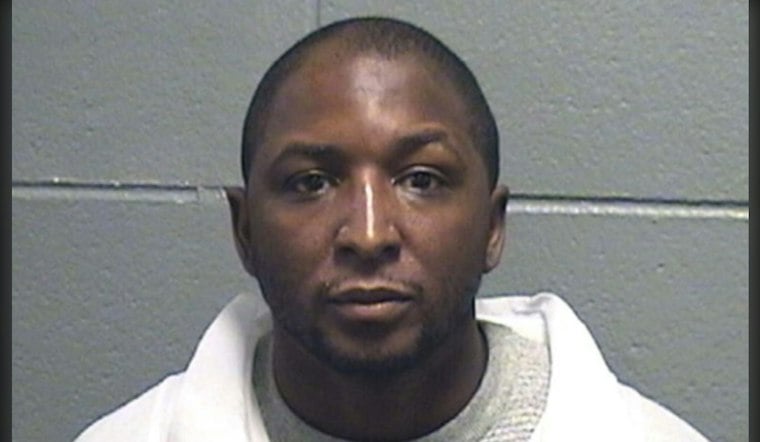
Steven Wade, 46, has been sentenced to 100 years in prison after a jury convicted him on 10 felony counts arising from a 2023 South Shore confrontation with Chicago police. The sentence resolves that prosecution, but Wade still faces a separate first-degree murder case in the killing of Bridgette Myles, 58.
The standoff convictions included six counts of attempted murder of police officers, two counts of aggravated kidnapping and two counts of unlawful possession of a machine gun, according to CWB Chicago. Judge Alfredo Maldonado imposed 100 years for the attempted-murder convictions, 26 years for kidnapping and seven years for the machine-gun counts. The terms run concurrently, meaning they are served during the same period rather than one after another.
The murder case remains unresolved
The pending murder prosecution concerns Myles, who prosecutors say was fatally shot hours before Wade went to his former girlfriend’s home. She was found dead in a residence in the 7200 block of South Jeffery Boulevard. Court records cited by CWB Chicago say detectives linked Wade to the shooting through firearm evidence, fingerprints and witness statements. Those allegations have not been adjudicated in the separate case.
Because the murder case is separate, Wade’s 100-year sentence in the standoff prosecution does not decide whether he is guilty in Myles’ death. Illinois Department of Corrections guidance says people serving determinate sentences entered after Feb. 1, 1978, are not eligible for parole, although statutory sentence credits and mandatory supervised release may apply, according to the Illinois Department of Corrections.
What led to the convictions
Prosecutors said Wade arrived without notice at his ex-girlfriend’s home in the 12900 block of South Peoria Street on Feb. 27, 2023, armed and wearing body armor. His ex-girlfriend and her 21-year-old son remained inside while police responded to a 911 call. Prosecutors said officers exchanged gunfire with Wade before SWAT officers entered and removed the two hostages. CWB Chicago reported that police later found three additional guns nearby, including two prosecutors described as capable of automatic fire.
The jury’s verdict, rather than the unresolved murder allegation, is the basis for the 100-year sentence. The case record as described in the reporting establishes the convictions and sentence in the South Shore incident; it does not establish the outcome of the Myles prosecution.
Similar incidents provide context, not a trend
Other recent Chicago standoffs show that barricade cases can produce different combinations of alleged violence, victims and charges, but they do not by themselves demonstrate that such incidents are becoming more common. In July 2026, a separate Albany Park standoff left a woman and a SWAT officer injured, and a Chicago man faced nearly a dozen felony charges, WTTW reported. That case involved allegations that a 67-year-old woman was shot and that a 14-year-old girl and a 42-year-old woman were held inside a home.
In a separate September 2026 incident in Logan Square, Patrick McDonald was accused of remaining barricaded for more than 17 hours and firing multiple times; he faced attempted-murder and other felony charges, according to Block Club Chicago. The comparisons are limited: those cases involved different locations, alleged conduct and procedural stages, while Wade’s South Shore case has resulted in a final sentence.
The broader risk to officers is documented separately from these examples. The Chicago Police Department’s 2025 annual report says department members were shot at 25 times that year. That figure does not identify how many incidents involved hostages or barricaded suspects and cannot be used to measure a trend in standoffs specifically.





