

























































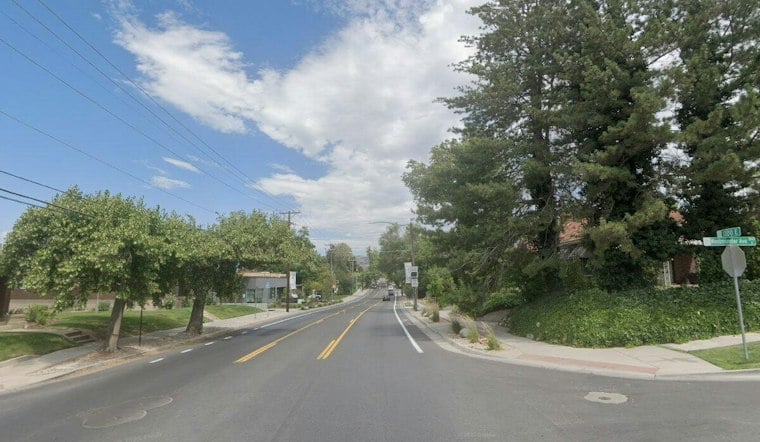
Every day, pedestrians and cyclists funnel through the intersection of Westminster Avenue and 1300 East in Sugar House. Meaghan Kelleher says walking the area after her baby's birth exposed her to the crossing's risks, including a near collision, and now she's asking Salt Lake City to pay for a fix.
Kelleher said the crossing is legal and that pedestrians heading north from Westminster University have few practical alternatives. Reaching the nearest signalized crossings requires a detour of nearly half a mile, according to details she presented at a Sugar House Community Council meeting. The council's account also estimated that four to five pedestrians cross there every 20 minutes during peak commute hours.
The community council account describes Westminster Avenue as more than a shortcut, saying the crossing connects Sugar House residents with Allen Park, Sugar House Park, neighborhood businesses and nearby apartments.
What the Law Actually Says
Under Utah Code § 41-6a-1002, unmarked street intersections function as legal crosswalks, meaning drivers are required to yield the right-of-way to pedestrians crossing within the driver's half of the roadway. State traffic law also explicitly bars drivers approaching from behind from passing a vehicle that has stopped at a marked or unmarked crosswalk to let someone cross, according to a rundown from KSL — a protection specifically meant to prevent the kind of multi-lane strikes that happen when one car stops and a trailing driver tries to zip past. Kelleher's account of a near miss at Westminster and 1300 East suggests a gap between legal pedestrian rights and real-world driver awareness on a busy arterial street.
Auto-pedestrian collisions account for nearly 15 percent of all traffic fatalities across Utah annually, with dense urban areas like Salt Lake City carrying elevated risk from foot traffic and distracted driving, per data cited by Resh Law.
A Designated Neighborhood Byway
Salt Lake City's Transportation Division identifies the route as the city's designated neighborhood byway.
The city has a precedent for using a pedestrian-activated signal elsewhere on 1300 East: its Transportation Division lists a new High-Intensity Activated Crosswalk, or HAWK, signal at 1300 East and Gilmer Avenue. That is a different intersection and does not establish that Westminster Avenue qualifies for the same treatment.
What the city has funded nearby
Salt Lake City's Transportation Division describes a HAWK as a pedestrian-activated crossing light intended to improve safety on busy streets with high pedestrian traffic. In a page listing crosswalk enhancements, the division includes a new HAWK at 1300 East and Gilmer Avenue, a nearby example of the treatment, according to Salt Lake City's Transportation Division. The city has also previously funded a related project focused on traffic calming and trail crossings. Salt Lake City says the McClelland Trail and Neighborhood Street Livability project received full funding in the 2019-2020 budget, with changes planned for 2022; the project targeted six trail crossings and six avenues between 1100 and 1300 East, according to the city's Transportation and Engineering divisions. Those locations and treatments differ from the Westminster Avenue crossing, but they provide a precedent for constituent-requested safety improvements in the area.
Kelleher's Bid for City Funding
To push the Westminster Avenue crossing toward that same kind of investment, Kelleher is proposing a Capital Improvement Program application. The proposal still needs city review and funding approval.
Kelleher is gathering support for the proposal and has presented it at community meetings. She's continuing to collect more support, and supporters can send letters or handwritten notes. Her push mirrors an earlier Sugar House win: the city previously put up $500,000 in CIP funds for McClelland Street's makeover into a two-block, pedestrian-focused shared street. Still, Kelleher's proposal requires city review and funding approval before the city commits any money, and for now, the approach on Westminster Avenue remains as it was when she started walking it after her baby's birth — legal, unmarked, and, in her account, dangerous.



