

























































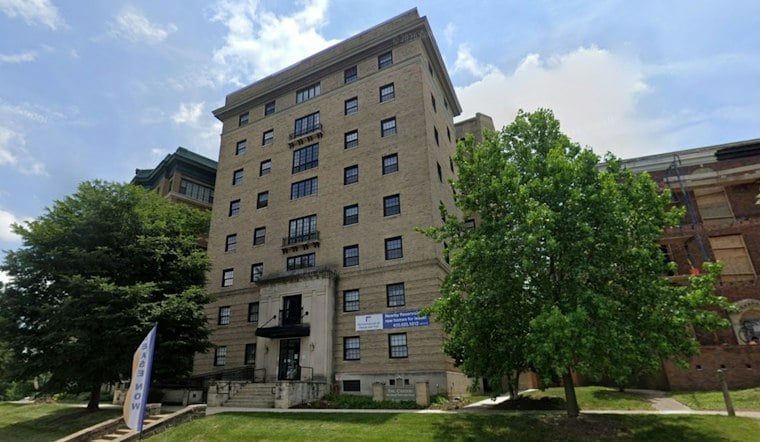
A Chateau resident is mentioned in an account about the historic apartment complex overlooking Druid Lake in Baltimore's Reservoir Hill neighborhood. The account discusses the buildings' conditions.
The Chateau and its next-door sister building, The Riviera, sit at 901 and 903 Druid Park Lake Drive and together hold 101 rental units, many of them federally subsidized, according to Apartment Finder. The buildings are the subject of an account that discusses maintenance and shared amenities. The Chateau houses elderly residents and people with disabilities. The account also discusses the building's fitness center and community room.
A National Park Service National Register registration form describes Reservoir Hill as one of Baltimore’s most diverse neighborhoods in terms of housing types.
Doriee Ford, a 74-year-old Riviera resident, and Lauren Muhammad, a 68-year-old Chateau resident, are among residents mentioned in the account.
Security and Building Conditions
The account discusses security and access at The Riviera and The Chateau, including conditions in shared spaces.
The account also discusses the buildings' elevators and common areas.
The account conveys Bellamy's frustration with the conditions.
Repairs Discussed
Mold, the basement, flooring, and smoke and carbon monoxide detectors are among the topics mentioned in the passage.
The passage also mentions an air-conditioning problem involving an apartment.
City Says It's Engaged; Priority-Dwelling Status Is Unclear
Baltimore City has issued 20 citations against The Chateau since 2017 for broken smoke alarms, trash and other maintenance problems, and the city said last week it issued a violation notice for Muhammad's unit specifically. The Baltimore Department of Housing and Community Development has said code enforcement actions are intended to bring properties into compliance.
The Chateau's priority-dwelling status is not established here. The timing of the next review is not stated here. The buildings' conditions have drawn ongoing neighborhood attention.
Baltimore's Strengthening Renters' Safety Act was enacted by the City Council to identify and monitor multi-family properties with recurring safety and code violations, allowing for more frequent inspections and possible loss of rental licenses for buildings designated as priority dwellings. To land on that list, a building with 20 or more units must meet specific statutory thresholds — such as unabated habitability violations lasting more than 60 days, elevator or lead paint violations exceeding 30 days, or a high volume of 311 complaints — according to Baltimore Fishbowl. That threshold helps explain why a building with citations dating back to 2017 and an array of active complaints has not yet been designated for the heightened oversight the law allows.
A Law Born From Reservoir Hill's Own Complaints
The irony is that Reservoir Hill helped inspire the law in the first place. Baltimore City Council members Zeke Cohen and James Torrence held a press conference outside Reservoir Hill apartment buildings in February 2023 to introduce the legislation that became the Strengthening Renters' Safety Act, citing widespread tenant complaints about broken elevators, rodents and mold in the neighborhood. The act took effect January 1, 2026, and buildings designated priority dwellings now face mandatory biannual inspections, oversight meetings with housing officials, and civil citations of up to $1,000 per day for unresolved violations. According to Baltimore City’s Property Maintenance and Code Enforcement page, the Strengthening Renters’ Safety Act takes effect on January 1, 2026.
The $1,000-per-day penalty is reserved for designated priority dwellings. The city has already shown willingness to escalate: in August, Mayor Brandon Scott and the City Council filed a lawsuit against the owners of Kernan Gardens Apartments after that complex was designated a high-violation priority dwelling, a case Baltimore sued the WAZ brothers in a dispute that shares the same statutory framework now governing The Chateau's fate.
The Chateau's federally subsidized units add another layer of complexity. The article discusses the federal subsidies. Landlords operating without a valid rental license may lose the ability to collect rent or pursue evictions, a restriction that would carry real weight if The Chateau's licensure were ever challenged.
The passage mentions Pennrose without further description. The passage places the tenant complaints against a broader backdrop of municipal oversight in Baltimore's rental market.



