

























































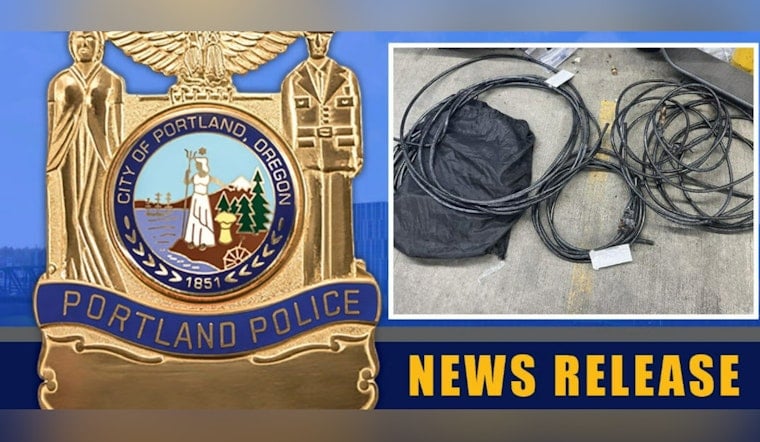
Officers responding to a burglary call at the shuttered Vibra Specialty Hospital on NE Hancock Street in Portland found something more organized than a simple break-in: a winch rigged to a car battery and configured to haul copper cable straight out of the building's conduit. Three people were arrested at the scene on August 25 and booked into the Multnomah County Jail on numerous charges, while a fourth suspect remains at large.
The vacant 10300 NE Hancock Street building has been hit by repeated burglaries and significant copper wire theft since closing to patients, according to KATU. Investigators identified those taken into custody as 46-year-old Robin Kaus, 45-year-old David Mudgett Jr., and 47-year-old Benjamin Eisenmann. At the scene, investigators located burglary tools including large cutters and the battery-powered winch, along with a large amount of copper already coiled and prepared for transport.
A Hospital Left Empty and Exposed
The building became an easy target after Vibra Specialty Hospital filed a WARN notice in December 2025 announcing it would permanently close the facility on February 1, 2026, laying off 310 healthcare workers amid ongoing financial challenges, according to KGW. The closure date shifted the facility from an operating hospital to an unoccupied commercial building almost overnight, leaving it vulnerable to the kind of repeated intrusions investigators say followed. After the shutdown, Vibra's parent organization said it would seek regulatory approval to reopen the site as an inpatient medical rehabilitation hospital, according to Vibra Specialty Hospital of Portland, a plan now complicated by the copper wire theft, which has caused substantial damage and an estimated repair bill in the millions of dollars.
Part of a Larger Citywide Investigation
The arrests trace back to a broader Portland Police Bureau investigation into organized telecommunications and commercial property metal theft that began in March 2026, per a Portland Police Bureau statement. Investigators believe the winch method found at the hospital is indicative of larger-scale copper theft operations rather than a one-off burglary, the bureau said. The Portland Police Bureau's Patrol and Neighborhood Response Team works to disrupt the people responsible for stealing copper and for facilitating the transportation and sale of the stolen metal, according to the same statement.
Investigators continue working to identify additional individuals involved in the operation, and the case remains active. The fourth suspect connected to the Hancock Street burglary has not been located.
A Pattern of Copper Theft Across Portland
The Vibra site is only the latest target in a wave of organized metal theft that has hit Portland's infrastructure and institutions over the past year. Telecommunications provider Lumen Technologies reported losing more than $2 million in damages and replacement costs from over 98 large-scale copper wire thefts targeting communication lines across the city between April and November 2025, KGW reported. That same month, Portland Police and Multnomah County Sheriff's deputies served a search warrant on a squatters' residence on NE Skidmore Street where occupants were allegedly burning insulation off stolen copper cables; two people were arrested and the property was returned to its owner's estate, an incident Hoodline covered in its earlier report on the raid.
In March, copper thieves stripped wiring from light poles along Interstate 84 and Interstate 205 in Northeast Portland, blacking out roughly 60 streetlights and costing the Oregon Department of Transportation an estimated $200,000 in repairs. That same month, police arrested 55-year-old Dedri White as a suspected central broker in the citywide theft ring, alleging she had processed over $487,000 worth of stolen metal through local recycling facilities in a single year.
State Law Tries to Close the Loophole
Oregon law already places strict requirements on scrap metal sales. Under Oregon Revised Statute 165.107, scrap metal businesses must maintain detailed transaction records, log sellers' photo IDs and vehicle license numbers, and delay non-ferrous metal payments by check for at least three business days. Separately, Oregon Revised Statute 164.857 makes it a crime to transport metal property on public highways or open premises with intent to deliver it to a scrap business without a signed Metal Transportation Certificate detailing the metal's origin, seller, and destination.
Those rules are part of why thieves have leaned on intermediary brokers to move stolen copper off the books, rather than selling directly to compliant recyclers. In February, Oregon lawmakers passed House Bill 4140, allowing state law enforcement agencies to register with scrap metal theft alert systems that broadcast real-time notifications of stolen metal property to regional recycling yards, a step aimed at intercepting stolen loads before they reach a scale.





