

























































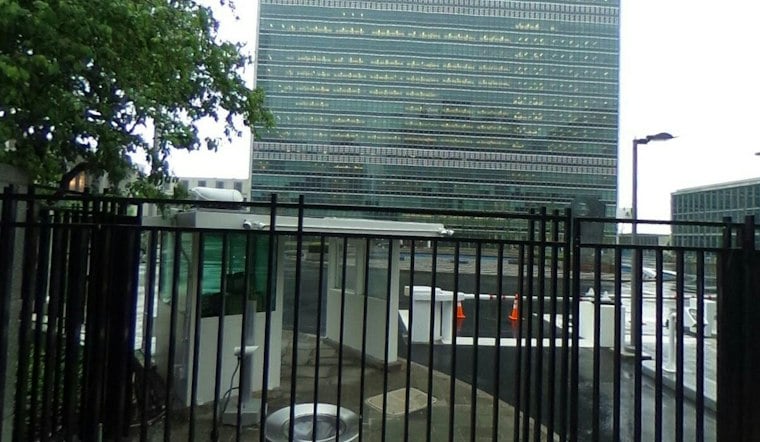
President Donald Trump told the United Nations General Assembly Tuesday that Cuba is a failed state whose communist government is under its greatest pressure ever and will fall, declaring that freedom will be coming to Cuba even as Havana's delegation walked out during his remarks.
Trump made the comments during his address to the UN General Assembly, telling the assembled delegates that communism will never be coming to America while insisting the Cuban government is on the brink of collapse, according to Reuters. The president also claimed Secretary of State Marco Rubio is deep into negotiations with Cuba, while alleging Havana has cultivated ties with left-wing American political groups including Antifa and the Democratic Socialists of America, according to Forbes. Trump had previously called Cuba a failed nation in March 2026, saying at the time that the United States had good plans for the country and would take care of it, per the same Reuters account.
An Energy Crisis After Venezuela's Fall
The speech landed at a moment of acute crisis for the island. Following the January 2026 U.S. military operation that resulted in Venezuelan President Nicolás Maduro's capture, Cuba faced a severe energy deficit, according to Wikipedia. Venezuela had supplied Cuba with oil before the operation, which Hoodline covered in earlier reporting on Tennessee's reaction to Maduro's capture.
The fallout has been severe. Cuba has suffered major island-wide power grid collapses in 2026, the Associated Press reported. The island has endured repeated grid failures amid chronic fuel shortages, per the same wire report.
Sanctions Pile Up on Nickel and Military Firms
Washington's pressure campaign has widened well beyond energy. The State Department announced a new round of sanctions on September 17 targeting Cuban entities and three individuals, focusing on military-linked companies and operators in Cuba's nickel mining industry, the country's largest export sector, according to Latin America Reports. The sanctions targeted high-ranking officers in the Cuban Revolutionary Armed Forces alongside major export firms, the outlet noted — a move that followed Hoodline's coverage of earlier sanctions Rubio rolled out in September against Cuban fuel firms and a Castro grandson.
Those measures build on an executive order that established secondary sanctions involving foreign banks and companies doing business with the Cuban state, according to the Latin America Risk Report. Foreign banks and companies now face secondary sanctions if they facilitate designated Cuban transactions — a threat Hoodline first detailed when the order was signed, describing how it put Miami's money pipeline on notice.
Poverty Tops 66% as UN Experts Warn of Crisis
The human toll has drawn independent scrutiny. UN Human Rights Council experts reported in August 2026 that U.S. measures restricting fuel imports into Cuba have led to a humanitarian crisis, crippling water supplies, irrigation, health services, and trash collection, according to UN News. The experts warned that depriving populations of essential resources violates international legal norms, per the same report.
An independent economic study published in September 2026 estimated that 66% of the Cuban population lived in poverty, up from 45% in mid-2025, according to the Associated Press. Cuban government estimates have attributed economic losses to U.S. sanctions, with Cuba's GDP projected to contract by 6.5% this year — the sharpest economic contraction in the Latin American region, according to the World Socialist Web Site.
Conflicting Claims Over Negotiations
Trump's assertion that Rubio is actively negotiating with Havana runs directly counter to Cuba's own public position. Cuban Foreign Minister Bruno Rodríguez Parrilla stated in September 2026 that formal bilateral negotiations between Havana and Washington aimed at resolving diplomatic tensions had ceased, per Latin America Reports. Cuban officials have repeatedly condemned U.S. measures as an attempt at economic strangulation, the outlet noted.
International alignment against Havana has also grown. On September 18, the European Parliament passed a resolution asking the European Union to suspend its Political Dialogue and Cooperation Agreement with Cuba and impose sanctions on regime leaders over human rights violations, according to Latin America Reports. The move is notable given that the EU has historically maintained broader commercial and diplomatic ties with Cuba than Washington has.
U.S.-Cuba Tensions
The United States has maintained a trade embargo on Cuba for more than 60 years, per Reuters. Hoodline has tracked South Florida's exile business community as it has weighed future investment pledges tied to reform and as Trump has previously floated a friendly takeover framing for the island's political future.
Whether Trump's declaration that freedom is coming to Cuba reflects an imminent shift or continues a familiar pattern of escalating rhetoric remains to be seen. For now, the gap between Washington's stated diplomatic outreach and Havana's insistence that talks have collapsed leaves the two governments publicly contradicting each other even as the island's blackouts, shortages, and poverty rates continue to climb.





