

























































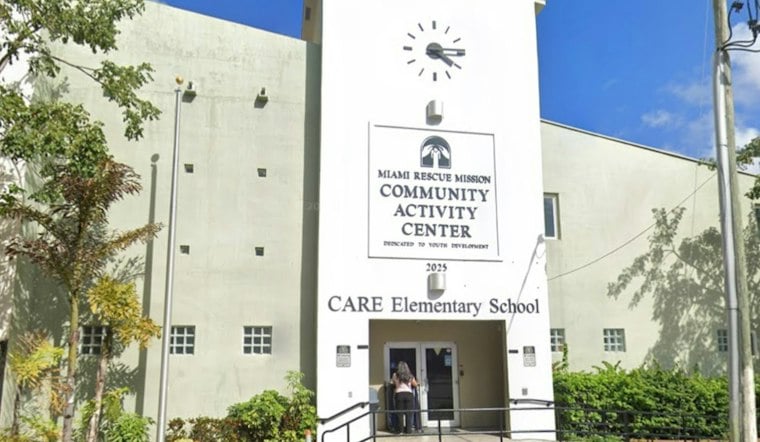
A Miami private school that charges its families nothing is opening its doors wider. CARE Elementary, which has spent years building a tuition-free education model in Wynwood, has launched a second campus in Little Haiti with room to eventually serve about 110 students, even as the new site currently counts just seven kids enrolled.
According to The Miami Times, the Little Haiti campus has capacity for about 45 students this year and is enrolling kindergarten through second grade for the 2026-27 school year, with plans to add third grade in 2027 and expand through fifth grade by 2029. The Wynwood campus, meanwhile, is nearing its 150-student capacity with roughly 140 kids already enrolled. CARE hosted a community block party at the new Little Haiti site earlier this month to introduce the school to the neighborhood.
CARE Elementary was founded in March 2014 as a nonprofit serving underserved minority children in Miami, according to the Wynwood Business Improvement District. When the school opened its doors in August 2015, diagnostic reading assessments found that only 5% of its incoming third-graders were reading at grade level, according to The Miami Foundation. The move into Little Haiti places the school in a neighborhood that has been the subject of research into health disparities, per NCBI.
Two Adults in Every Classroom
CARE's model pairs a lead teacher with an assistant in every classroom, and some classrooms can include up to four adults working with children at once, per the Miami Times report. First-grade teacher Catherine Woods, who also serves as CARE's primary curriculum director, has 23 students in her own class. She worked in public education before joining CARE and has been at the school for six years, the outlet notes.
Lakeisha Williams, a fifth-grade teacher with 24 years in education overall, has worked at CARE for seven years, according to the same account. The school runs whole-group lessons followed by smaller-group instruction, with an intervention team supporting students who need extra help and enrichment tracks for those ready to move ahead. Principal Christopher Simmonds said CARE advances students based on ability rather than grade level or age, and stressed that the school does not select students based on academic achievement — instead, he said, CARE seeks out students who need its services most.
Career Day Every Week
Fifth-grade teacher Lakeisha Williams described the school's approach to education as one that treats the whole child, bringing doctors, lawyers, marine biologists, architects and contractors into the school to introduce students to career options. Simmonds called it “career day every week,” the report states.
That approach has translated into gains on the TerraNova Multiple Assessments, a nationally normed standardized test the school uses to track progress. CARE reported 93% of its kindergarten through fifth-grade students were at or above grade level in reading in 2026, up from 70% in 2019. Math scores climbed from 73% at or above grade level in 2019 to 96% in 2026, while science rose from 78% to 91% and social studies reached 82% in 2026, all according to the school's own figures as relayed by the Miami Times. The outlet notes that TerraNova and the FAST assessments used in Florida public schools are not directly comparable, since public schools use a different testing system. Statewide, Black students posted a five-percentage-point year-over-year gain in English language arts and a three-percentage-point gain in mathematics in 2026, according to the Florida Department of Education.
Serving Overtown, Little Haiti and Beyond
CARE serves predominantly Black and Hispanic families, including many from nearby Overtown. Enrollment includes 62% Black students, 37% Hispanic students and 1% white students, representing 12 countries of origin. Parent Keiny Castillo sends her two sons, ages 7 and 8 and enrolled in second and third grade, to CARE, and said her family pays nothing for the school's services — books, uniforms, meals, transportation and additional academic support all included. She described CARE as “a blessing.”
Parent Blademil Grullon's daughter attended Ransom Everglades School after starting at CARE in kindergarten, and Grullon's son, who started at CARE the same way, hopes to become a sports attorney or agent. Ransom Everglades, where some CARE graduates go on to attend, outlines a need-based financial-aid process, according to Ransom Everglades School. Byron Jones, a former NFL player and CARE donor, said students go a great distance when they're surrounded by caring schools and teachers.
How the Tuition-Free Model Is Funded
CARE students receive Step Up for Students scholarships, which cover about half of the school's tuition costs. Step Up for Students has opened applications for the 2026-27 school year, according to Step Up for Students.
The remaining gap is covered by donor, sponsor and grant funding, which pays for technology, uniforms, school supplies, after-school programming, transportation, field trips and meals. Simmonds described the funding model as “an all-inclusive approach.”
With the Wynwood campus nearly full and Little Haiti just getting started, CARE's next stretch will be filling those remaining open seats while building out the grade levels it has promised through 2029.


