

























































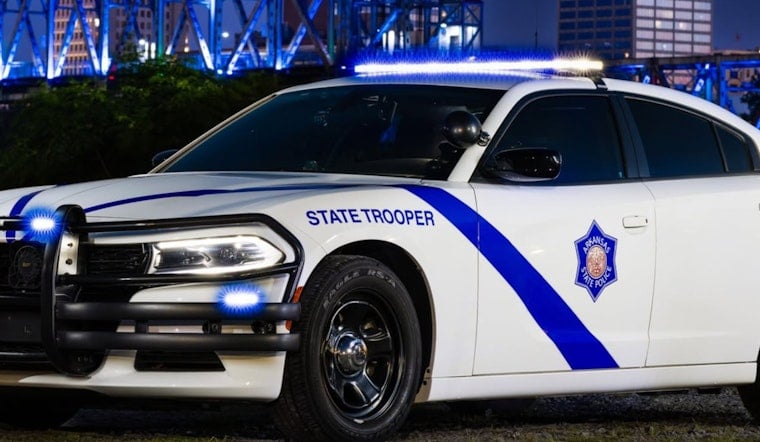
A West Memphis man led Arkansas State Police on a high-speed chase through city streets early on August 29, reaching more than 80 mph in zones posted for 30 and 35 mph before a tactical vehicle intervention forced his car to a stop and a police K-9 tracked him down on foot, according to a state police report. James V. Gregory, 40, was booked into the Crittenden County jail following the pursuit, which began shortly before 2 a.m. and ended with troopers reporting he described himself as extremely drunk and high.
The chase started on Interstate 40 near the 282-mile marker in West Memphis, where Trooper Eli Thomas was stationed and observed a black passenger car traveling west at about 68 mph in a 65-mph zone, as reported by NEA Report. Thomas identified the vehicle as a black Nissan Versa, which then exited the interstate at Exit 280 and turned onto Martin Luther King Jr. Drive — a stretch of road that connects I-40 directly to nearby commercial hubs near the Arkansas-Tennessee border, according to Love's Travel Stop location data.
Once off the interstate, the driver accelerated to approximately 65 mph in a 45-mph zone and, according to the report, brake-checked Thomas's patrol car. The Nissan continued swerving between lanes and partially into the center turn lane before passing a stopped tractor-trailer with about half the car entering a ditch. The vehicle then ran a red light at Broadway and Walker at roughly 60 mph.
Two Failed Interventions Before the Car Finally Stopped
Thomas performed a tactical vehicle intervention, or TVI, at Broadway and 14th Street, but the maneuver failed to end the pursuit, per the same report. The Nissan continued west onto Broadway, at times exceeding 80 mph on roads posted for 30 and 35 mph, before Thomas performed a second TVI near Eighth Street. That second intervention finally stopped the car in a parking area along Broadway.
Arkansas State Police have leaned heavily on TVI and PIT maneuvers to end chases in recent years. Troopers used the tactic to end 251 of 620 pursuits statewide in 2023 — 41 percent of all state police chases that year — according to KATV. The agency's use of the maneuver has drawn legal scrutiny before; in November 2021, the Associated Press reported that state police revised their PIT policy following a settlement with an injured motorist, limiting the maneuver to situations that are objectively reasonable to prevent imminent death or serious injury, or under exigent circumstances.
Driver Fled on Foot Before K-9 Caught Him
After the Nissan stopped, the driver got out and ran west down a sidewalk through a business area, the report states. Tfc Gunner Fultz deployed his police K-9 after Gregory continued running, and the dog apprehended him by biting and holding him until troopers were able to handcuff him. Gregory sustained a bleeding forehead injury during the encounter, and an ambulance was requested after the K-9 apprehension.
Once handcuffed, Gregory reportedly struck his head against the glass of a patrol vehicle and threatened Thomas, according to the police report. Thomas reported smelling a strong odor of intoxicants coming from Gregory after the arrest, along with bloodshot, watery eyes and slurred speech. Gregory refused medical treatment when EMS arrived at the scene, the report states, and also refused to continue listening to the Arkansas statement of rights reading.
Thomas ultimately transported Gregory to Baptist Memorial Hospital-Crittenden, the sole full-service acute care hospital with a 24-hour emergency department in Crittenden County, where Gregory underwent an MRI. He refused antibiotics offered for the K-9 bite and forehead injury, and was later medically cleared for release, according to the report. Per the same account, Gregory told troopers, “You don't need a test. I can tell you how drunk and how high I am.”
Charges Reflect Arkansas's Tougher Fleeing Laws
The state police report lists a lengthy set of charges against Gregory, including felony fleeing by vehicle, fleeing on foot, DWI, refusal to submit to a chemical test, reckless driving, speeding more than 15 mph over the limit, careless and prohibited driving, criminal mischief, and failure to obey a stop sign and a traffic control device.
Arkansas law treats fleeing far more harshly than it once did. Under Arkansas Code § 5-54-125, fleeing from an officer in a vehicle is elevated from a Class A misdemeanor to a Class D felony if the driver exceeds the posted speed limit, and to a Class C felony if the vehicle is driven in a manner creating substantial danger of death or serious injury with extreme indifference to human life, according to FindLaw. Arkansas Act 822, passed in April 2025, further amended that statute to elevate fleeing to a Class C felony specifically when a driver exits a moving vehicle and continues fleeing on foot, according to the Arkansas State Legislature.
Gregory's alleged refusal to submit to a chemical breath or blood test carries its own consequences separate from any criminal case. Under Arkansas's Implied Consent Law, refusing such testing after a DWI arrest triggers an automatic administrative license suspension of 180 days for a first refusal, along with mandatory victim impact panel attendance and a reinstatement fee, according to the Arkansas Department of Finance and Administration. Arkansas Code § 5-65-107 also bars prosecutors from plea-bargaining a DWI charge down to a lesser offense such as reckless driving, per attorney Wesley Rhodes.
Part of a Broader Pattern on West Memphis Roads
This is not the first time Arkansas State Police have used a tactical vehicle intervention along this same stretch of West Memphis. In December 2024, troopers executed a TVI at the intersection of Broadway Boulevard and Martin Luther King Jr. Drive to stop a vehicle carrying three theft suspects traveling over 100 mph, as Hoodline previously reported.
Statewide, pursuit numbers have been trending downward. Arkansas State Police recorded 180 fewer vehicle pursuits in 2024 compared to 2023 — a 29 percent decline that agency leaders attributed to stricter fleeing laws and the addition of 120 troopers, according to a report on a February legislative hearing. Even so, cases like Gregory's show that when drivers refuse to stop, high-speed interventions remain standard procedure for Arkansas troopers.





